.webp&w=384&q=75)

Loading, please wait...
Loading, please wait...

The AI pregnancy ultrasound tool developed by Butterfly Network has officially received FDA clearance. This innovative technology aims to simplify gestational age estimation, particularly in underserved regions. Consequently, clinicians can now provide faster assessments without requiring extensive specialized training in fetal biometry.
Traditional ultrasound machines often rely on expensive piezoelectric crystals. In contrast, the Butterfly device utilizes a single silicon chip for whole-body imaging. This unique design makes the device more portable and cost-effective for rural clinics. Additionally, the AI model underwent rigorous training on over 21 million ultrasound images. Therefore, it provides consistent results for pregnancies between 16 and 37 weeks. The system delivers an estimate in under two minutes, which drastically reduces wait times for patients.
Gaps in prenatal imaging remain a significant challenge in many global regions, including parts of the United States and India. However, this tool delivers accurate estimates without requiring users to interpret complex images. Therefore, healthcare providers in emergency departments and rural settings can make quicker clinical decisions. The company has already successfully deployed this technology in Malawi and Uganda. Moreover, they plan to expand its use across various international markets to bridge the gap in obstetric services.
The FDA currently encourages the integration of artificial intelligence into medical devices to enhance diagnostic accuracy. They believe that machine learning can generate vital new insights from clinical data produced during care delivery. As a result, this clearance marks a significant step toward digitizing maternal care. Furthermore, the tool integrates directly into the Butterfly app for seamless workflow management. This digital transition helps clinicians in low-resource settings manage patient volume more effectively.
Q1: What is the primary function of this AI tool?
The tool provides an automated estimate of gestational age in pregnant patients between 16 and 37 weeks without requiring manual biometric measurements.
Q2: Who can use this technology?
It is designed for clinicians in various settings, including emergency departments and rural clinics, to help provide prenatal care where specialists may be unavailable.
Q3: How does the hardware differ from traditional ultrasounds?
Instead of expensive crystals, the device uses a single silicon chip, making it more affordable and portable for diverse clinical environments.
Disclaimer: This content is for informational and educational purposes only. It does not constitute medical advice or replace professional judgment. Refer to the latest local and national guidelines for clinical practice.
References

Read summarized clinical updates, watch expert medical content, and earn CME certifications right from your smartphone.
Open your smartphone camera to scan and install.





Butterfly Network receives FDA clearance for an AI tool that estimates gestational age in under two minutes, improving access to prenatal care globally....
6 months ago
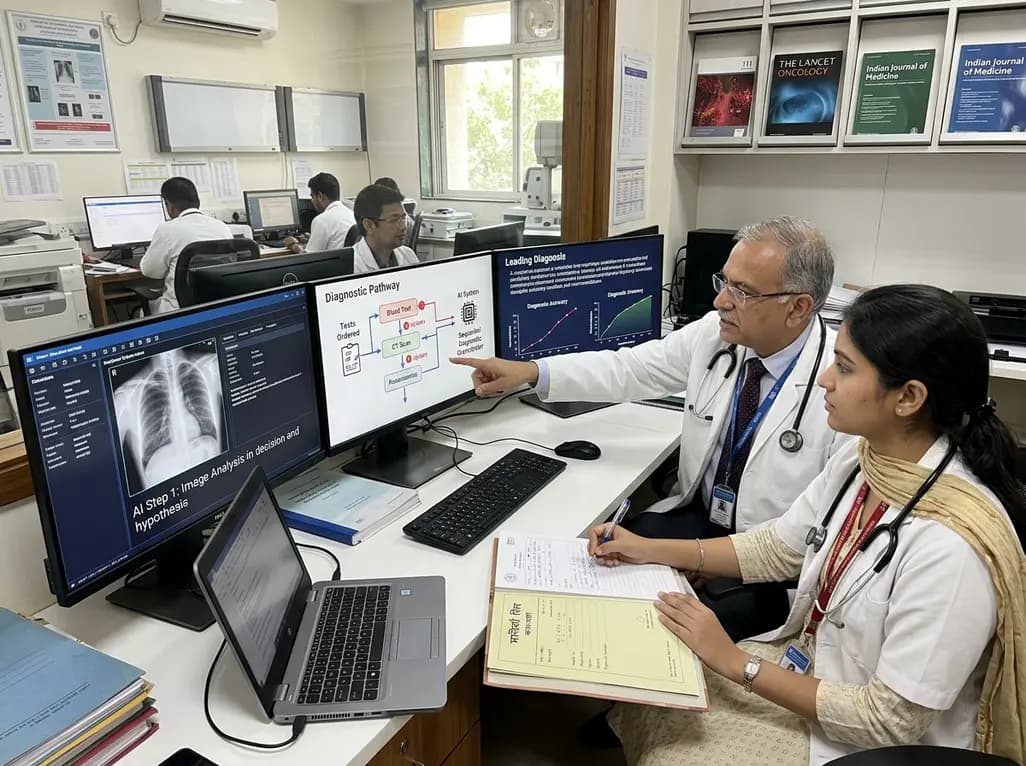
A breakthrough peer-reviewed study demonstrates that a sequential AI diagnosis system can mirror real-world clinical reasoning. By ordering stepwise tests and updating hypotheses dynamically, this multi-agent orchestrator achieved superior diagnostic accuracy while reducing investigative costs.
Today

A prenatal case highlights severe glutaric acidemia type II presenting as bilateral hyperechoic cystic kidneys at 18 weeks. Whole-exome sequencing revealed a novel homozygous ETFDH frameshift variant, demonstrating the power of rapid genetic testing in fetal renal anomalies.
Today

Review how tailored exercise programs benefit frail older patients with heart failure. Explore pathophysiological mechanisms, individualized training prescriptions, and strategies to overcome adherence barriers in clinical practice.
Yesterday

This comparative study evaluates posterior labral tears with and without glenohumeral instability, highlighting distinct demographic patterns, MRI underestimation in stable shoulders, and successful arthroscopic repair outcomes.
Yesterday

A clinical study demonstrates that early intervention with tocilizumab, either as monotherapy or bridged with corticosteroids, achieves significant proptosis reduction and resolves active inflammation in treatment-naive thyroid eye disease.
Yesterday
