.webp&w=384&q=75)

Loading, please wait...
Loading, please wait...
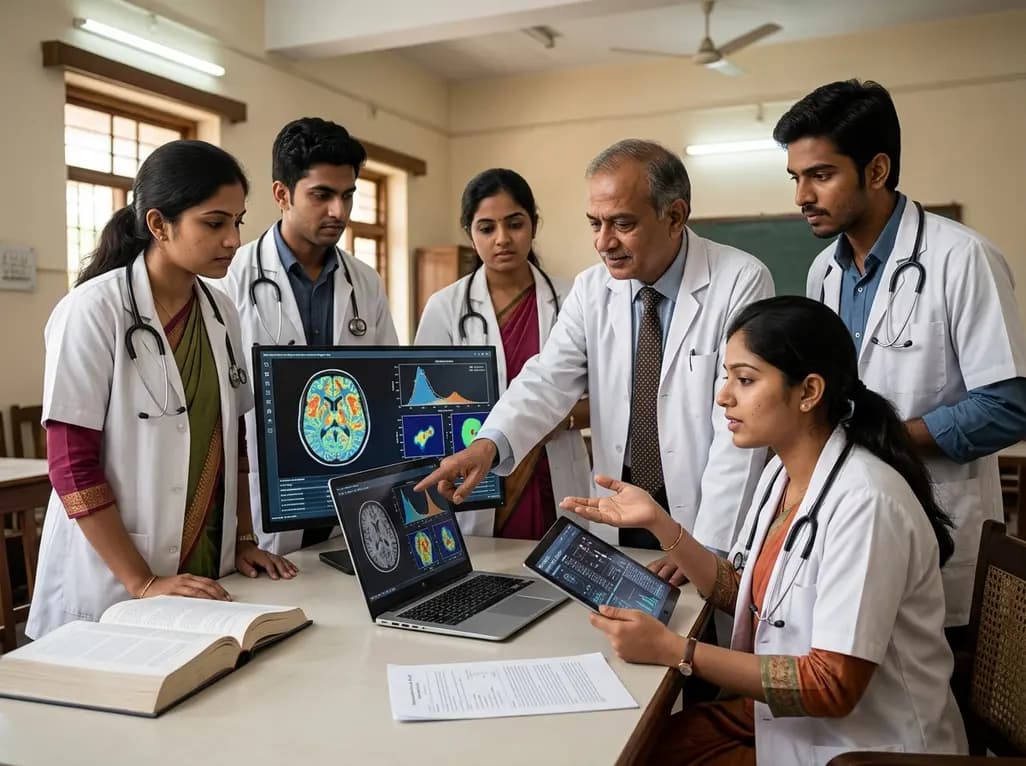
Artificial intelligence is no longer a futuristic concept but a present reality transforming global healthcare landscapes. Specifically, AI in medical education has emerged as a pivotal tool for enhancing how students learn, research, and eventually practice medicine. A recent cross-sectional study conducted in Vietnam provides a comprehensive look at the current state of knowledge, attitudes, and practices among medical students. This research is particularly timely as healthcare systems worldwide, including those in India, grapple with integrating digital health into traditional curricula. The findings suggest that while students are increasingly comfortable with the idea of AI, there remains a significant gap between theoretical knowledge and practical application. Understanding these nuances is essential for educators who must prepare the next generation of doctors for an AI-integrated clinical environment. Consequently, this study serves as a vital benchmark for institutions looking to modernize their teaching methodologies and research standards.
The study, which included 1,002 medical students at Thai Binh University of Medicine and Pharmacy, revealed a median percentage of maximum possible (POMP) score of 66.67 for AI knowledge. Notably, almost 80% of participants expressed a high level of familiarity with common AI tools. This indicates that the modern medical student is not a stranger to technology. However, a deeper analysis shows that this knowledge is often superficial, focused more on general awareness than technical proficiency. Furthermore, students who were older or in higher years of study tended to score better, suggesting that clinical exposure naturally increases technological literacy. In addition, gender-based differences were observed, with male students occasionally reporting higher familiarity with specific technical aspects. Nevertheless, the overall knowledge score suggests that without formal training, students are left to navigate the complexities of AI independently. Therefore, the integration of structured AI modules into the core medical curriculum is necessary to move beyond basic familiarity toward professional competence.
Attitudes toward AI in medical education are generally optimistic, with the Vietnam study reporting a median POMP score of 70.00. This positivity is a crucial factor for the successful adoption of new technologies. Most students view AI as a supportive tool that can reduce administrative burdens and assist in complex diagnostic processes. Moreover, they do not perceive AI as a threat to their future careers but rather as an enhancement to their clinical capabilities. This trend is mirrored globally; for instance, recent surveys at AIIMS Nagpur in India also show that students are eager to embrace digital transformation. However, a positive attitude does not always equate to an uncritical one. Many students remain cautious about the reliability of AI-generated data. They emphasize that while AI can provide rapid insights, the final clinical judgment must always reside with the human physician. Consequently, fostering a balanced perspective—where students appreciate AI’s potential while remaining aware of its limitations—should be a primary goal for medical educators today.
Despite high knowledge and positive attitudes, the practical application of AI remains relatively low, with a median POMP score of 50.00. Currently, medical students primarily use AI for information retrieval and literature research support. They leverage large language models to summarize research papers or organize study schedules. While these are efficient uses of technology, they represent only the entry level of AI's potential. In contrast, using AI for advanced predictive modeling or personalized patient care simulations is still rare. This discrepancy highlights a common problem: students have the tools but lack the supervised clinical frameworks to use them effectively. To address this, institutions must provide hands-on workshops that go beyond basic search queries. By encouraging students to use validated AI diagnostic tools in a controlled environment, educators can help bridge the gap between interest and actual proficiency. Furthermore, providing access to medically-vetted AI platforms can ensure that student practices remain safe and evidence-based.
The findings from Vietnam resonate strongly with the evolving medical education landscape in India. The National Medical Commission (NMC) has recently signaled a major shift toward integrating AI and clinical research into the undergraduate and postgraduate curriculum. During the HealthAIcon 2026 conference, leaders emphasized that doctors must become as comfortable with algorithms as they are with stethoscopes. For instance, Kasturba Medical College in Manipal has already established a dedicated Department of AI in Healthcare, the first of its kind in India. This institutional support is vital because, as the Vietnam study shows, knowledge and attitudes are the strongest predictors of practice. If Indian institutions provide the right infrastructure, student practices will likely follow the positive trends seen in their attitudes. Moreover, the move toward an AI-ready workforce in India is supported by new regulatory frameworks that prioritize digital literacy. Consequently, Indian medical students are poised to become leaders in the responsible use of AI across diverse clinical settings.
As we look toward the future, the ethical implications of AI in medical education cannot be ignored. The Vietnam study and similar Indian research highlight significant concerns regarding data privacy and the potential for algorithmic bias. Students are rightfully worried that over-reliance on AI might erode their critical thinking skills. Therefore, any AI-focused curriculum must include robust training in ethics and digital professionalism. Students need to learn how to identify "hallucinations" in AI outputs and understand the legalities of using patient data in research. Additionally, the future of pedagogy will likely involve AI-driven virtual reality and personalized learning pathways that adapt to each student’s pace. This will revolutionize clinical training by allowing for risk-free practice of high-stakes procedures. However, the humanistic elements of medicine—empathy, communication, and moral reasoning—must remain at the heart of education. By automating routine tasks, AI should ultimately empower future doctors to focus more on the human connection with their patients.
The primary barriers include a lack of structured curricula, limited access to medically-vetted AI tools, and a shortage of faculty trained to teach these technologies. Additionally, many students express concerns over the accuracy of AI-generated content and the ethical risks associated with data privacy. Without institutional mandates and standardized training protocols, adoption often remains fragmented and dependent on individual student initiative rather than a cohesive educational strategy.
AI significantly enhances research efficiency by streamlining literature reviews and data synthesis. Students can use AI tools to quickly summarize vast amounts of research, identify relevant citations, and organize data for analysis. This allows them to focus more on critical appraisal and hypothesis generation rather than manual information retrieval. However, it is essential that students verify all AI-generated citations and data to maintain academic integrity and ensure clinical accuracy.
In India, the NMC is the regulatory body responsible for modernizing medical curricula to meet modern healthcare demands. It has recently advocated for the integration of clinical research and AI training into medical education. By providing a national framework for AI literacy, the NMC ensures that future doctors across the country are equipped with the digital skills necessary to navigate an increasingly tech-driven healthcare environment while maintaining high ethical and professional standards.
Disclaimer: This content is for informational and educational purposes only... Refer to the latest local and national guidelines for clinical practice.
References
Bui MT et al. Knowledge, Attitudes, and Practices Related to AI in Learning and Research Among Medical Students in Vietnam: Cross-Sectional Study. JMIR Form Res. 2026 Jul 03. doi: 10.2196/95867. PMID: 42397674.
Sheth A. AI already a part of clinical environment, medical education must adapt: NMC Chief Dr Abhijat Sheth. Medical Dialogues. 2026 May 18.
Prasad et al. Knowledge, Attitude and Practice About Artificial Intelligence Among Medical Undergraduate and Postgraduate Students in a Tertiary Care Centre: A Cross-Sectional Survey. AIIMS Nagpur. PMC. 2026 Jan 01.
"
Read summarized clinical updates, watch expert medical content, and earn CME certifications right from your smartphone.
Open your smartphone camera to scan and install.





A cross-sectional study of 1,002 medical students in Vietnam reveals positive attitudes but a significant gap in the practical application of AI in research. As India’s National Medical Commission pushes for digital health integration, understanding student readiness is crucial for future curriculum design.
3 months ago

Novel diimide and hydrazone scaffolds, particularly compound #C4, synergistically reactivate latent HIV-1 when combined with JQ1 or PKC activators. Demonstrating donor-matched proviral transcription ex vivo and non-canonical signaling, these findings advance shock and kill strategies toward reservoir eradication.
Today

A comparative cohort study evaluates vNOTES vs TLH hysterectomy for benign conditions, demonstrating shorter operative duration, faster return to daily activities, and equivalent female sexual function scores without increased dyspareunia.
Today

Review how tailored exercise programs benefit frail older patients with heart failure. Explore pathophysiological mechanisms, individualized training prescriptions, and strategies to overcome adherence barriers in clinical practice.
Yesterday

This comparative study evaluates posterior labral tears with and without glenohumeral instability, highlighting distinct demographic patterns, MRI underestimation in stable shoulders, and successful arthroscopic repair outcomes.
Yesterday

A clinical study demonstrates that early intervention with tocilizumab, either as monotherapy or bridged with corticosteroids, achieves significant proptosis reduction and resolves active inflammation in treatment-naive thyroid eye disease.
Today
