.webp&w=384&q=75)

Loading, please wait...
Loading, please wait...
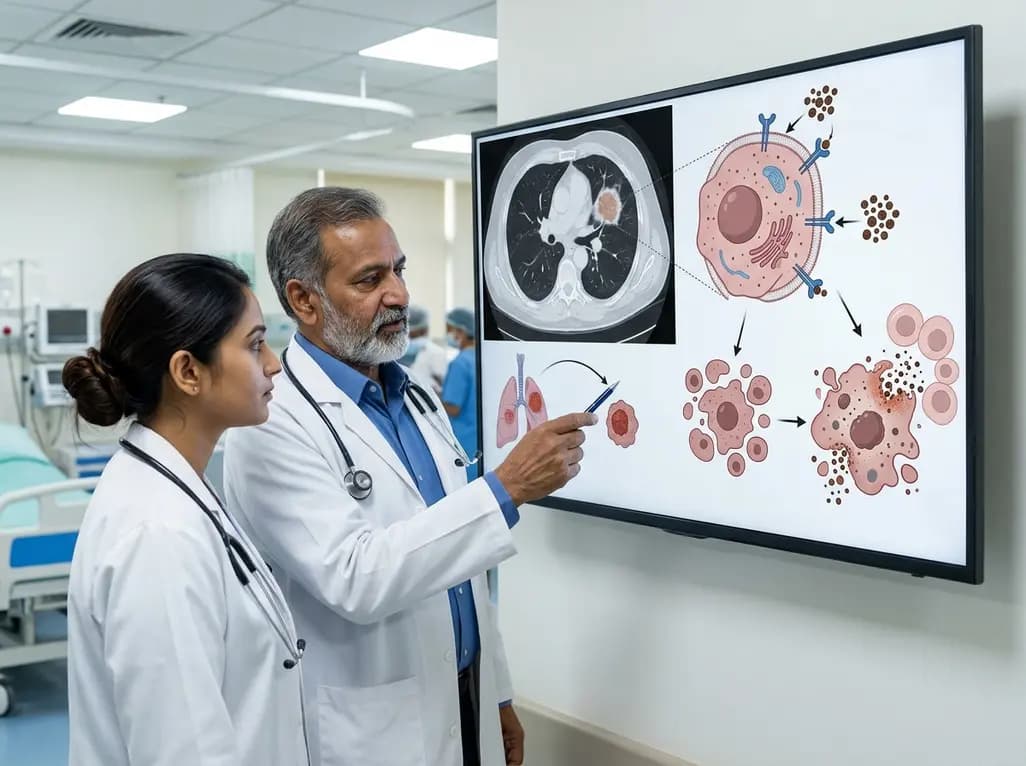
Non-small cell lung cancer (NSCLC) remains a formidable challenge in clinical oncology, particularly due to its propensity for developing resistance to conventional therapies. While researchers have identified ferroptosis as a promising therapeutic target, NSCLC often exhibits an inherent high tolerance to this specific form of cell death. This resistance necessitates the development of innovative delivery systems that can sensitize cancer cells to oxidative damage. A groundbreaking study recently introduced a TRPV1-targeting approach using a Fe-phenolate network, known as FeOLDA, to provoke simultaneous apoptosis and ferroptosis. By focusing on Ferroptosis in NSCLC treatment, this strategy aims to bypass common resistance mechanisms that plague standard chemotherapy protocols in the Indian clinical landscape.
The FeOLDA platform is a sophisticated self-delivery system designed to transport both intracellular iron and the TRPV1 agonist, -oleoyldopamine (OLDA). The therapeutic efficacy of this network lies in its ability to orchestrate two distinct yet synergistic cell death pathways. Once internalized by the target lung cancer cells, the platform releases OLDA, which specifically activates the Transient Receptor Potential Vanilloid 1 (TRPV1) channels. This activation results in a massive influx of calcium ions, leading to intracellular calcium overload. Such a surge triggers severe mitochondrial and endoplasmic reticulum (ER) stress, which ultimately culminates in programmed cell death via apoptosis. Simultaneously, the iron ions delivered by the network catalyze the Fenton reaction within the tumor environment. This chemical reaction significantly depletes glutathione (GSH) and the protective enzyme glutathione peroxidase 4 (GPX4). The resulting accumulation of lipid peroxides drives the cell toward ferroptosis. By integrating these two pathways, the FeOLDA network ensures a comprehensive attack on malignant cells, making it a robust candidate for enhancing the efficacy of Ferroptosis in NSCLC treatment.
The role of TRPV1 in cancer biology has gained increasing attention, particularly as a gateway for inducing cellular stress. In the context of the FeOLDA study, the selective activation of these channels by OLDA serves as a critical trigger for apoptosis. When TRPV1 channels are opened, the resulting calcium signaling cascade disrupts the delicate balance within the mitochondria. This disruption leads to the loss of mitochondrial membrane potential and the release of pro-apoptotic factors into the cytoplasm. Furthermore, the sustained calcium influx places an immense burden on the endoplasmic reticulum, initiating the unfolded protein response and further accelerating the apoptotic process. This mechanism is particularly advantageous because it leverages the specific physiological characteristics of NSCLC cells, which often overexpress certain ion channels. By precisely targeting TRPV1, the FeOLDA network achieves a level of specificity that is often lacking in systemic chemotherapy. This targeted approach not only enhances the induction of apoptosis but also creates a cellular environment that is significantly more susceptible to the concurrent iron-mediated oxidative damage, thereby refining the approach to Ferroptosis in NSCLC treatment.
Ferroptosis is distinguished from other forms of cell death by its reliance on iron-dependent lipid peroxidation. The FeOLDA network maximizes this process by ensuring the efficient delivery of iron ions directly to the intracellular compartment. Once released, these ions participate in Fenton chemistry, reacting with hydrogen peroxide to generate highly reactive hydroxyl radicals. These radicals are potent initiators of lipid peroxidation, which damages the structural integrity of cellular membranes. In a healthy cell, the GPX4 enzyme serves as a primary defense by neutralizing these peroxides. However, the multifaceted stress induced by the FeOLDA network effectively depletes the cellular stores of GSH, the essential cofactor for GPX4. Without this protective shield, the cancer cell becomes overwhelmed by oxidative stress. Notably, the study demonstrated that this iron-driven mechanism works in tandem with the OLDA-induced stress to ensure that even cells with high resistance to single-mode therapy are successfully eliminated. This synergistic effect represents a significant advancement in our understanding of how to optimize Ferroptosis in NSCLC treatment for difficult-to-treat malignancies.
One of the most critical considerations in the development of new cancer therapies is the preservation of healthy tissue. The FeOLDA study highlighted remarkable selective cytotoxicity, showing a strong preference for A549 NSCLC cells over normal bronchial epithelial BEAS-2B cells. This selectivity is likely attributed to the differential expression of TRPV1 channels and the varying metabolic requirements of cancerous versus healthy cells. In vivo studies further underscored the safety of this platform, demonstrating that FeOLDA effectively suppressed tumor growth without the debilitating side effects commonly associated with cisplatin, such as significant weight loss or multi-organ toxicity. In the Indian context, where patient tolerance to aggressive chemotherapy can be a limiting factor, such a targeted and efficient strategy offers a more viable alternative. The lack of systemic toxicity suggests that Fe-phenolate networks could be administered at therapeutic doses with a much wider safety margin. Consequently, this research provides a promising foundation for the next generation of lung cancer-targeted treatments that prioritize both efficacy and patient quality of life through the clever application of Ferroptosis in NSCLC treatment.
The success of the FeOLDA platform indicates a paradigm shift toward multifunctional nanoparticles in oncology. These systems do more than just deliver drugs; they act as catalysts for specific biochemical reactions that exploit the vulnerabilities of the tumor microenvironment. As we look toward the future, the integration of ion-channel targeting with iron-mediated cell death could be expanded to other types of solid tumors that exhibit resistance to standard apoptosis-inducing agents. Furthermore, the ability to avoid the systemic toxicity seen with heavy-metal-based drugs like cisplatin could revolutionize the clinical management of NSCLC. Continued research is needed to refine the biocompatibility of these networks and to explore their potential in combination with immunotherapy or radiotherapy. Nevertheless, the current findings provide clear evidence that modulating Ferroptosis in NSCLC treatment through targeted iron delivery is a highly effective strategy. For healthcare providers in India, staying abreast of these developments is essential as we move toward personalized and precision-based cancer care that seeks to overcome the hurdles of drug resistance and therapeutic toxicity.
Non-small cell lung cancer often possesses high levels of antioxidant defenses, particularly the GPX4 enzyme and glutathione (GSH). These components effectively neutralize lipid peroxides before they can cause lethal membrane damage. Additionally, many NSCLC cells have inherent metabolic adaptations that limit iron accumulation, making traditional ferroptosis-inducing agents less effective. The FeOLDA network overcomes this by simultaneously delivering iron and inducing severe mitochondrial stress to overwhelm these protective mechanisms.
The safety of the FeOLDA network is primarily rooted in its targeted delivery mechanism. By utilizing OLDA to activate TRPV1 channels, which are frequently overexpressed or more sensitive in malignant cells, the system achieves selective internalization. Normal cells, like BEAS-2B bronchial epithelial cells, do not experience the same level of calcium overload or iron-driven oxidative stress, which significantly reduces the risk of systemic side effects and organ toxicity compared to traditional chemotherapy.
Combining apoptosis and ferroptosis creates a "double-hit" on the cancer cell, making it much harder for the cell to survive through compensatory pathways. Apoptosis addresses the cell via established signaling cascades like mitochondrial stress, while ferroptosis targets the cell’s metabolic and oxidative vulnerabilities. This dual-action approach ensures that even if a cell develops resistance to one pathway, the other can still ensure effective cell death, leading to more robust tumor suppression.
Disclaimer: This content is for informational and educational purposes only and does not constitute medical advice or a professional recommendation. The field of oncology is rapidly evolving, and individual patient care should always be managed by qualified healthcare professionals. Refer to the latest local and national guidelines for clinical practice.
References
Wang Z et al. TRPV-1-targeted Fe-phenolate network provokes apoptosis and ferroptosis to treat non-small cell lung cancer. Biomater Sci. 2026 Jul 07. doi: 10.1039/d6bm00434b. PMID: 42411334.
Stockwell BR. Ferroptosis as a biological phenomenon. Cell. 2022;185(3):469-485. doi:10.1016/j.cell.2022.01.012.
Dixon SJ et al. Ferroptosis: An Iron-Dependent Form of Nonapoptotic Cell Death. Cell. 2012;149(5):1060-1072. doi:10.1016/j.cell.2012.03.042.

Read summarized clinical updates, watch expert medical content, and earn CME certifications right from your smartphone.
Open your smartphone camera to scan and install.





Non-small cell lung cancer (NSCLC) often resists traditional ferroptosis-based therapies. A new study introduces FeOLDA, a TRPV1-targeted Fe-phenolate network that triggers both apoptosis and ferroptosis, demonstrating selective toxicity and significant tumor suppression in vivo without systemic side effects.
3 months ago

Depemokimab offers twice-yearly dosing for severe eosinophilic asthma and chronic rhinosinusitis with nasal polyps, significantly cutting exacerbations and hospital admissions.
4 days back

A novel copper metal-organic framework hydrogel remodels the uterine microenvironment to stimulate robust endometrial regeneration, reduce intrauterine fibrosis, and restore reproductive fertility, offering a groundbreaking strategy for managing refractory endometrial damage and Asherman syndrome.
4 days back

New research reveals that non-ablative radiotherapy suppresses ventricular tachycardia by increasing conduction velocity via NaV1.5 upregulation and action potential prolongation. However, sustained sodium current elevation and depressed calcium handling highlight the need for careful clinical translation.
6 days back

A single-cell transcriptomic atlas reveals how peripheral nerve injuries cause dorsal root ganglion remodeling. By evaluating proximal nerve crush and resection, researchers identify distinct glial and immune programs that resolve neuropathic pain and promote regeneration.
4 days back
A breakthrough study demonstrates that fullerol-primed extracellular vesicles generated in a 3D SECCS bioreactor attenuate ferroptosis and restore myogenic regeneration in diabetes via the FOXO3 pathway, offering a cell-free therapeutic strategy for diabetic musculoskeletal degeneration.
4 days back
