.webp&w=384&q=75)

Loading, please wait...
Loading, please wait...

The TP53 gene serves as the critical "guardian of the genome," encoding the p53 tumor suppressor protein that regulates cell cycle arrest and apoptosis. However, germline mutations in this gene lead to Li-Fraumeni Syndrome (LFS), a devastating autosomal dominant condition. Consequently, individuals with LFS face an extremely high lifetime risk of developing various early-onset malignancies. These typically include breast cancer, brain tumors, and soft tissue sarcomas. Clinicians often encounter challenges when a patient presents with a TP53 germline variant pathogenicity that remains unclear. Specifically, missense mutations often appear benign in functional protein assays but may hide deeper molecular defects. A recent case involving a two-year-old with rhabdomyosarcoma has illuminated this diagnostic complexity. By investigating the c.671A > C (p.E224A) variant, researchers have mapped a path from uncertainty to definitive pathogenicity.
Li-Fraumeni Syndrome presents a unique challenge in pediatric and adult oncology due to its broad phenotypic spectrum. Furthermore, the syndrome is highly penetrant, meaning almost all carriers will develop at least one cancer in their lifetime. For instance, children with LFS often suffer from adrenocortical carcinomas or choroid plexus tumors. In addition, the family history typically reveals multiple relatives affected by diverse cancers before the age of 45. Therefore, accurate genetic testing remains the cornerstone of management. Unfortunately, many genetic reports return results classified as Variants of Uncertain Significance (VUS). This classification leaves families in a state of clinical limbo. Moreover, doctors cannot provide clear surveillance guidelines without a definitive diagnosis. Transitioning a VUS to a "likely pathogenic" status requires rigorous functional and in silico evidence to ensure patient safety.
Most pathogenic TP53 mutations occur within the DNA-binding domain of the protein, directly affecting its transcriptional activity. Nevertheless, a significant number of identified variants are missense substitutions that do not obviously disrupt protein function. In the case of the c.671A > C variant, initial yeast and human cell assays showed wild-type-like activity. This result initially suggested the variant might be benign. However, focusing solely on the protein product can be misleading. Many exonic mutations actually influence the pre-mRNA splicing process rather than the final protein structure. Consequently, the genomic sequence might look like a simple amino acid change, but the cellular machinery treats it as a signal to skip an entire exon. This phenomenon highlights why traditional functional assays often fail to capture the full spectrum of TP53 germline variant pathogenicity.
To resolve the discrepancy between protein activity and clinical history, researchers turned to advanced in silico tools and minigene assays. Specifically, tools like SpliceAI can predict how a single nucleotide change affects donor or acceptor splice sites. In this study, the c.671A > C variant, located at the penultimate nucleotide of exon 6, received a high SpliceAI score of 0.77. Subsequently, minigene analysis confirmed that this variant causes the complete skipping of exon 6. This skipping likely leads to a frameshift and a premature stop codon. Ultimately, this results in a truncated, non-functional protein or triggers nonsense-mediated mRNA decay. Therefore, the variant is pathogenic not because it creates a faulty protein, but because it prevents the production of the normal protein altogether. This insight provided the molecular evidence needed for family counseling.
In India, where genetic testing is becoming more accessible, the accurate interpretation of TP53 variants is vital. Pediatricians and oncologists must recognize that a "negative" functional report for a missense variant does not rule out LFS if splicing is affected. Additionally, once a variant is reclassified as pathogenic, clinicians must implement the "Chompret criteria" for family screening. This involves rigorous surveillance, including whole-body MRI and regular blood work for early detection of secondary cancers. Furthermore, genetic counselors must explain the 50% inheritance risk to relatives. Because LFS families often experience significant psychological distress, providing a definitive molecular diagnosis offers much-needed clarity. Furthermore, early detection through these protocols significantly improves the five-year survival rates for high-risk individuals in resource-limited settings.
The discovery that predicted missense variants can act as splicing mutations represents a paradigm shift in molecular diagnostics. Consequently, future genetic screening panels should integrate RNA-based analysis or robust splicing predictions into their standard workflows. Moreover, this approach will likely reduce the number of VUS reports that currently frustrate clinical decision-making. Researchers are also exploring how these splicing defects might be targeted by novel therapies, such as antisense oligonucleotides. Additionally, the integration of large-scale functional datasets into clinical databases will refine our understanding of TP53 germline variant pathogenicity. As our diagnostic tools become more sophisticated, we move closer to a future where every genetic variant has a clear clinical interpretation. Ultimately, this will lead to more personalized and effective care for patients with hereditary cancer syndromes.
Clinicians primarily use the Chompret criteria to identify patients who should undergo TP53 genetic testing. These criteria include individuals with a tumor belonging to the LFS spectrum, such as a sarcoma or brain tumor, before age 46. Additionally, patients with multiple tumors or those with a first-degree relative diagnosed with an LFS-related cancer before age 56 meet the criteria. Identifying these high-risk families is essential for early intervention and cancer prevention strategies.
Splicing analysis is crucial because many exonic mutations do not just change amino acids but also disrupt the mRNA maturation process. For example, a variant might cause exon skipping, leading to a non-functional protein. Standard protein-based assays often miss these defects, resulting in a false-negative pathogenicity assessment. By using in silico tools and minigene assays, researchers can uncover the true disease-causing mechanism, ensuring patients receive an accurate molecular diagnosis.
Management for Li-Fraumeni Syndrome carriers involves lifelong, intensive cancer surveillance. This typically includes annual whole-body MRI, brain MRI, and abdominal ultrasounds every six months to detect early-onset tumors. Furthermore, women require frequent breast cancer screening, often starting in their 20s. Clinicians also emphasize the importance of genetic counseling for all family members. This comprehensive approach aims to identify cancers at their earliest, most treatable stages, significantly improving long-term health outcomes for carriers.
Disclaimer: This content is for informational and educational purposes only. It does not constitute medical advice or a professional healthcare provider-patient relationship. Always seek the advice of your physician or other qualified health provider with any questions you may have regarding a medical condition. Refer to the latest local and national guidelines for clinical practice.
References
Velkova I et al. Missense but mis-spliced: germline TP53 variant c.671A > C (p.E224A) and the path from uncertainty to pathogenicity. Sci Rep. 2026 Jul 16. doi: 10.1038/s41598-026-62400-x. PMID: 42463867.
Bougeard G et al. Revisiting Li-Fraumeni Syndrome From TP53 Mutation Carriers. J Clin Oncol. 2015;33(21):2345-2352.
Frebourg T et al. Guidelines for the Li-Fraumeni and heritable TP53-related cancer syndromes. Eur J Hum Genet. 2020;28(10):1379-1386.

Read summarized clinical updates, watch expert medical content, and earn CME certifications right from your smartphone.
Open your smartphone camera to scan and install.





Recent research highlights that some TP53 missense variants, like c.671A>C, actually cause disease by disrupting RNA splicing. This discovery helps reclassify variants of uncertain significance, enabling better clinical management and counseling for families with Li-Fraumeni Syndrome.
3 months ago

Depemokimab offers twice-yearly dosing for severe eosinophilic asthma and chronic rhinosinusitis with nasal polyps, significantly cutting exacerbations and hospital admissions.
3 days back

A novel copper metal-organic framework hydrogel remodels the uterine microenvironment to stimulate robust endometrial regeneration, reduce intrauterine fibrosis, and restore reproductive fertility, offering a groundbreaking strategy for managing refractory endometrial damage and Asherman syndrome.
3 days back

New research reveals that non-ablative radiotherapy suppresses ventricular tachycardia by increasing conduction velocity via NaV1.5 upregulation and action potential prolongation. However, sustained sodium current elevation and depressed calcium handling highlight the need for careful clinical translation.
5 days back

A single-cell transcriptomic atlas reveals how peripheral nerve injuries cause dorsal root ganglion remodeling. By evaluating proximal nerve crush and resection, researchers identify distinct glial and immune programs that resolve neuropathic pain and promote regeneration.
3 days back
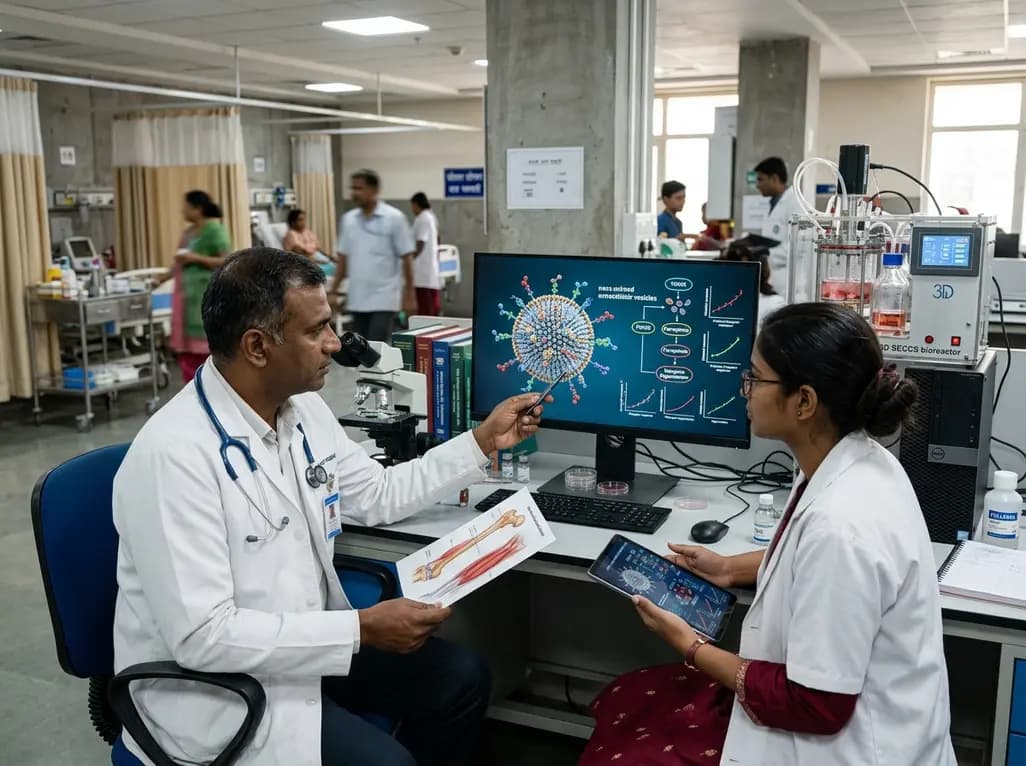
A breakthrough study demonstrates that fullerol-primed extracellular vesicles generated in a 3D SECCS bioreactor attenuate ferroptosis and restore myogenic regeneration in diabetes via the FOXO3 pathway, offering a cell-free therapeutic strategy for diabetic musculoskeletal degeneration.
3 days back
