.webp&w=384&q=75)

Loading, please wait...
Loading, please wait...
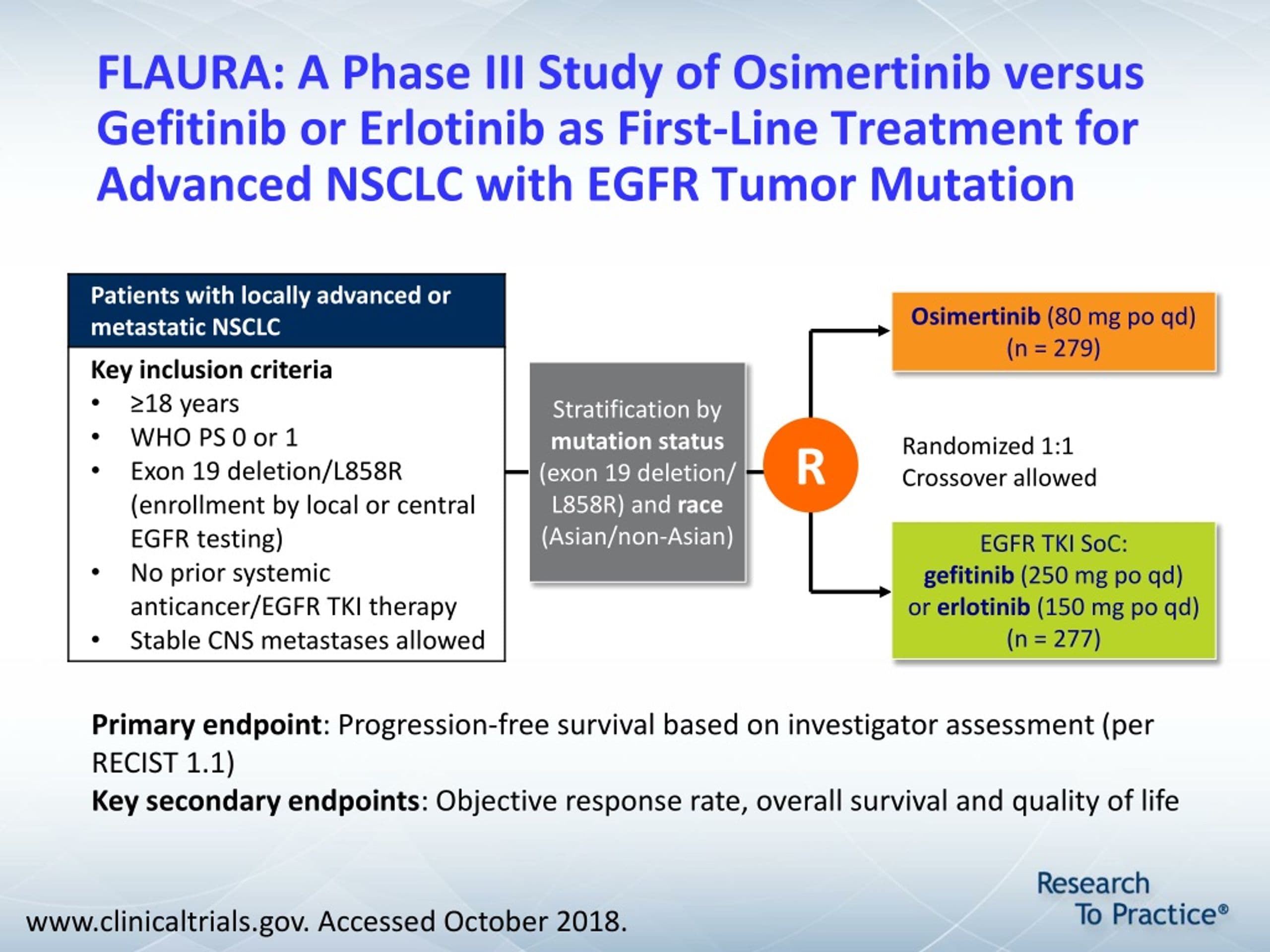
The final overall-survival analysis of the FLAURA trial established osimertinib as a major first-line option for patients with advanced non-small-cell lung cancer harboring sensitizing EGFR mutations. In previously untreated patients, osimertinib produced a longer median overall survival than standard first-generation EGFR tyrosine kinase inhibitors. The survival benefit was achieved while maintaining a broadly comparable overall safety profile, despite longer treatment exposure. For HCPs, the study demonstrates the clinical importance of obtaining molecular results before selecting systemic therapy in appropriate advanced NSCLC. It also shows how treatment sequencing has evolved: targeted therapy can be selected up front when a relevant driver alteration is identified, rather than relying solely on histology and clinical stage. This fits the NAPCON lung-cancer sessions on biomarker testing and access to modern staging and treatment pathways. The paper should not be generalized to EGFR-negative disease, but it provides a clear example of how biomarker-driven treatment can change outcomes in a defined molecular subgroup. In multidisciplinary practice, the result reinforces the value of coordinated pathology, molecular testing, imaging and oncology decision-making.

Read summarized clinical updates, watch expert medical content, and earn CME certifications right from your smartphone.
Open your smartphone camera to scan and install.





The final overall-survival analysis of the FLAURA trial established osimertinib as a major first-line option for patients with advanced non-small-cell lung cancer harboring sensitizing EGFR mutations. In previously untreated patients, osimertinib produced a longer median overall survival than standard first-generation EGFR tyrosine kinase inhibitors. The survival benefit was achieved while maintaining a broadly comparable overall safety profile, despite longer treatment exposure. For HCPs, the study demonstrates the clinical importance of obtaining molecular results before selecting systemic therapy in appropriate advanced NSCLC. It also shows how treatment sequencing has evolved: targeted therapy can be selected up front when a relevant driver alteration is identified, rather than relying solely on histology and clinical stage. This fits the NAPCON lung-cancer sessions on biomarker testing and access to modern staging and treatment pathways. The paper should not be generalized to EGFR-negative disease, but it provides a clear example of how biomarker-driven treatment can change outcomes in a defined molecular subgroup. In multidisciplinary practice, the result reinforces the value of coordinated pathology, molecular testing, imaging and oncology decision-making.
3 weeks back

Discover how catalytic nanozymes redefine autoimmune disease therapy by establishing a physiological redox set-point to restore immune tolerance without broad immunosuppression.
Last week

Recent research reveals that downregulating YAP1/TAZ-TEAD via Hippo signaling triggers spontaneous human trophoblast syncytialization in 3D cultures, illuminating placental biology and preeclampsia.
3 weeks back

A landmark comparative study evaluates atrial electrophysiology across humans, swine, and rodents. By linking cellular recordings with transcriptomics and in silico modeling, researchers resolve cross-species gaps, explaining translational failures to advance targeted therapies for atrial arrhythmias.
3 weeks back

A novel pathology-adaptive surface engineering strategy uses functionalized plasma polymer coatings to selectively modulate AGE adsorption, reducing oxidative stress and restoring bone formation in diabetic and aging microenvironments.
last month

Researchers have developed an innovative ultrasound-responsive nano-contrast agent that co-delivers CIITA-siRNA and rapamycin directly to inflamed thyroid tissue, significantly reducing autoimmune injury and thyroid autoantibodies in preclinical models of Hashimoto thyroiditis.
3 weeks back
