

Loading, please wait...
Loading, please wait...
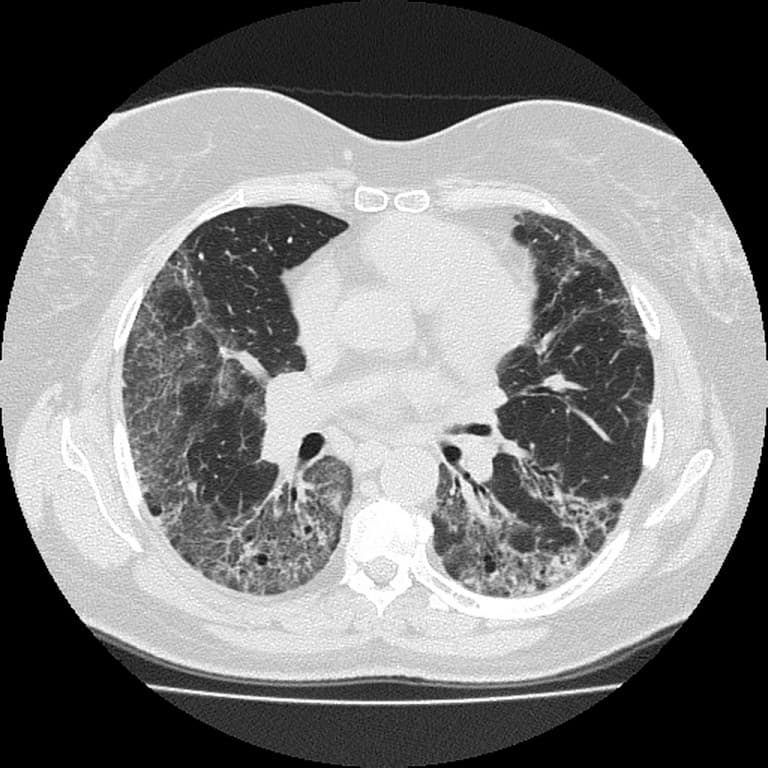
The INBUILD trial evaluated nintedanib in patients with progressive fibrosing interstitial lung diseases other than idiopathic pulmonary fibrosis. The randomized placebo-controlled study showed that nintedanib slowed the rate of decline in forced vital capacity across a broad group of fibrosing ILDs with a progressive phenotype. The benefit was consistent across major diagnostic subgroups, supporting the concept that treatment decisions can sometimes be guided by disease behavior rather than diagnosis alone. The clinical relevance is substantial for pulmonary practice because patients with connective-tissue-disease-associated ILD, chronic hypersensitivity pneumonitis, and other fibrosing disorders may develop a progressive trajectory even when they do not meet criteria for IPF. For HCPs, the paper supports regular assessment of change over time and timely referral to an ILD-focused multidisciplinary service when progression is suspected. As with IPF, adverse effects—especially diarrhea—need active management. The findings directly support the conference’s emphasis on antifibrotics beyond classic IPF and on longitudinal imaging, pulmonary function, and trajectory rather than relying on a single scan or isolated measurement.

Read summarized clinical updates, watch expert medical content, and earn CME certifications right from your smartphone.
Open your smartphone camera to scan and install.





The INBUILD trial evaluated nintedanib in patients with progressive fibrosing interstitial lung diseases other than idiopathic pulmonary fibrosis. The randomized placebo-controlled study showed that nintedanib slowed the rate of decline in forced vital capacity across a broad group of fibrosing ILDs with a progressive phenotype. The benefit was consistent across major diagnostic subgroups, supporting the concept that treatment decisions can sometimes be guided by disease behavior rather than diagnosis alone. The clinical relevance is substantial for pulmonary practice because patients with connective-tissue-disease-associated ILD, chronic hypersensitivity pneumonitis, and other fibrosing disorders may develop a progressive trajectory even when they do not meet criteria for IPF. For HCPs, the paper supports regular assessment of change over time and timely referral to an ILD-focused multidisciplinary service when progression is suspected. As with IPF, adverse effects—especially diarrhea—need active management. The findings directly support the conference’s emphasis on antifibrotics beyond classic IPF and on longitudinal imaging, pulmonary function, and trajectory rather than relying on a single scan or isolated measurement.
4 weeks back

A bioengineered oral nanozyme microsupplement converts pathological ROS into a protective polydopamine hydrogel shield. By curbing neutrophil extracellular traps and balancing T cells, this platform outperforms standard 5-ASA in preclinical colitis models, opening new paths for sustained remission.
2 days back

Recent research reveals that downregulating YAP1/TAZ-TEAD via Hippo signaling triggers spontaneous human trophoblast syncytialization in 3D cultures, illuminating placental biology and preeclampsia.
4 weeks back

Abdominal aortic aneurysm rupture remains a catastrophic vascular emergency. Groundbreaking research reveals that USP53 accelerates aneurysm progression by reprogramming smooth muscle cell metabolism toward aerobic glycolysis, highlighting a promising target beyond conventional diameter-based surveillance.
3 days back

A breakthrough study leverages natural language processing to accurately identify incident medication-related osteonecrosis of the jaw and track antiresorptive drug holidays from clinical narratives in electronic health records, advancing osteoporosis pharmacovigilance and dental safety.
3 days back

Recent research defines ferro-aging as a conserved iron-lipid axis driving organ decline across primates. Age-related iron dyshomeostasis stimulates ACSL4-mediated lipid peroxidation, promoting cellular senescence. Notably, vitamin C directly inhibits ACSL4, suppressing phospholipid oxidation and multi-organ decay.
4 days back
