.webp&w=384&q=75)

Loading, please wait...
Loading, please wait...
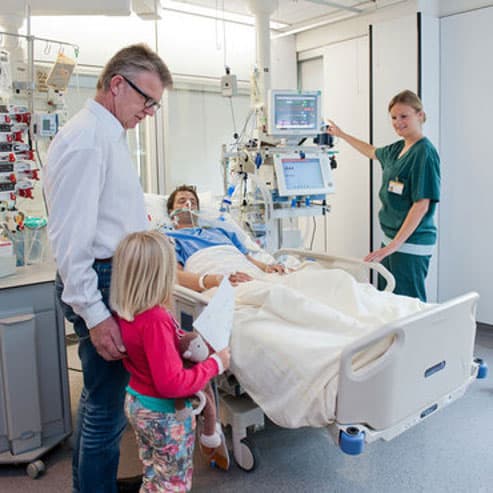
The ICU Visits randomised clinical trial evaluated whether flexible family visitation could reduce delirium in adult ICU patients. Across 36 Brazilian ICUs, flexible visiting—up to 12 hours per day with family education—was compared with usual restricted visitation. The primary outcome was delirium incidence. Despite substantially longer family presence, delirium was not significantly reduced. This is clinically useful because it prevents an intuitive but unsupported assumption that more family presence alone will automatically prevent delirium. However, the intervention was associated with better anxiety and depression scores among family members. That finding matters in an ICU model built around humanisation: an intervention can have meaningful benefits even when the primary patient-centred outcome does not change. For HCPs, the lesson is to distinguish the goals of family visitation. Families may support orientation, communication, shared decisions and emotional wellbeing, but delirium prevention still requires a wider strategy that includes sleep, mobility, sedation optimisation and cognitive engagement. The study fits CritiCARE 2026's family-presence and humanisation themes while illustrating the importance of testing compassionate practices rather than assuming their effects. It is a good example of how patient outcomes and family outcomes should both be considered when designing ICU policies.

Read summarized clinical updates, watch expert medical content, and earn CME certifications right from your smartphone.
Open your smartphone camera to scan and install.





The ICU Visits randomised clinical trial evaluated whether flexible family visitation could reduce delirium in adult ICU patients. Across 36 Brazilian ICUs, flexible visiting—up to 12 hours per day with family education—was compared with usual restricted visitation. The primary outcome was delirium incidence. Despite substantially longer family presence, delirium was not significantly reduced. This is clinically useful because it prevents an intuitive but unsupported assumption that more family presence alone will automatically prevent delirium. However, the intervention was associated with better anxiety and depression scores among family members. That finding matters in an ICU model built around humanisation: an intervention can have meaningful benefits even when the primary patient-centred outcome does not change. For HCPs, the lesson is to distinguish the goals of family visitation. Families may support orientation, communication, shared decisions and emotional wellbeing, but delirium prevention still requires a wider strategy that includes sleep, mobility, sedation optimisation and cognitive engagement. The study fits CritiCARE 2026's family-presence and humanisation themes while illustrating the importance of testing compassionate practices rather than assuming their effects. It is a good example of how patient outcomes and family outcomes should both be considered when designing ICU policies.
3 weeks back

Discover how catalytic nanozymes redefine autoimmune disease therapy by establishing a physiological redox set-point to restore immune tolerance without broad immunosuppression.
Last week

Recent research reveals that downregulating YAP1/TAZ-TEAD via Hippo signaling triggers spontaneous human trophoblast syncytialization in 3D cultures, illuminating placental biology and preeclampsia.
3 weeks back

A landmark comparative study evaluates atrial electrophysiology across humans, swine, and rodents. By linking cellular recordings with transcriptomics and in silico modeling, researchers resolve cross-species gaps, explaining translational failures to advance targeted therapies for atrial arrhythmias.
3 weeks back

A novel pathology-adaptive surface engineering strategy uses functionalized plasma polymer coatings to selectively modulate AGE adsorption, reducing oxidative stress and restoring bone formation in diabetic and aging microenvironments.
last month

Researchers have developed an innovative ultrasound-responsive nano-contrast agent that co-delivers CIITA-siRNA and rapamycin directly to inflamed thyroid tissue, significantly reducing autoimmune injury and thyroid autoantibodies in preclinical models of Hashimoto thyroiditis.
3 weeks back
