.webp&w=384&q=75)

Loading, please wait...
Loading, please wait...
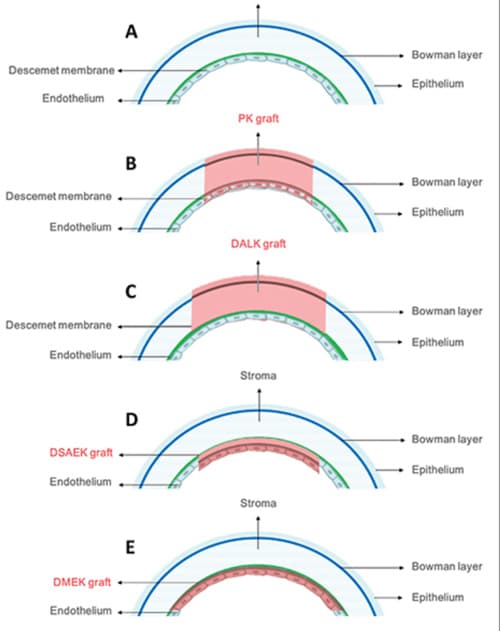
Long-term registry data comparing endothelial and full-thickness corneal transplantation provide useful context for surgical decision-making. In a Singapore Corneal Transplant Registry cohort, eyes undergoing DMEK, DSAEK, and penetrating keratoplasty (PK) for Fuchs endothelial corneal dystrophy or bullous keratopathy were followed for graft survival. DMEK showed the highest cumulative graft survival in the reported cohort, followed by DSAEK and PK. These results support the continued move toward lamellar endothelial replacement when disease is confined to the posterior cornea. However, retrospective registry comparisons can be influenced by patient selection, disease severity, surgeon preference, and changes in surgical practice over time. For clinicians, the key takeaway is that procedure choice should be anatomically driven. DMEK offers selective replacement of dysfunctional endothelium with a small graft, while DSAEK and PK remain valuable when anatomy, visualization, previous surgery, scarring, or other factors make DMEK less suitable. The study is a useful reminder that graft survival is only one outcome; visual rehabilitation, detachment rates, rebubbling, endothelial cell loss, rejection, and technical feasibility should all be integrated into the surgical plan.

Read summarized clinical updates, watch expert medical content, and earn CME certifications right from your smartphone.
Open your smartphone camera to scan and install.





Long-term registry data comparing endothelial and full-thickness corneal transplantation provide useful context for surgical decision-making. In a Singapore Corneal Transplant Registry cohort, eyes undergoing DMEK, DSAEK, and penetrating keratoplasty (PK) for Fuchs endothelial corneal dystrophy or bullous keratopathy were followed for graft survival. DMEK showed the highest cumulative graft survival in the reported cohort, followed by DSAEK and PK. These results support the continued move toward lamellar endothelial replacement when disease is confined to the posterior cornea. However, retrospective registry comparisons can be influenced by patient selection, disease severity, surgeon preference, and changes in surgical practice over time. For clinicians, the key takeaway is that procedure choice should be anatomically driven. DMEK offers selective replacement of dysfunctional endothelium with a small graft, while DSAEK and PK remain valuable when anatomy, visualization, previous surgery, scarring, or other factors make DMEK less suitable. The study is a useful reminder that graft survival is only one outcome; visual rehabilitation, detachment rates, rebubbling, endothelial cell loss, rejection, and technical feasibility should all be integrated into the surgical plan.
4 weeks back

Discover how catalytic nanozymes redefine autoimmune disease therapy by establishing a physiological redox set-point to restore immune tolerance without broad immunosuppression.
Last week

Recent research reveals that downregulating YAP1/TAZ-TEAD via Hippo signaling triggers spontaneous human trophoblast syncytialization in 3D cultures, illuminating placental biology and preeclampsia.
3 weeks back

A landmark comparative study evaluates atrial electrophysiology across humans, swine, and rodents. By linking cellular recordings with transcriptomics and in silico modeling, researchers resolve cross-species gaps, explaining translational failures to advance targeted therapies for atrial arrhythmias.
3 weeks back

A novel pathology-adaptive surface engineering strategy uses functionalized plasma polymer coatings to selectively modulate AGE adsorption, reducing oxidative stress and restoring bone formation in diabetic and aging microenvironments.
last month

Researchers have developed an innovative ultrasound-responsive nano-contrast agent that co-delivers CIITA-siRNA and rapamycin directly to inflamed thyroid tissue, significantly reducing autoimmune injury and thyroid autoantibodies in preclinical models of Hashimoto thyroiditis.
3 weeks back
