.webp&w=384&q=75)

Loading, please wait...
Loading, please wait...
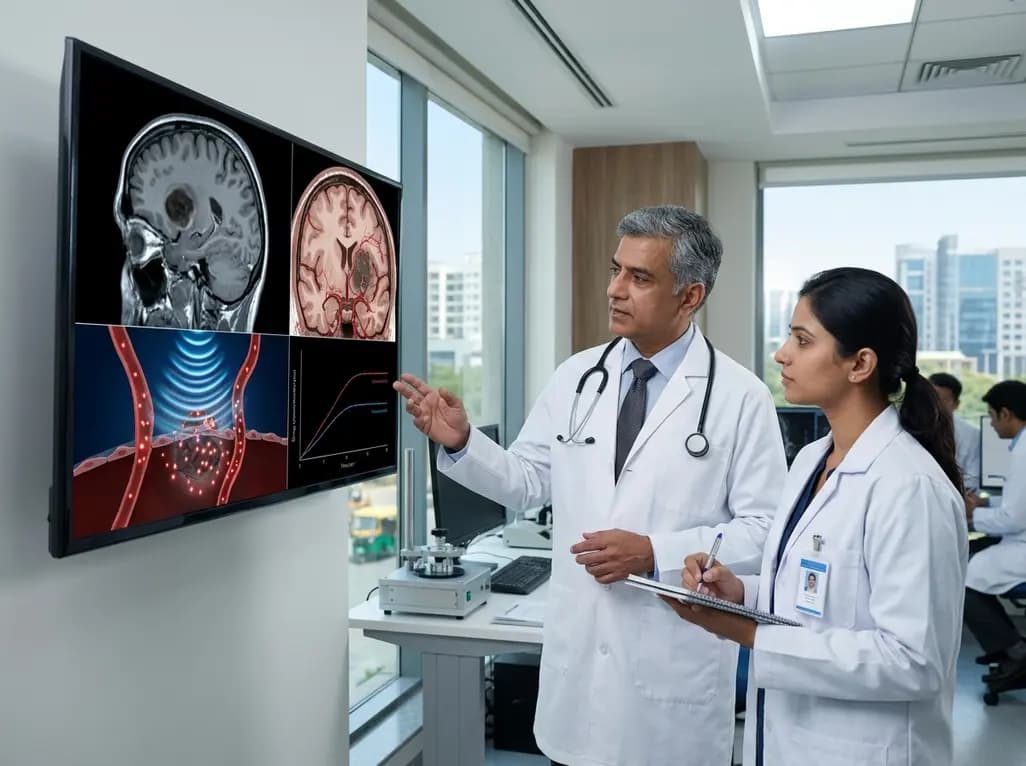
Glioblastoma (GBM) remains the most aggressive and lethal primary brain malignancy in adults. Despite the established standard of care involving surgical resection followed by chemoradiation and temozolomide (TMZ), patient outcomes have stagnated for decades. One of the most significant impediments to effective treatment is the physiological blood-brain barrier (BBB). This highly selective semipermeable border protects the neural tissue from toxins but simultaneously restricts the entry of over 98% of small-molecule drugs. Consequently, achieving therapeutic concentrations of temozolomide within the tumor core and infiltrative margins is exceptionally difficult. Recently, focused ultrasound BBB opening has emerged as a promising, non-invasive technology to transiently disrupt this barrier. By allowing localized drug delivery, this method could potentially transform the pharmacological landscape of neuro-oncology. Clinicians and researchers are now focusing on how this technology can be integrated into standard protocols to overcome intrinsic resistance mechanisms. This systematic review synthesizes the latest evidence to evaluate whether this innovation can finally shift the survival curve for GBM patients. Understanding this synergy between imaging and pharmacology is vital for modern oncology practice.
The technical process of achieving localized barrier disruption involves the precise coordination of ultrasound waves and intravenous microbubbles. When low-frequency ultrasound energy is focused on a specific brain region, it interacts with these circulating microbubbles in a process known as stable cavitation. The resulting acoustic pressure causes the bubbles to expand and contract rapidly, exerting mechanical force on the vascular endothelium. This physical stimulation transiently opens the tight junctions of the BBB, creating a window for drugs like temozolomide to pass into the brain parenchyma. Furthermore, this process is highly localized and entirely reversible, with the barrier typically closing within several hours. Modern systems use magnetic resonance imaging (MRI) guidance to ensure that the sonication is targeted specifically to the tumor volume. This precision minimizes the risk of damage to healthy brain tissue while maximizing drug exposure where it is needed most. Moreover, the procedure avoids the complications associated with invasive surgical delivery methods or high-dose systemic chemotherapy. Therefore, this approach provides a unique platform for enhancing the pharmacokinetic profile of existing agents. Notably, the mechanical disruption may also trigger local immune responses, further contributing to the therapeutic effect.
Extensive preclinical studies have provided the foundational evidence required to move focused ultrasound BBB opening into human trials. Research using orthotopic xenograft models has consistently shown that FUS-mediated disruption significantly increases intratumoral drug concentrations. Specifically, studies quantifying temozolomide levels have reported a two-to-threefold increase in drug exposure within the targeted areas compared to control groups. Beyond simple pharmacokinetics, these models demonstrate a clear therapeutic benefit, including reduced tumor growth rates and measurable survival extensions. For instance, animals treated with the combination of ultrasound and chemotherapy often exhibit significantly longer progression-free survival than those receiving chemotherapy alone. These findings suggest that the mechanical opening of the barrier effectively bypasses the primary delivery bottleneck. Additionally, researchers have explored various ultrasound parameters to optimize the safety window and drug delivery efficiency. This robust body of preclinical work underscores the potential for translating these results into clinical success. The data also highlight that the timing of drug administration relative to sonication is a critical variable for maximizing efficacy. Consequently, these insights have directly informed the design of early-phase human clinical trials.
Early clinical trials have primarily focused on establishing the safety and feasibility of MRI-guided barrier disruption in human subjects. Current systematic reviews of these trials indicate that the procedure is remarkably well-tolerated with a favorable safety profile. Notably, there have been no reports of procedure-related neurological deficits or serious adverse events in the initial cohorts. Patients undergoing the procedure typically experience only mild, transient effects that resolve quickly after the session. These studies have successfully demonstrated that reproducible BBB opening can be achieved in the human brain without causing long-term vascular or parenchymal damage. Furthermore, the use of MRI allows clinicians to confirm the extent of the opening in real-time using contrast-agent extravasation as a surrogate marker. While these early studies were not powered to determine survival benefits, they have laid the essential groundwork for larger efficacy trials. The integration of focused ultrasound into the maintenance phase of the Stupp protocol appears feasible within a standard hospital workflow. However, researchers emphasize that clinical efficacy remains unproven until more extensive data are collected. Nevertheless, the successful demonstration of safety represents a major milestone in the development of this technology.
Recent high-impact clinical data have begun to suggest that barrier disruption might indeed translate into improved survival for GBM patients. A landmark multicenter trial recently reported that adding focused ultrasound to standard temozolomide treatment led to a significant increase in both progression-free and overall survival. Specifically, the study highlighted a measurable survival advantage in patients who received repeated sonication sessions compared to historical controls. This breakthrough provides the first clinical signal that enhanced drug delivery directly impacts the natural history of the disease. Moreover, liquid biopsy data from these trials suggest that BBB opening also facilitates the release of tumor-derived biomarkers into the bloodstream. This secondary effect could enable better monitoring of tumor evolution and treatment response through simple blood tests. Despite these encouraging results, the medical community remains cautious, calling for larger randomized controlled trials to validate these findings. Standardizing the dosage of microbubbles and ultrasound intensity across different centers remains a priority for the field. Consequently, the next few years will be crucial for determining if this technology becomes a standard part of neuro-oncological care. The momentum behind these trials reflects the urgent need for innovative solutions in brain tumor management.
As the field of focused ultrasound moves forward, addressing methodological gaps is essential for widespread clinical adoption. Future research must prioritize the development of standardized protocols to ensure that outcomes are consistent across different institutions and devices. Furthermore, the inclusion of molecular stratification in trial design will help identify which patient subgroups are most likely to benefit from this targeted approach. For example, patients with unmethylated MGMT promoters, who typically respond poorly to temozolomide, might see the greatest relative benefit from enhanced delivery. Additionally, scientists are investigating the use of ultrasound to deliver more complex agents, such as monoclonal antibodies and immunotherapy. These larger molecules traditionally face even greater hurdles in crossing the BBB, making FUS an ideal delivery platform. Improving the speed and comfort of the procedure through the development of skull-mounted or portable devices is also a key area of innovation. In conclusion, focused ultrasound-mediated barrier opening represents a paradigm shift in the treatment of central nervous system disorders. By bridging the gap between drug discovery and effective delivery, this technology offers a beacon of hope for patients facing a glioblastoma diagnosis. Continued collaboration between clinicians and engineers will be the driving force behind its ultimate success.
Yes, early clinical evidence suggests the procedure is safe and well-tolerated. Systematic reviews show no serious procedure-related neurological complications. The barrier disruption is temporary and localized, with the BBB typically closing within 24 hours. Most side effects are mild and transient, such as temporary headaches or mild discomfort during sonication.
The blood-brain barrier normally restricts temozolomide from reaching high concentrations in the brain. Focused ultrasound uses microbubbles to physically open tight junctions in the blood vessels near the tumor. This allows significantly more chemotherapy to reach the glioblastoma cells, potentially overcoming resistance and improving tumor control as seen in preclinical models.
While current research focuses heavily on glioblastoma, the principle of BBB opening applies to various brain tumors. Clinical trials are already exploring its use for brain metastases from breast or lung cancer. It could also facilitate the delivery of targeted therapies, immunotherapies, and larger molecules that generally cannot cross the BBB effectively.
Disclaimer: This content is for informational and educational purposes only and does not constitute medical advice, diagnosis, or treatment. Always seek the advice of your physician or other qualified health provider with any questions you may have regarding a medical condition. Refer to the latest local and national guidelines for clinical practice.
References
Campos J et al. Focused ultrasound-mediated blood-brain barrier opening to enhance temozolomide delivery in glioblastoma: a systematic review of preclinical and early clinical evidence. Neurosurg Rev. 2026 Jul 04. doi: 10.1007/s10143-026-04367-x. PMID: 42399440.
Woodworth G et al. Microbubble-enhanced transcranial focused ultrasound with temozolomide for patients with high-grade gliomas: A multicenter, open-label, phase 1/2 trial. Lancet Oncol. 2025;26(1):15-28. doi: 10.1016/S1470-2045(24)00551-7.
Zhu H et al. Focused ultrasound-mediated enhancement of blood–brain barrier permeability for brain tumor treatment: a systematic review of clinical trials. Neurosurg Rev. 2024;47(1):412. doi: 10.1007/s10143-024-02611-2.

Read summarized clinical updates, watch expert medical content, and earn CME certifications right from your smartphone.
Open your smartphone camera to scan and install.





This systematic review explores focused ultrasound-mediated blood-brain barrier opening to enhance temozolomide delivery in glioblastoma. It evaluates preclinical success and early clinical evidence regarding safety, feasibility, and therapeutic impact for patients with aggressive brain tumors.
3 months ago

Depemokimab offers twice-yearly dosing for severe eosinophilic asthma and chronic rhinosinusitis with nasal polyps, significantly cutting exacerbations and hospital admissions.
3 days back

A novel copper metal-organic framework hydrogel remodels the uterine microenvironment to stimulate robust endometrial regeneration, reduce intrauterine fibrosis, and restore reproductive fertility, offering a groundbreaking strategy for managing refractory endometrial damage and Asherman syndrome.
3 days back

New research reveals that non-ablative radiotherapy suppresses ventricular tachycardia by increasing conduction velocity via NaV1.5 upregulation and action potential prolongation. However, sustained sodium current elevation and depressed calcium handling highlight the need for careful clinical translation.
5 days back

A single-cell transcriptomic atlas reveals how peripheral nerve injuries cause dorsal root ganglion remodeling. By evaluating proximal nerve crush and resection, researchers identify distinct glial and immune programs that resolve neuropathic pain and promote regeneration.
3 days back

A breakthrough study demonstrates that fullerol-primed extracellular vesicles generated in a 3D SECCS bioreactor attenuate ferroptosis and restore myogenic regeneration in diabetes via the FOXO3 pathway, offering a cell-free therapeutic strategy for diabetic musculoskeletal degeneration.
3 days back
