.webp&w=384&q=75)

Loading, please wait...
Loading, please wait...

Identifying hereditary cancer syndromes has historically relied on single-syndrome models like BRCAPRO or MMRpro. However, clinical oncology has rapidly shifted toward broad multigene panel testing. Clinicians require advanced tools to evaluate complex, multi-cancer family histories efficiently. The novel Fam3PRO risk prediction methodology addresses this vital clinical need by estimating carrier probabilities and long-term cancer risks across multiple susceptibility genes simultaneously. By integrating parameters across 21 genes and 17 cancers, this platform delivers unified risk assessment. Consequently, clinicians can streamline candidate selection for genetic testing and targeted early detection strategies.
Hereditary cancer predisposition accounts for a significant proportion of malignancies worldwide. Historically, risk evaluation focused on single gene-syndrome pairs, such as BRCA1/2 for hereditary breast and ovarian cancer or mismatch repair genes for Lynch syndrome. Although these legacy tools transformed genetic counseling, modern clinical practice utilizes comprehensive next-generation sequencing panels. These multigene panels test dozens of genes simultaneously, revealing actionable pathogenic variants beyond classic syndromic presentations.
However, traditional risk prediction models fail to capture the cumulative risk associated with multiple genes or overlapping cancer phenotypes. Consequently, clinicians often struggle to quantify an individual's overall susceptibility when family histories display diverse tumor types across generations. Modern medical genetics demands generalizable Mendelian models that accommodate an arbitrary number of genes and cancers. Such tools eliminate the need for running multiple isolated risk calculators for a single patient. Furthermore, unified risk stratification optimizes healthcare resources by accurately identifying individuals who truly benefit from germline sequencing, tailored surveillance protocols, and proactive risk-reducing interventions.
The Fam3PRO risk prediction framework represents a significant technological leap in Mendelian risk modeling. Built upon rigorous principles of Bayesian probability theory and genetics, Fam3PRO incorporates population-level parameters derived from extensive scientific literature. Specifically, the comprehensive platform currently integrates information across 21 high- and moderate-penetrance genes and 17 distinct cancer types, including breast, ovarian, colorectal, endometrial, and pancreatic malignancies.
Unlike older single-syndrome algorithms, Fam3PRO calculates the probability of being heterozygous for at least one pathogenic variant across all evaluated genes simultaneously. Additionally, the software generates age-specific conditional penetrance trajectories to project an individual's future risk of developing various cancers over time. This dual capacity allows clinicians to offer personalized counseling regarding both genetic carrier status and prospective cancer development.
Furthermore, the computational efficiency of Fam3PRO enables rapid calculations, making it suitable for seamless integration into electronic health record systems and web-based clinical interfaces. By allowing customization of gene-cancer sub-models, the platform adapts to diverse clinical settings, ranging from specialized cancer genetics clinics to general oncology practices.
Rigorous validation is essential before implementing risk prediction models into clinical decision-making. Researchers validated the performance of Fam3PRO using three independent, multi-ethnic panel cohorts. These diverse cohorts ensured that the model's predictive accuracy remains robust across heterogeneous populations with varying baseline allele frequencies and disease prevalence.
When evaluating established gene-cancer associations, such as those in hereditary breast-ovarian cancer and Lynch syndrome, Fam3PRO demonstrated discrimination and calibration metrics comparable to established tools like BRCAPRO and MMRpro. This finding confirms that expanding the model to include multiple genes does not compromise its precision for classic hereditary syndromes.
Moreover, in the combined multi-ethnic cohort, Fam3PRO evaluated the overall probability of harboring a pathogenic variant in any of the 21 susceptibility genes. The model achieved a solid discrimination index (C-statistic) of 0.64 (95% CI: 0.62–0.67). Furthermore, the calibration ratio of observed to expected carrier frequency was 1.13 (95% CI: 1.05–1.22), demonstrating reliable agreement between predicted and actual genetic outcomes across populations.
The clinical value of any risk prediction tool lies in its ability to identify actionable high-risk individuals who might otherwise be missed. In comparative analyses, Fam3PRO demonstrated superior sensitivity in capturing pathogenic variant carriers when compared to conventional single-syndrome models. Specifically, at standard clinical probability thresholds of 2.5% and 5%, Fam3PRO identified significantly more individuals at high risk of carrying a pathogenic variant in any of the 21 genes than BRCAPRO and MMRpro combined.
This enhanced identification capacity stems from the model's ability to aggregate subtle familial risk signals across multiple cancer types. Single-syndrome models often ignore extra-syndromic cancers in a family pedigree, underestimating total genetic risk. In contrast, Fam3PRO accounts for diverse malignancies, preventing high-risk patients from falling through clinical cracks.
Additionally, identifying carrier probabilities early enables timely referral for comprehensive germline testing. For healthcare providers, this translates into more efficient triage and better utilization of genetic counseling services. Ultimately, Fam3PRO ensures that individuals with moderate-to-high genetic susceptibility receive appropriate counseling and diagnostic workups.
Integrating comprehensive risk prediction tools like Fam3PRO into routine oncology and primary care can transform cancer prevention strategies. In clinical practice, estimating accurate carrier probabilities guides decisions regarding risk-reducing surgeries, intense chemoprevention, and enhanced surveillance schedules. For example, high-risk individuals can begin high-sensitivity imaging, such as breast MRI or early colonoscopies, years before standard population screening recommendations apply.
Furthermore, precise familial risk stratification extends beyond the proband to benefit immediate family members. Cascading genetic testing within families relies on identifying the initial carrier accurately. By offering clear future risk estimates, Fam3PRO empowers clinicians to initiate cascade testing across generations, potentially preventing primary cancers in biological relatives.
As multigene testing becomes standard practice globally, user-friendly digital interfaces for Fam3PRO will facilitate broad adoption. Primary care physicians, gynecologists, and general oncologists can easily input family history data to receive instant risk metrics. Consequently, Fam3PRO bridges the gap between complex statistical genetics and practical clinical care, empowering physicians to deliver personalized, life-saving preventive interventions.
Fam3PRO is an advanced Mendelian risk prediction model designed to estimate carrier probabilities and future cancer risks across 21 genes and 17 cancer types. Unlike traditional single-syndrome models like BRCAPRO or MMRpro, Fam3PRO evaluates complex, multi-cancer family histories simultaneously. Consequently, it provides a comprehensive assessment of overall hereditary cancer risk, improving candidate identification for multigene panel testing.
Fam3PRO was validated across three independent, multi-ethnic panel cohorts, demonstrating strong reliability. For classic syndromes, its performance matches established tools like BRCAPRO and MMRpro. When predicting carrier status across all 21 genes, Fam3PRO achieved a discrimination C-statistic of 0.64 and a calibration ratio of 1.13. This confirms its accuracy and consistency across diverse patient backgrounds.
Fam3PRO identifies more high-risk individuals than legacy models by aggregating risk factors across multiple cancer types. At standard probability thresholds of 2.5% and 5%, Fam3PRO flags a higher number of pathogenic variant carriers across 21 susceptibility genes than BRCAPRO and MMRpro combined. Therefore, clinicians can refer candidates for genetic testing more effectively, ensuring earlier diagnosis and preventive care.
Disclaimer: This content is for informational and educational purposes only and does not constitute medical advice, diagnosis, or treatment. Healthcare professionals should exercise their independent clinical judgment and consult official clinical guidelines when making decisions regarding risk assessment or genetic testing. Refer to the latest local and national guidelines for clinical practice.
References
Liang JW et al. Familial Risk Stratification Across Cancer Syndromes Using Fam3PRO. Genet Med. 2026 Jul 22. doi: undefined. PMID: 42489042.
Parmigiani G et al. Evaluating a Mendelian risk prediction model that aggregates across genes and cancers. J Clin Oncol. 2026;44(12):1420-1428.

Read summarized clinical updates, watch expert medical content, and earn CME certifications right from your smartphone.
Open your smartphone camera to scan and install.





Fam3PRO is a validated Mendelian risk prediction model that evaluates multi-gene and multi-cancer familial risks across 21 genes and 17 cancers, outperforming legacy single-syndrome models in capturing high-risk pathogenic variant carriers.
3 months ago

Depemokimab offers twice-yearly dosing for severe eosinophilic asthma and chronic rhinosinusitis with nasal polyps, significantly cutting exacerbations and hospital admissions.
6 days back

A novel copper metal-organic framework hydrogel remodels the uterine microenvironment to stimulate robust endometrial regeneration, reduce intrauterine fibrosis, and restore reproductive fertility, offering a groundbreaking strategy for managing refractory endometrial damage and Asherman syndrome.
6 days back

New research reveals that non-ablative radiotherapy suppresses ventricular tachycardia by increasing conduction velocity via NaV1.5 upregulation and action potential prolongation. However, sustained sodium current elevation and depressed calcium handling highlight the need for careful clinical translation.
Last week

A single-cell transcriptomic atlas reveals how peripheral nerve injuries cause dorsal root ganglion remodeling. By evaluating proximal nerve crush and resection, researchers identify distinct glial and immune programs that resolve neuropathic pain and promote regeneration.
6 days back
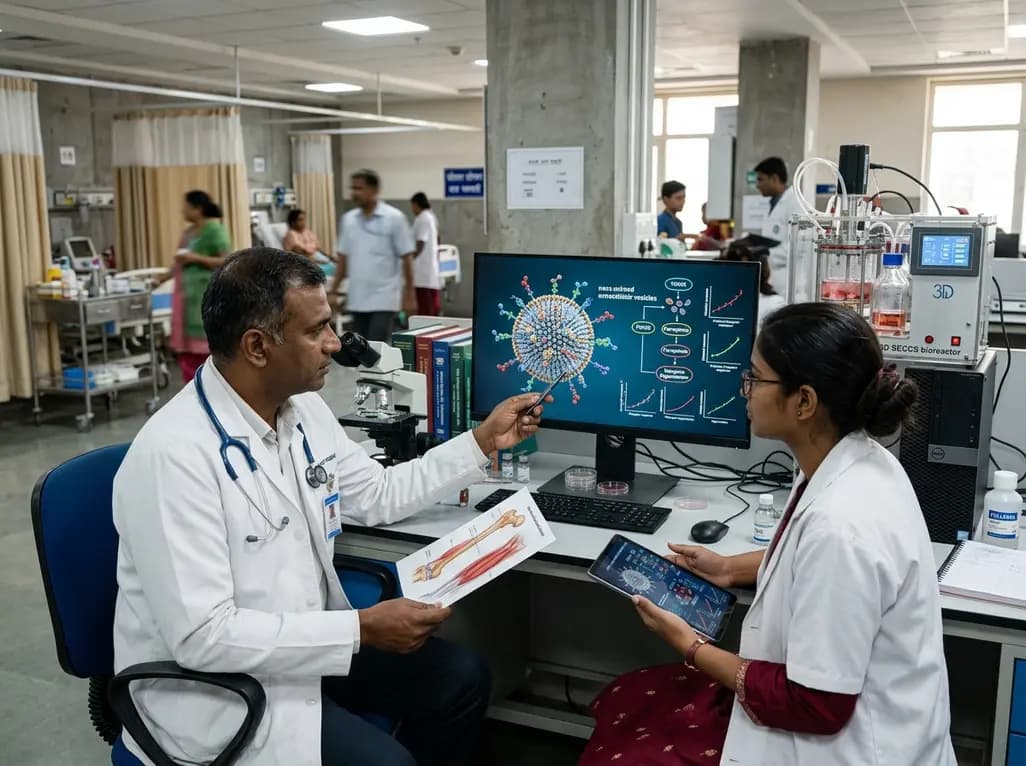
A breakthrough study demonstrates that fullerol-primed extracellular vesicles generated in a 3D SECCS bioreactor attenuate ferroptosis and restore myogenic regeneration in diabetes via the FOXO3 pathway, offering a cell-free therapeutic strategy for diabetic musculoskeletal degeneration.
6 days back
