.webp&w=384&q=75)

Loading, please wait...
Loading, please wait...
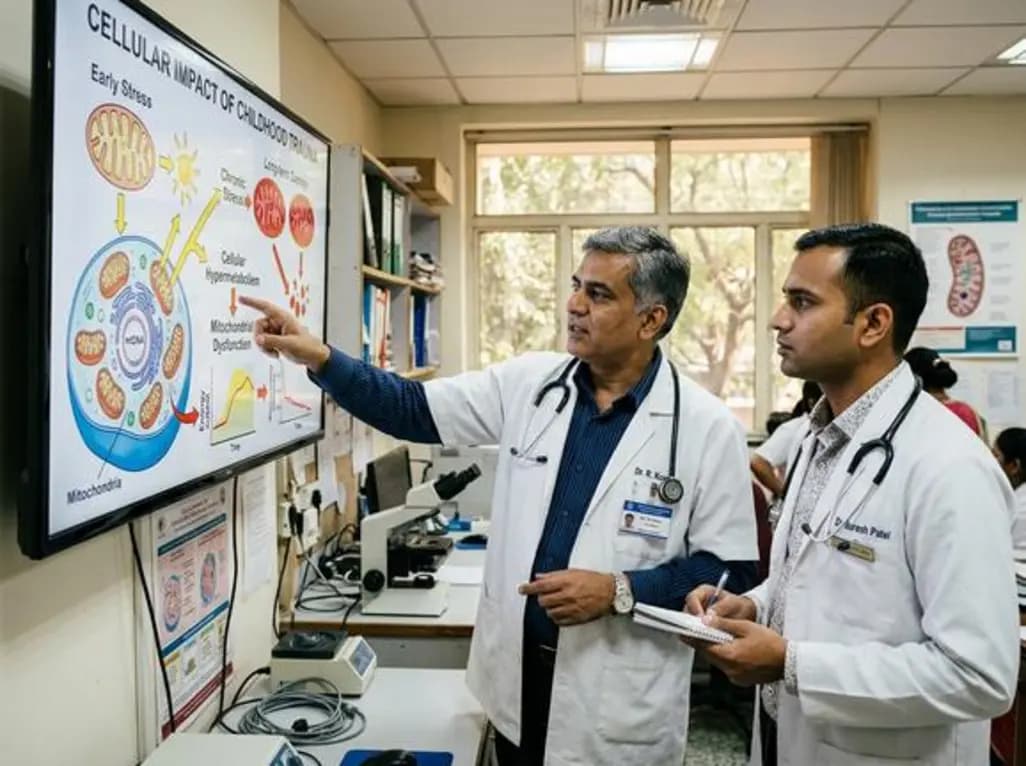
A groundbreaking study published in Biological Psychiatry reveals how early-life adversity fundamentally rewires cellular energy production. Specifically, researchers from the University of California, Los Angeles (UCLA) found that childhood trauma alters adult mitochondrial bioenergetics. Consequently, this adaptive cellular response eventually turns maladaptive over a person's lifespan. This finding provides a clear biological explanation for the long-term health declines seen in trauma survivors.
Initially, researchers analyzed blood samples from over 140 diverse adult participants. The investigators then conducted a functional cellular "stress test" on these live immune cells. Interestingly, they discovered that cumulative exposure to childhood trauma correlated with an increased mitochondrial respiratory capacity. This means that mitochondria from individuals who faced severe adversity produce more energy under stress than those from controls. Although this hypermetabolic state helps cells survive immediate challenges, it proves harmful over the long term. As a result, working under constant chronic stress wears cells out prematurely. Ultimately, this leads to cellular exhaustion and downstream tissue dysfunction.
Furthermore, the UCLA research team distinguished between different types of childhood trauma. Specifically, they analyzed experiences characterized by threat, such as physical abuse, versus deprivation, such as physical neglect. Interestingly, threat-based adversity resulted in lower baseline cell energy production. However, these cells remain highly prepared to meet potential future demands. In contrast, deprivation triggered increased glycolytic activity and inefficient energy production. Therefore, deprivation-related experiences may cause greater baseline cellular dysfunction than active threats.
Consequently, these insights could significantly improve clinical outcomes for patients with a history of trauma. Furthermore, understanding how early-life adversity embeds itself in cellular biology helps doctors design earlier interventions. For instance, early screening for childhood stress might allow pediatricians to implement preventive measures. Additionally, identifying these cellular pathways might lead to new treatments that mitigate mitochondrial decay. In the long run, protecting cellular energy production may prevent the onset of age-related physical and psychiatric diseases.
Q1: What is mitochondrial hypermetabolism?
Specifically, mitochondrial hypermetabolism refers to an increased capacity of mitochondria to produce energy when cells are under stress. Consequently, while this serves as a helpful short-term coping mechanism, chronic hypermetabolism eventually wears out cells.
Q2: How do threat and deprivation affect cells differently?
Specifically, experiences of threat lower baseline energy production but keep cells prepared for future stressors. On the other hand, deprivation leads to inefficient energy production and direct cellular dysfunction.
Q3: Why is this research clinically important?
This study shows that childhood trauma leaves a lasting physical imprint on adult cellular health. Therefore, clinicians can use these findings to develop early interventions before age-related physical and psychiatric diseases develop.
Disclaimer: This content is for informational and educational purposes only. It does not constitute medical advice or replace professional judgment. Refer to the latest local and national guidelines for clinical practice.
References

Read summarized clinical updates, watch expert medical content, and earn CME certifications right from your smartphone.
Open your smartphone camera to scan and install.





UCLA researchers have discovered that childhood trauma and neglect alter adult mitochondrial function. While the body initially boosts cell energy to cope with stress, this long-term hypermetabolism eventually damages cells, elevating the risk of chronic psychiatric and physical diseases later in life.
4 months ago

Depemokimab offers twice-yearly dosing for severe eosinophilic asthma and chronic rhinosinusitis with nasal polyps, significantly cutting exacerbations and hospital admissions.
3 days back

A novel copper metal-organic framework hydrogel remodels the uterine microenvironment to stimulate robust endometrial regeneration, reduce intrauterine fibrosis, and restore reproductive fertility, offering a groundbreaking strategy for managing refractory endometrial damage and Asherman syndrome.
4 days back

New research reveals that non-ablative radiotherapy suppresses ventricular tachycardia by increasing conduction velocity via NaV1.5 upregulation and action potential prolongation. However, sustained sodium current elevation and depressed calcium handling highlight the need for careful clinical translation.
6 days back

A single-cell transcriptomic atlas reveals how peripheral nerve injuries cause dorsal root ganglion remodeling. By evaluating proximal nerve crush and resection, researchers identify distinct glial and immune programs that resolve neuropathic pain and promote regeneration.
3 days back

A breakthrough study demonstrates that fullerol-primed extracellular vesicles generated in a 3D SECCS bioreactor attenuate ferroptosis and restore myogenic regeneration in diabetes via the FOXO3 pathway, offering a cell-free therapeutic strategy for diabetic musculoskeletal degeneration.
3 days back
