.webp&w=384&q=75)

Loading, please wait...
Loading, please wait...

Researchers have recently identified unique DNA methylation episignatures for two specific genes, KMT2A and KMT2B, which play a central role in rare neurodevelopmental disorders. Specifically, pathogenic variants in these genes lead to Wiedemann-Steiner syndrome (WDSTS) and Dystonia 28 (DYT28). Because clinical presentations of these conditions often overlap, reaching a precise diagnosis remains a significant challenge for many families. Consequently, the integration of epigenetic data provides a powerful solution for clinical geneticists and pediatricians in complex cases.
The study validated specific signatures for both genes using cohorts comprising various truncating and missense variants. The KMT2A-WDSTS signature encompasses 264 CpG sites, while the KMT2B-DYT28 signature includes 752 mostly hypermethylated sites. Notably, these signatures demonstrated high sensitivity and achieved pathogenicity scores between 80% and 85% during validation. Furthermore, these molecular biomarkers successfully classified variants of uncertain significance (VUS), showing strong agreement with existing phenotypic and in-silico data.
In many clinical scenarios, genetic testing identifies variants that lack a clear functional interpretation. By applying DNA methylation episignatures, clinicians can determine if a patient's variant mimics the epigenetic profile of a known pathogenic case. Interestingly, certain variants in the KMT2A transactivation domain and KMT2B disordered regions showed control-like methylation. This finding suggests that alternative mechanisms might drive pathogenesis in these specific atypical cases. Therefore, combining genetic, epigenetic, and clinical data is essential for a holistic and accurate diagnosis.
Ultimately, these gene-specific signatures represent a paradigm shift in precision medicine for neurodevelopmental disorders. They facilitate the identification of specific biological pathways, such as HOX gene enrichment in KMT2A cases and ion transport relations in KMT2B cases. This deeper biological understanding helps refine the diagnostic pipeline, especially for uncertain and atypical presentations. Moreover, the adoption of these epigenetic tools may reduce the diagnostic odyssey for many patients with rare movement and intellectual disabilities.
They are unique and reproducible patterns of DNA methylation across the genome that act as molecular biomarkers for specific genetic and neurodevelopmental disorders.
They allow clinicians to compare a patient's specific epigenetic profile against established disease signatures to confirm or rule out the pathogenicity of an uncertain mutation.
Disclaimer: This content is for informational and educational purposes only and does not constitute medical advice. Refer to the latest local and national guidelines for clinical practice.
References
Awamleh Z et al. KMT2A and KMT2B episignatures address diagnostic challenges associated with rare neurodevelopmental disorders. Genet Med. 2026 Jun 19. doi: undefined. PMID: 42318777.
Aref-Eshghi E et al. Evaluation of DNA Methylation Episignatures for Diagnosis and Phenotype Prediction in Hereditary Neurodevelopmental Disorders. Nat Commun. 2020;11(1):4839. doi:10.1038/s41467-020-18612-4.
Foroutan A et al. Clinical Utility of a Unique Genome-Wide DNA Methylation Signature for KMT2A-Related Syndrome. Int J Mol Sci. 2022;23(4):1815. doi:10.3390/ijms23041815.

Read summarized clinical updates, watch expert medical content, and earn CME certifications right from your smartphone.
Open your smartphone camera to scan and install.





Researchers have developed highly specific DNA methylation episignatures for KMT2A and KMT2B. These molecular biomarkers help clinicians resolve variants of uncertain significance (VUS), providing a more accurate diagnosis for rare conditions like Wiedemann-Steiner syndrome and Dystonia 28.
4 months ago

Depemokimab offers twice-yearly dosing for severe eosinophilic asthma and chronic rhinosinusitis with nasal polyps, significantly cutting exacerbations and hospital admissions.
3 days back

A novel copper metal-organic framework hydrogel remodels the uterine microenvironment to stimulate robust endometrial regeneration, reduce intrauterine fibrosis, and restore reproductive fertility, offering a groundbreaking strategy for managing refractory endometrial damage and Asherman syndrome.
4 days back

New research reveals that non-ablative radiotherapy suppresses ventricular tachycardia by increasing conduction velocity via NaV1.5 upregulation and action potential prolongation. However, sustained sodium current elevation and depressed calcium handling highlight the need for careful clinical translation.
6 days back

A single-cell transcriptomic atlas reveals how peripheral nerve injuries cause dorsal root ganglion remodeling. By evaluating proximal nerve crush and resection, researchers identify distinct glial and immune programs that resolve neuropathic pain and promote regeneration.
4 days back
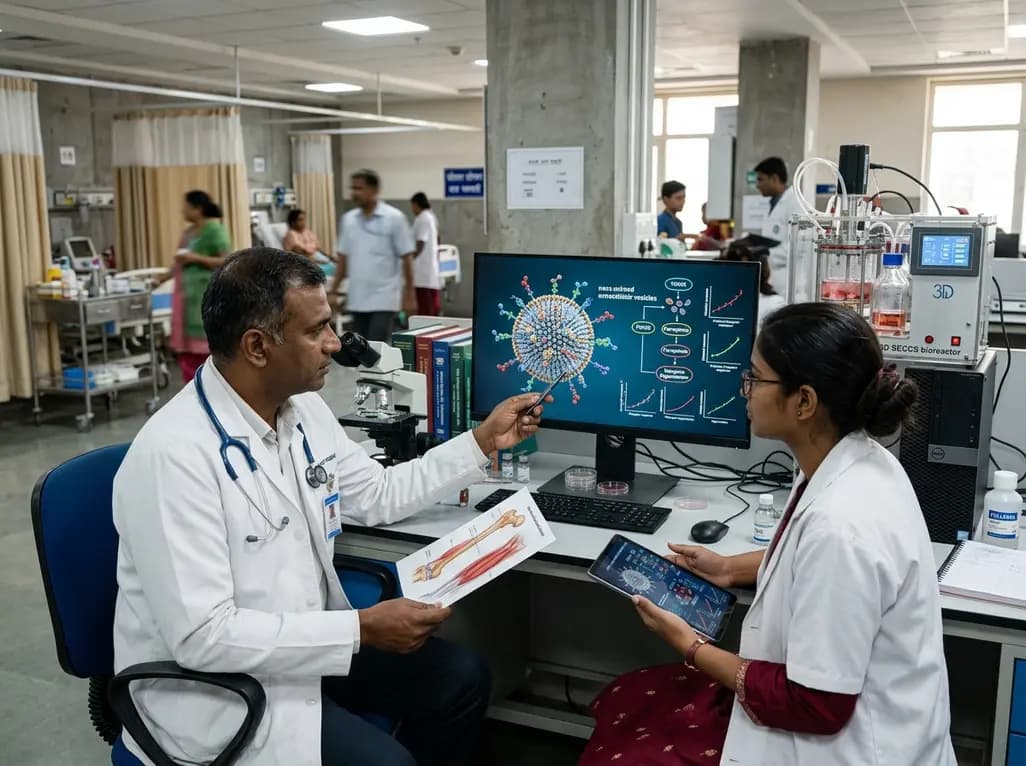
A breakthrough study demonstrates that fullerol-primed extracellular vesicles generated in a 3D SECCS bioreactor attenuate ferroptosis and restore myogenic regeneration in diabetes via the FOXO3 pathway, offering a cell-free therapeutic strategy for diabetic musculoskeletal degeneration.
4 days back
