.webp&w=384&q=75)

Loading, please wait...
Loading, please wait...
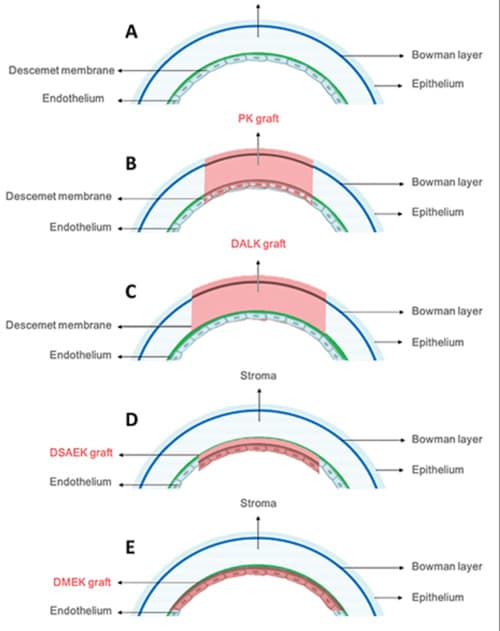
Comparative evidence consistently shows that Descemet membrane endothelial keratoplasty (DMEK) can provide faster and better visual rehabilitation than Descemet stripping automated endothelial keratoplasty (DSAEK), although the procedures have different technical demands. A systematic review and meta-analysis comparing the two techniques found better spectacle-corrected visual acuity and patient satisfaction after DMEK, while endothelial cell density outcomes were not significantly different overall. One important trade-off was a higher rebubbling rate with DMEK. This balance is clinically relevant in modern endothelial keratoplasty practice. DMEK's thinner, more anatomically selective graft can improve optical quality, but graft unfolding, positioning, detachment management, and learning-curve issues can affect early postoperative care. Surgeons therefore need to consider not only visual outcomes but also recipient anatomy, surgeon experience, and the likelihood of postoperative interventions. The evidence supports DMEK as a highly effective option when the goal is rapid and high-quality visual recovery, while recognizing that DSAEK remains an important and often more forgiving technique in selected settings.

Read summarized clinical updates, watch expert medical content, and earn CME certifications right from your smartphone.
Open your smartphone camera to scan and install.





Comparative evidence consistently shows that Descemet membrane endothelial keratoplasty (DMEK) can provide faster and better visual rehabilitation than Descemet stripping automated endothelial keratoplasty (DSAEK), although the procedures have different technical demands. A systematic review and meta-analysis comparing the two techniques found better spectacle-corrected visual acuity and patient satisfaction after DMEK, while endothelial cell density outcomes were not significantly different overall. One important trade-off was a higher rebubbling rate with DMEK. This balance is clinically relevant in modern endothelial keratoplasty practice. DMEK's thinner, more anatomically selective graft can improve optical quality, but graft unfolding, positioning, detachment management, and learning-curve issues can affect early postoperative care. Surgeons therefore need to consider not only visual outcomes but also recipient anatomy, surgeon experience, and the likelihood of postoperative interventions. The evidence supports DMEK as a highly effective option when the goal is rapid and high-quality visual recovery, while recognizing that DSAEK remains an important and often more forgiving technique in selected settings.
last month

Preclinical findings demonstrate that ginsenoside Ra1 preserves vascular integrity and attenuates multi-organ injury during sepsis by targeting non-muscle myosin heavy chain IIA (NMMHC IIA) and dampening TLR4/NF-κB/NLRP3 inflammatory signaling.
2 days back

An all-printed immunosensing microchip detects urinary sFlt-1 in just 10 minutes with 3.61 pg/mL sensitivity. By leveraging photonic bandgap engineering, this low-cost, cleanroom-free platform provides non-invasive preeclampsia screening, offering substantial benefits for point-of-care obstetric triage.
3 days back

Wearable ultrasound patches are transforming healthcare by shifting medicine from episodic evaluations to continuous monitoring. Discover how flexible acoustic transducers advance cardiovascular tracking, musculoskeletal imaging, neuromodulation, and on-demand closed-loop theranostics.
3 days back

A breakthrough study leverages natural language processing to accurately identify incident medication-related osteonecrosis of the jaw and track antiresorptive drug holidays from clinical narratives in electronic health records, advancing osteoporosis pharmacovigilance and dental safety.
Last week

Recent research defines ferro-aging as a conserved iron-lipid axis driving organ decline across primates. Age-related iron dyshomeostasis stimulates ACSL4-mediated lipid peroxidation, promoting cellular senescence. Notably, vitamin C directly inhibits ACSL4, suppressing phospholipid oxidation and multi-organ decay.
Last week
