.webp&w=384&q=75)

Loading, please wait...
Loading, please wait...

Cytomegalovirus (CMV) often complicates recovery for children following allogeneic hematopoietic cell transplantation (allo-HCT). Therefore, clinicians must evaluate CMV T-cell immunity to manage these infectious risks effectively. Recently, a retrospective analysis investigated the utility of the CMV T-cell immunity panel (CMV-TCIP) among pediatric recipients. Specifically, the study sought to correlate immune responses with viral DNAemia and clinically significant infections.
The research team analyzed twenty-seven test results from ten pediatric patients. Moreover, the median age at transplant was 8.5 years, mostly involving cases of hematologic malignancy. Researchers categorized a poor response as IFN-γ production ≤ 0.2% in CD4 or CD8 T cells. In contrast, they defined a result above 0.2% as adequate. Consequently, this threshold helped differentiate patients capable of controlling viral replication.
Furthermore, the data demonstrated a clear link between immune status and viral load levels. Specifically, subjects with an adequate response typically maintained viral loads below 500 IU/mL. In contrast, those with poor responses often displayed significantly higher viral concentrations. Thus, the CMV-TCIP panel serves as a biological mirror for the patient's current viral control status.
Identifying patients at risk for clinically significant CMV infection (csCMVi) remains a top priority. In this study, clinicians defined csCMVi as a viral load exceeding 500 IU/mL. However, results showed that an adequate CMV T-cell immunity profile strongly predicted a lower risk of developing csCMVi. Consequently, these findings support using immune monitoring to tailor antiviral therapy. Ultimately, this individualized approach may reduce drug exposure while maintaining safety for transplant recipients.
The CMV-TCIP is a diagnostic test that measures cell-mediated immunity by quantifying interferon-gamma (IFN-γ) release from CD4 and CD8 T cells. It helps clinicians understand how well a transplant recipient's immune system can control the cytomegalovirus.
An adequate response, defined as IFN-γ production greater than 0.2%, indicates a stronger immune capability. In pediatric transplant patients, this level is associated with lower viral loads and a lower risk of progressing to clinically significant infections.
Disclaimer: This content is for informational and educational purposes only. It does not constitute professional medical advice, diagnosis, or treatment. Always seek the advice of your physician or other qualified healthcare provider with any questions you may have regarding a medical condition. Refer to the latest local and national guidelines for clinical practice.
References
Probst V et al. Evaluation of Cytomegalovirus (CMV) T-Cell Mediated Immunity in Children With CMV DNAemia After Allogeneic Hematopoietic Cell Transplantation. Transpl Infect Dis. 2026 Jun 18. doi: 10.1111/tid.70253. PMID: 42315990.
Dulek D et al. Multicenter Prospective Cohort Study of CMV T cell Immunity and First post-transplant CMV DNAemia in Pediatric Solid Organ Transplant Recipients. IPTA 2025 Abstract.
Arya S et al. A pilot study of the CMV inSIGHT™ T-cell immunity panel to assess cytomegalovirus (CMV) cell mediated immunity (CMI) in allogeneic hematopoietic cell transplant (HCT) recipients. ResearchGate. 2026 Apr.

Read summarized clinical updates, watch expert medical content, and earn CME certifications right from your smartphone.
Open your smartphone camera to scan and install.





A retrospective study evaluates CMV T-cell immunity (CMV-TCIP) in pediatric allo-HCT recipients. Results indicate that an adequate response (IFN-γ > 0.2%) correlates with lower viral loads and reduced clinically significant infection, offering a potential tool for monitoring post-transplant complications.
4 months ago

Depemokimab offers twice-yearly dosing for severe eosinophilic asthma and chronic rhinosinusitis with nasal polyps, significantly cutting exacerbations and hospital admissions.
3 days back

A novel copper metal-organic framework hydrogel remodels the uterine microenvironment to stimulate robust endometrial regeneration, reduce intrauterine fibrosis, and restore reproductive fertility, offering a groundbreaking strategy for managing refractory endometrial damage and Asherman syndrome.
3 days back

New research reveals that non-ablative radiotherapy suppresses ventricular tachycardia by increasing conduction velocity via NaV1.5 upregulation and action potential prolongation. However, sustained sodium current elevation and depressed calcium handling highlight the need for careful clinical translation.
5 days back

A single-cell transcriptomic atlas reveals how peripheral nerve injuries cause dorsal root ganglion remodeling. By evaluating proximal nerve crush and resection, researchers identify distinct glial and immune programs that resolve neuropathic pain and promote regeneration.
3 days back
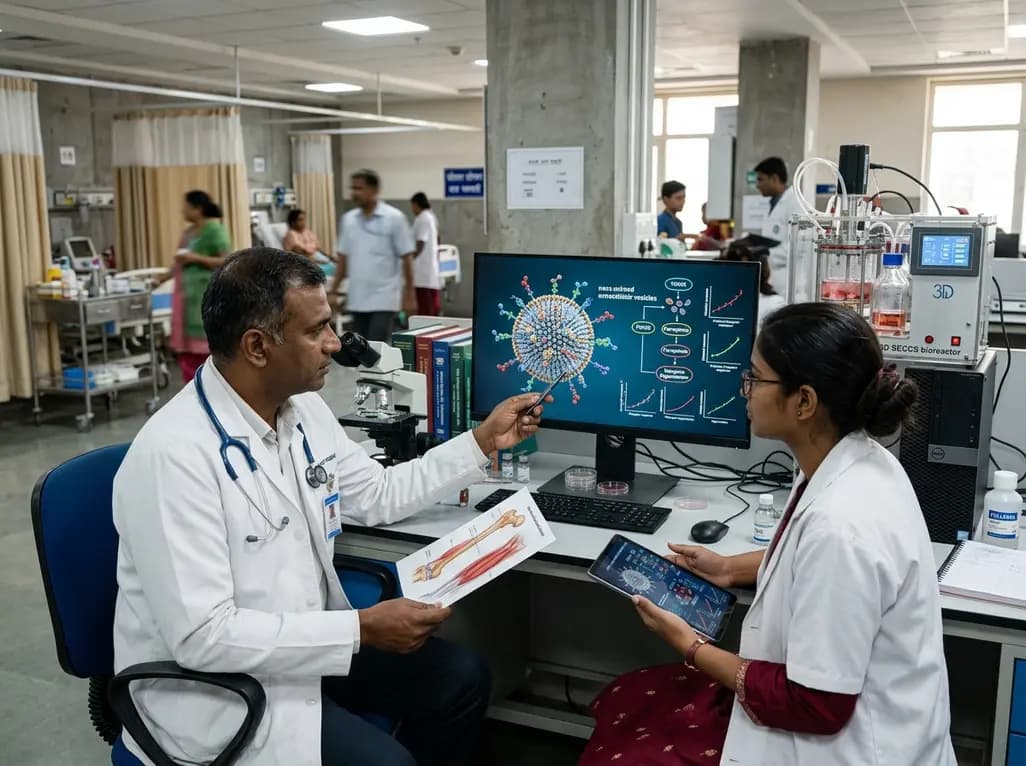
A breakthrough study demonstrates that fullerol-primed extracellular vesicles generated in a 3D SECCS bioreactor attenuate ferroptosis and restore myogenic regeneration in diabetes via the FOXO3 pathway, offering a cell-free therapeutic strategy for diabetic musculoskeletal degeneration.
3 days back
