.webp&w=384&q=75)

Loading, please wait...
Loading, please wait...

Recent advancements at Northwestern University have introduced a novel wearable stress detection technology to monitor mental and physical health. This lightweight, bandage-like device adheres to the chest to sense physiological changes hidden deep within the body. Consequently, it provides clinicians with a real-time, whole-body view of stress levels without requiring invasive procedures. Because stress often manifests physically before a person becomes consciously aware of it, this tool serves as an essential early warning system.
The device weighs under eight grams and integrates multiple tiny sensors into a single, soft platform. Specifically, it simultaneously tracks heart activity, breathing patterns, sweat response, blood flow, and skin temperature. A miniature microphone captures acoustic signals from the lungs while a motion sensor detects mechanical changes. Furthermore, the system measures electrical conductivity in the skin, which is a well-known marker of sweat gland activity. This multi-dimensional approach ensures a more accurate reading than traditional methods that rely on isolated data points.
This technology offers significant advantages for vulnerable populations who cannot communicate their discomfort, such as infants or the elderly. Moreover, researchers designed the system to operate wirelessly, transmitting data to smartphones or tablets for immediate analysis. Machine learning algorithms then evaluate these patterns to identify acute or prolonged stress episodes. Consequently, this capability allows for better management of mental health conditions and sleep disorders. Healthcare providers can also use the device to monitor critically ill patients who may face health risks from high stress levels.
Researchers validated the device's performance through various real-world and controlled experiments. In simulated tests, the wearable matched the accuracy of commercial polygraph systems. Furthermore, during cognitive challenges, it detected stress signals that aligned with pupil dilation measurements. Because the device moves naturally with the skin and operates for over 24 hours, it remains comfortable for continuous use. Therefore, this innovation represents a significant step toward making stress monitoring more accessible and objective in clinical settings.
Q1: What physiological signals does the device track to measure stress?
The device monitors heart activity, respiration, sweat gland response, blood flow, and skin temperature to provide a holistic view of the body's stress response.
Q2: How does the technology analyze the collected health data?
Data is sent wirelessly to a mobile device where machine learning algorithms analyze complex patterns in real-time to detect stress and discomfort.
Q3: Can this device be used for pediatric patients?
Yes, the team specifically designed the device to be non-invasive and lightweight, making it suitable for monitoring stress in infants and children.
Disclaimer: This content is for informational and educational purposes only. It does not constitute medical advice or replace professional judgment. Refer to the latest local and national guidelines for clinical practice.
References

Read summarized clinical updates, watch expert medical content, and earn CME certifications right from your smartphone.
Open your smartphone camera to scan and install.





Researchers developed an 8-gram wearable device that uses biophysical signals and machine learning to detect stress in real-time for clinical populations....
5 months ago
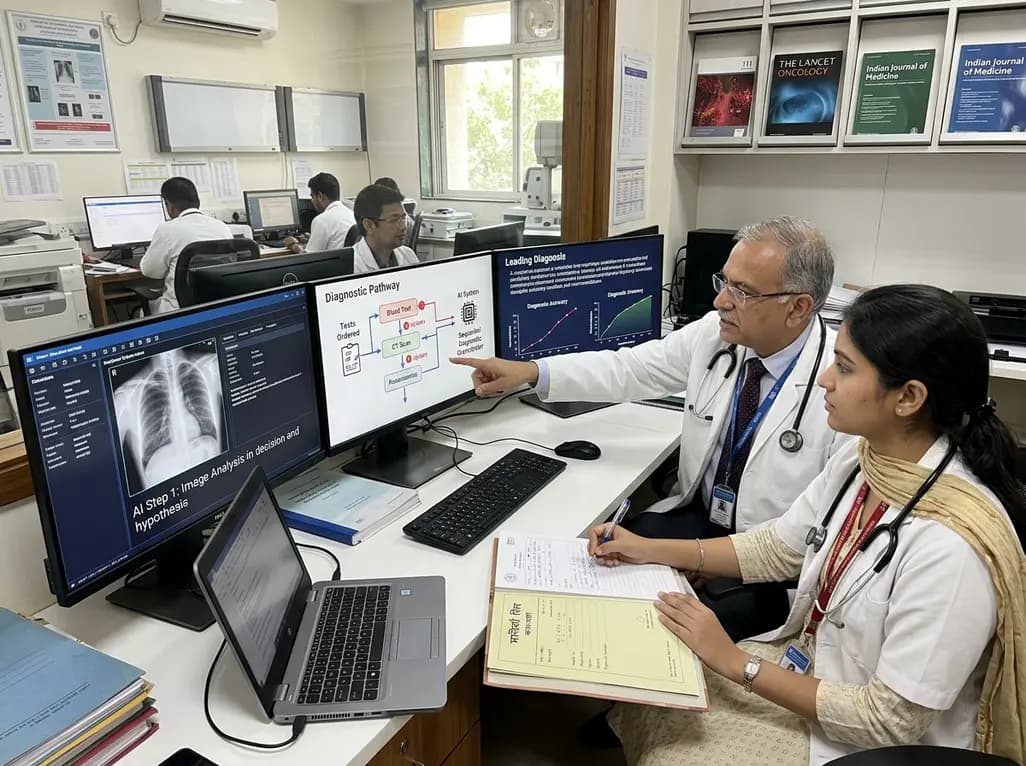
A breakthrough peer-reviewed study demonstrates that a sequential AI diagnosis system can mirror real-world clinical reasoning. By ordering stepwise tests and updating hypotheses dynamically, this multi-agent orchestrator achieved superior diagnostic accuracy while reducing investigative costs.
Today

A prenatal case highlights severe glutaric acidemia type II presenting as bilateral hyperechoic cystic kidneys at 18 weeks. Whole-exome sequencing revealed a novel homozygous ETFDH frameshift variant, demonstrating the power of rapid genetic testing in fetal renal anomalies.
Today

Review how tailored exercise programs benefit frail older patients with heart failure. Explore pathophysiological mechanisms, individualized training prescriptions, and strategies to overcome adherence barriers in clinical practice.
Yesterday

This comparative study evaluates posterior labral tears with and without glenohumeral instability, highlighting distinct demographic patterns, MRI underestimation in stable shoulders, and successful arthroscopic repair outcomes.
Yesterday

A clinical study demonstrates that early intervention with tocilizumab, either as monotherapy or bridged with corticosteroids, achieves significant proptosis reduction and resolves active inflammation in treatment-naive thyroid eye disease.
Yesterday
