.webp&w=384&q=75)

Loading, please wait...
Loading, please wait...
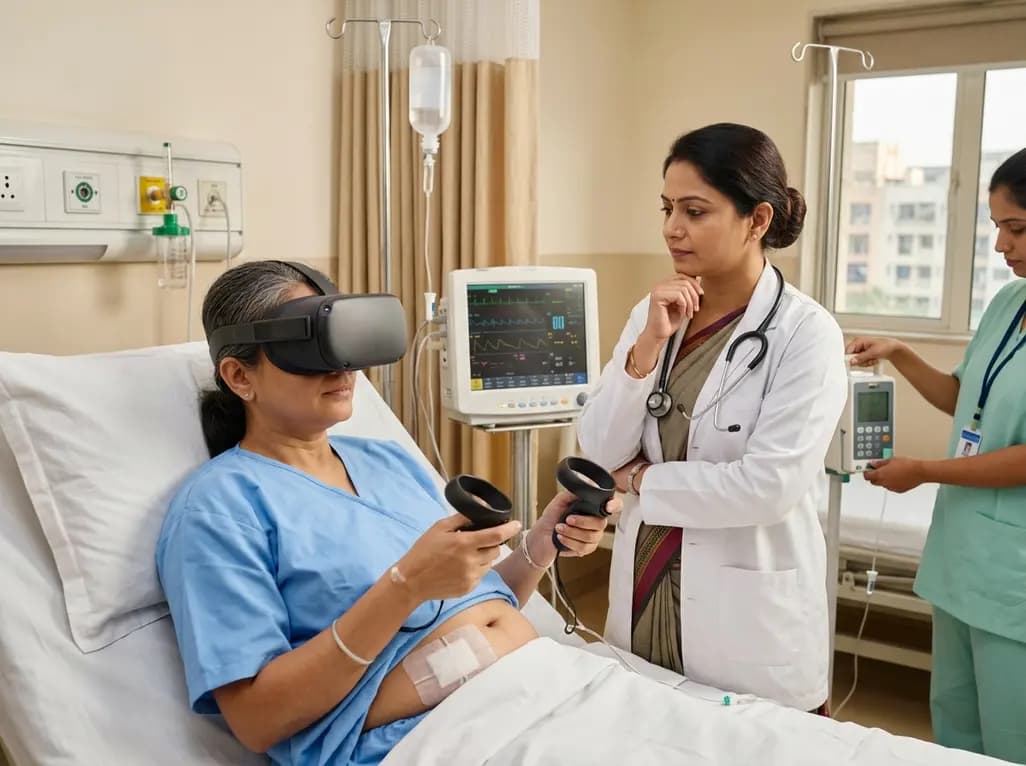
Modern surgical practice continually seeks innovative methods to enhance patient recovery and minimize the physiological and psychological burden of invasive procedures. One such innovation is virtual reality pain management, a digital health intervention that uses immersive environments to distract patients from painful stimuli. While virtual reality has shown significant promise in acute settings, such as wound debridement or minor outpatient procedures, its effectiveness in the context of postoperative recovery following major surgery remains a subject of intense academic debate. Clinicians are particularly interested in non-pharmacological adjuncts that can potentially reduce the reliance on opioids and other systemic analgesics. Consequently, researchers have begun investigating how immersive technology might influence the recovery trajectory of patients undergoing minimally invasive gynecologic surgery (MIGS). Although the surgical techniques for MIGS have advanced remarkably, postoperative pain and anxiety remain significant challenges that impact patient satisfaction and hospital discharge timelines. Therefore, evaluating the clinical utility of VR in this setting is essential for determining its place in the modern multimodal analgesic toolkit.
Minimally invasive gynecologic surgery, encompassing procedures like laparoscopy and hysteroscopy, is generally associated with less pain than traditional open surgery. However, patients still experience significant visceral and somatic discomfort during the initial recovery phase. Traditional pain management strategies typically involve a combination of nonsteroidal anti-inflammatory drugs, paracetamol, and occasionally opioids. While these pharmacological approaches are effective, they often carry side effects such as nausea, dizziness, and constipation, which can delay overall recovery. Moreover, the psychological component of pain, specifically preoperative and postoperative anxiety, is frequently overlooked in conventional care protocols. This gap in holistic care has led to the exploration of distraction-based therapies. Virtual reality works on the gate control theory of pain, suggesting that the brain has a limited capacity for processing sensory information. By flooding the visual and auditory senses with pleasant, immersive content, VR aims to reduce the perception of pain signals. Nevertheless, the transition of this technology from a procedural distraction tool to a postoperative recovery aid requires rigorous clinical validation through randomized controlled trials.
To address the evidence gap, researchers at Sun Yat-sen Memorial Hospital in China conducted a randomized controlled trial involving 131 patients. These individuals were undergoing laparoscopy or combined hysteroscopy for various benign gynecologic diseases. The study participants were randomly assigned to either a control group or a VR intervention group. All patients followed a standardized general anesthesia protocol during their surgery to ensure baseline consistency. The control group received standard postoperative analgesic therapy, which is the current clinical norm. In contrast, the VR group received a single 20-minute immersive intervention exactly six hours after their surgery. The researchers focused on measuring pain and anxiety levels using the visual analog scale (VAS) at specific intervals. The primary outcome was defined as the change in pain scores between the six-hour and seven-hour marks. Additionally, secondary outcomes such as maximum pain scores, hospitalization costs, and length of stay were meticulously tracked to provide a comprehensive view of the intervention's impact on the healthcare system and patient well-being.
The results of the trial indicated that a single session of virtual reality pain management did not significantly alter the pain experience for these patients. Specifically, there was no statistically significant difference in the primary outcome of pain score changes between the VR and control groups. The mean difference was measured at 0.169, which fell well within the range of statistical insignificance. Furthermore, the maximum pain scores recorded by the patients did not show a meaningful reduction in the intervention group. Beyond physical pain, the study also looked at anxiety levels, which are often cited as a key area where VR could excel. Surprisingly, no significant improvement was observed in anxiety scores either. From a systemic perspective, the intervention did not influence the length of hospital stay or the total cost of hospitalization. These findings suggest that while VR is a fascinating technological adjunct, its application as a brief, one-time intervention during the postoperative recovery phase may not provide the same robust benefits seen during acute, short-duration procedural interventions.
Despite the lack of a superior analgesic effect, the study provided valuable data regarding the safety and tolerability of virtual reality in a surgical population. One of the primary concerns with VR technology is the risk of "cybersickness," characterized by symptoms like dizziness, nausea, and vomiting. However, the trial found no significant differences in the incidence of these adverse events between the two groups. This indicates that VR is well-tolerated by patients, even in the sensitive period following general anesthesia and abdominal surgery. This safety profile is encouraging for future research, suggesting that the technology can be safely integrated into clinical workflows. The lack of efficacy in this specific trial may be attributed to several factors, including the short duration of the intervention or the specific nature of postoperative pain compared to procedural pain. Future studies might explore longer or more frequent VR sessions, or perhaps content that is specifically tailored to the neurobiology of postoperative recovery. For now, standard care remains the most reliable pathway for managing patient comfort after gynecologic surgery.
For practitioners in India and globally, these findings serve as a reminder that technological innovation must be balanced with evidence-based application. While the allure of digital health is strong, the implementation of virtual reality pain management should be guided by specific clinical contexts where it has demonstrated clear value. In the setting of recovery from minimally invasive gynecologic surgery, a single 20-minute session may not be sufficient to overcome the complex physiological pain pathways active several hours after a procedure. However, this does not negate the potential of VR in other areas of gynecology. For example, recent meta-analyses have suggested that VR may be highly effective during conscious procedures like intrauterine device (IUD) insertion or office hysteroscopy, where the pain is intense but short-lived. Clinicians should continue to monitor the evolution of this technology, focusing on its potential for reducing anxiety and enhancing the patient experience in outpatient settings. As the software becomes more sophisticated and the hardware more accessible, personalized digital therapeutics may eventually find their place in a truly multimodal approach to women's health and surgical recovery.
Virtual reality is considered a safe non-pharmacological adjunct rather than a complete alternative to standard analgesia. Research indicates that VR is well-tolerated by most patients, with no significant increase in postoperative nausea or dizziness. However, it should be used in conjunction with standard care protocols. Clinicians must assess individual patient suitability, as those prone to severe motion sickness might find the immersive experience uncomfortable during their initial recovery.
The lack of significant impact may be due to the intervention's timing and duration. Postoperative pain involves complex visceral and somatic pathways that persist for hours or days. A single 20-minute VR session at the six-hour mark might provide temporary distraction but may not be intensive enough to alter the overall pain trajectory. Additionally, standard analgesic care in modern hospitals is already quite effective, making it difficult for an adjunct to show statistical superiority.
While many studies suggest VR is excellent for reducing procedural anxiety, this specific trial in gynecologic surgery did not find a significant difference in postoperative anxiety scores. This suggests that the psychological burden of recovering from surgery may require more sustained or specialized interventions than a brief VR session. Future research is investigating whether pre-operative VR exposure to the surgical environment might be more effective at lowering anxiety than post-operative distraction sessions.
Disclaimer: This content is for informational and educational purposes only. It does not constitute professional medical advice, diagnosis, or treatment. Always seek the advice of your physician or other qualified healthcare provider with any questions you may have regarding a medical condition. Performance of any technological intervention should be under the supervision of trained medical staff. Refer to the latest local and national guidelines for clinical practice.
References
Hu Q et al. Effects of Virtual Reality on Postoperative Pain Management Following Minimally Invasive Gynecologic Surgery: Randomized Controlled Trial. JMIR Form Res. 2026 Jul 02. doi: 10.2196/92442. PMID: 42390916.
Baradwan S, et al. The effect of virtual reality on pain and anxiety management during outpatient hysteroscopy: a systematic review and meta-analysis of randomized controlled trials. Arch Gynecol Obstet. 2024 Apr;309(4):1267-1280. doi: 10.1007/s00404-023-07234-x.
Malik A, et al. Virtual Reality for Postoperative Pain Management: A Review of Current Evidence. Pain Medicine. 2024 Dec;25(12):815-825. doi: 10.1093/pm/pnae112.
Zhao Y, et al. Effectiveness of Non-Pharmacological Interventions for Pain Management After Laparoscopic Cholecystectomy: A Systematic Review and Network Meta-Analysis. PMC. 2025 Dec;12(1):45-58.

Read summarized clinical updates, watch expert medical content, and earn CME certifications right from your smartphone.
Open your smartphone camera to scan and install.





A randomized controlled trial investigated the impact of virtual reality on postoperative pain and anxiety after minimally invasive gynecologic surgery. Despite its potential for distraction, the 20-minute VR intervention showed no significant improvement over standard analgesia in this specific recovery setting.
3 months ago

Novel diimide and hydrazone scaffolds, particularly compound #C4, synergistically reactivate latent HIV-1 when combined with JQ1 or PKC activators. Demonstrating donor-matched proviral transcription ex vivo and non-canonical signaling, these findings advance shock and kill strategies toward reservoir eradication.
Today

A cross-sectional study reveals that maternal RSV vaccination coverage reached only 43.7% in Argentina, with maternal vaccine knowledge being the sole independent predictor of uptake. Clinicians play a crucial role in eliminating informational and structural barriers to optimize infant health.
Today

Review how tailored exercise programs benefit frail older patients with heart failure. Explore pathophysiological mechanisms, individualized training prescriptions, and strategies to overcome adherence barriers in clinical practice.
Yesterday

This comparative study evaluates posterior labral tears with and without glenohumeral instability, highlighting distinct demographic patterns, MRI underestimation in stable shoulders, and successful arthroscopic repair outcomes.
Yesterday

A clinical study demonstrates that early intervention with tocilizumab, either as monotherapy or bridged with corticosteroids, achieves significant proptosis reduction and resolves active inflammation in treatment-naive thyroid eye disease.
Yesterday
