.webp&w=384&q=75)

Loading, please wait...
Loading, please wait...

Recent advancements in vibrotactile haptic feedback are transforming how medical professionals interact with virtual environments. Traditionally, mechanical damping from encapsulation matrices limited the output of piezoelectric polymers like poly(vinylidene fluoride) (PVDF). However, a new interface design successfully overcomes these physical barriers. This innovation enables immersive experiences in the medical metaverse, which facilitates better surgical training and patient rehabilitation.
Researchers introduced a unique internal chamber structure within the soft piezoelectric interface. This design significantly enhances vibrational displacement and force. Consequently, users can feel subtle textures and dynamic sensations, such as flowing water, with high precision. The team also developed a wearable, wireless driving circuit. Therefore, clinicians can independently adjust the amplitude and frequency of feedback for various clinical applications.
In surgical settings, haptic technology provides essential tactile cues during robotic procedures. Because surgeons cannot feel tissue directly through a screen, high-fidelity vibration effectively substitutes for physical touch. Furthermore, this technology supports neurological rehabilitation. Patients practicing motor skills in virtual reality receive real-time sensory feedback, which promotes neuroplasticity. Notably, these systems enhance user presence, making virtual medical consultations feel remarkably realistic.
It provides tactile feedback that mimics physical sensations. This allows surgeons to gauge pressure and tissue resistance more accurately during remote or robotic-assisted operations.
Yes, high-fidelity vibrotactile feedback helps patients in neuro-rehabilitation by providing real-time sensory cues during motor skill exercises in virtual reality environments.
Disclaimer: This content is for informational and educational purposes only and does not constitute medical advice, diagnosis, or treatment. Always seek the advice of a qualified healthcare provider regarding a medical condition. Refer to the latest local and national guidelines for clinical practice.
References
Liu J et al. A Flexible Vibrotactile Interface for Immersive Metaverse Interaction. ACS Appl Mater Interfaces. 2026 May 11. doi: 10.1021/acsami.6c04893. PMID: 42109211.
VR for Health. Virtual Reality: Expanding Haptic Applications in Medical Simulation Beyond Specialized Surgical Training. 2025.
NIH. The application of metaverse in healthcare. PMC. 2024.

Read summarized clinical updates, watch expert medical content, and earn CME certifications right from your smartphone.
Open your smartphone camera to scan and install.





Researchers have developed a soft, high-performance piezoelectric interface that significantly improves vibrotactile feedback for medical VR applications....
5 months ago

Researchers at IIT Bombay have engineered an automated, cost-effective point-of-care device that diagnoses anaemia and sickle cell disease from a single drop of blood. By measuring blood smear spreading length, this portable tool assesses blood viscosity to offer rapid screening in resource-limited healthcare centers.
Today
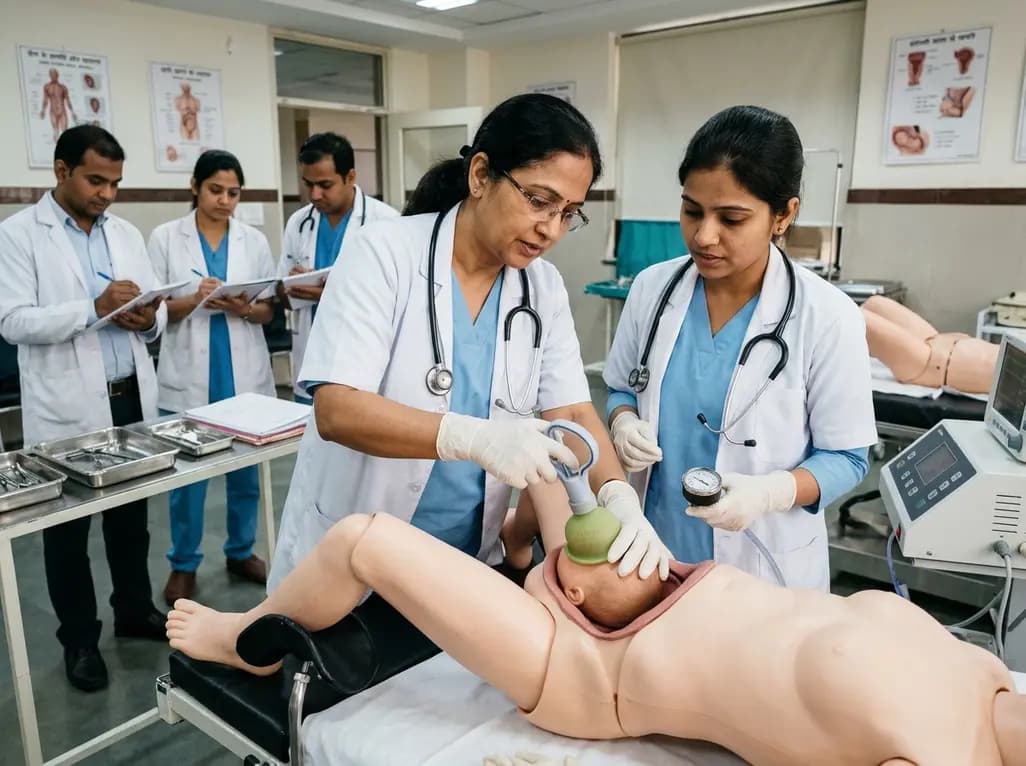
A multicenter study evaluates whether standardized simulation training reduces cup detachment during vacuum-assisted vaginal birth. Evidence-based simulation equips obstetricians to improve cup placement, reduce maternal-fetal trauma, and optimize clinical decision-making during operative deliveries.
Today

A breakthrough ultrathin multimodal sensor decouples physical hemodynamic monitoring from disposable electrochemical calibration, achieving long-term wearable glucose prediction with 81.36% accuracy and a 9.12% MARD. This offers a robust, drift-free solution for outpatient metabolic surveillance.
Today

A comparative review of tension band wiring and intramedullary screw fixation in thumb metacarpophalangeal arthrodesis, evaluating union rates, hardware complications, and clinical outcomes.
Today

Following regulatory scrutiny from FSSAI regarding promotional representations and lean muscle preservation claims, Dr. Reddy's Laboratories and Nestlé Health Science are currently reviewing the branding and marketing strategy for their joint nutritional supplement Celevida GLP+.
Today
