.webp&w=384&q=75)

Loading, please wait...
Loading, please wait...
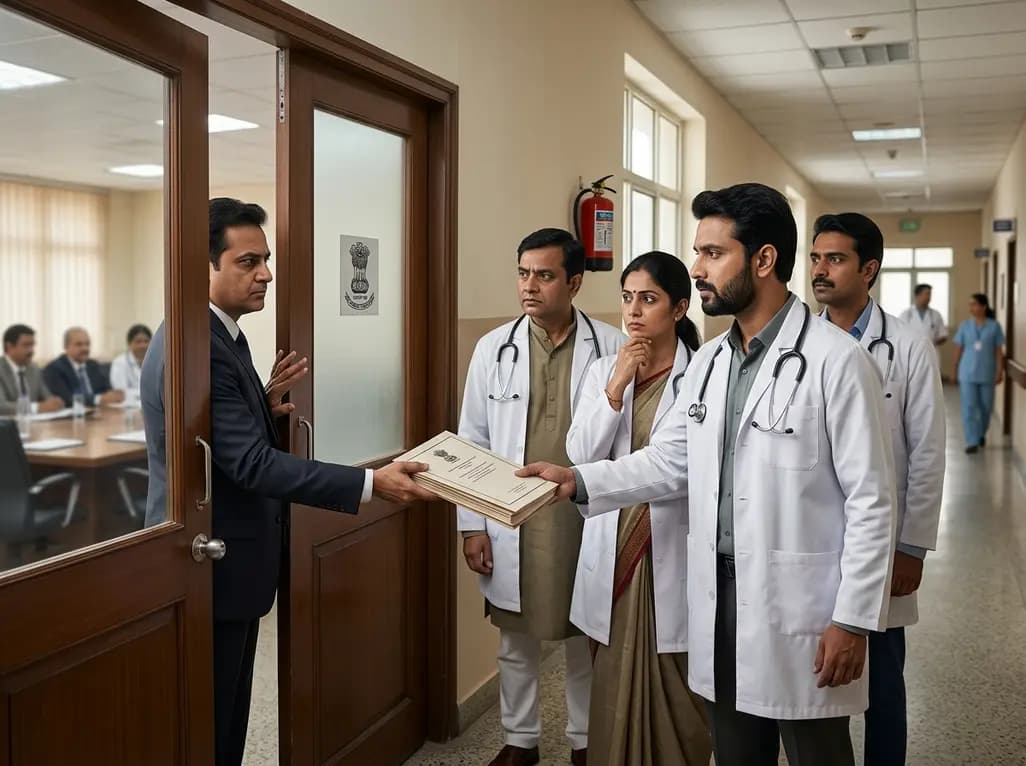
Specifically, representatives of the United Doctors Front NEET delegation were barred from presenting before a key Parliamentary Standing Committee. Consequently, this exclusion has sparked intense debate within the medical community and political circles. Meanwhile, the committee met to discuss critical issues regarding the National Eligibility-cum-Entrance Test (NEET). Therefore, many experts are questioning the transparency of the examination reform process.
Indeed, the committee had formally invited the doctors' body to share their views on examination reforms. However, ruling party MPs strongly opposed their participation during the meeting. Consequently, the committee asked the five-member delegation to wait outside the meeting hall. Chairman Digvijaya Singh later expressed regret over this decision to the representatives. He explained that a majority of the panel members did not want them to attend. Nevertheless, Singh personally sat with the doctors to hear their grievances.
Although they could not participate in the main meeting, the doctors submitted a memorandum. Specifically, they demanded the dissolution of the National Testing Agency (NTA). Furthermore, they urged the creation of a new examination body through an Act of Parliament. This proposed body would remain directly accountable to Parliament. In addition, the doctors highlighted that the current NTA lacks adequate auditing mechanisms. Meanwhile, the NTA is planning to transition NEET-UG to a computer-based test format. Therefore, these proposed reforms aim to eliminate future paper leaks and malpractices.
Q1: Why was the United Doctors Front excluded from the meeting?
Indeed, the representatives were excluded because several committee members raised objections. Consequently, they had to wait outside the hall.
Q2: What did the United Doctors Front demand in their memorandum?
Specifically, they demanded the dissolution of the National Testing Agency. Furthermore, they proposed creating a new examination body under direct parliamentary oversight.
Disclaimer: This content is for informational and educational purposes only. It does not constitute medical advice or replace professional judgment. Refer to the latest local and national guidelines for clinical practice.
References

Read summarized clinical updates, watch expert medical content, and earn CME certifications right from your smartphone.
Open your smartphone camera to scan and install.





UDF representatives were barred from a NEET parliamentary panel meeting, prompting them to submit a memorandum demanding the dissolution of the NTA....
4 months ago

Novel diimide and hydrazone scaffolds, particularly compound #C4, synergistically reactivate latent HIV-1 when combined with JQ1 or PKC activators. Demonstrating donor-matched proviral transcription ex vivo and non-canonical signaling, these findings advance shock and kill strategies toward reservoir eradication.
Today

A cross-sectional study reveals that maternal RSV vaccination coverage reached only 43.7% in Argentina, with maternal vaccine knowledge being the sole independent predictor of uptake. Clinicians play a crucial role in eliminating informational and structural barriers to optimize infant health.
Today

Review how tailored exercise programs benefit frail older patients with heart failure. Explore pathophysiological mechanisms, individualized training prescriptions, and strategies to overcome adherence barriers in clinical practice.
Yesterday

This comparative study evaluates posterior labral tears with and without glenohumeral instability, highlighting distinct demographic patterns, MRI underestimation in stable shoulders, and successful arthroscopic repair outcomes.
Yesterday

A clinical study demonstrates that early intervention with tocilizumab, either as monotherapy or bridged with corticosteroids, achieves significant proptosis reduction and resolves active inflammation in treatment-naive thyroid eye disease.
Yesterday
