.webp&w=384&q=75)

Loading, please wait...
Loading, please wait...

Voice represents a fundamental pillar of human identity, interpersonal communication, and self-expression. For transgender individuals, vocal characteristics strongly reinforce internal gender congruence and social perception. Consequently, understanding transgender vocal changes during medical transition remains essential for providing comprehensive gender-affirming care. When acoustic output misaligns with true gender identity, individuals frequently suffer profound psychological distress. Gender-affirming hormone therapy significantly influences laryngeal anatomy and acoustic function, yet clinical monitoring requires both objective measurements and subjective evaluations. A recent investigative protocol highlights the vital necessity of tracking vocal transitions during the initial six months of hormone administration. By combining computerized acoustic analysis with validated patient-reported outcome measures, clinicians can accurately evaluate physiological vocal adaptation. Furthermore, this dual-layered approach illuminates how endocrine regimens influence functional communication. As gender-affirming medicine expands, healthcare providers require standardized protocols to gauge therapy success and optimize psychosocial outcomes.
The clinical trajectory of voice modification holds substantial relevance across endocrinology, otolaryngology, and mental health. Voice pitch and resonance convey immediate social cues regarding gender identity. Consequently, discrepancies between perceived vocal acoustic qualities and internal identity can elevate anxiety, depression, and social avoidance. In transmasculine individuals undergoing testosterone therapy, androgen receptors stimulate vocal fold hypertrophy. This biological mechanism increases vocal cord mass and lowers the fundamental frequency over time. Conversely, feminizing hormone regimens containing estrogens and anti-androgens do not reverse previous laryngeal growth induced by androgen exposure during puberty. Therefore, transfeminine individuals often depend heavily on specialized speech therapy or phonosurgical procedures to achieve vocal congruence. Clinicians must recognize these distinct physiological pathways when counseling patients before treatment. Establishing structured baseline assessments ensures realistic expectations and significantly enhances psychosocial resilience.
Accurate assessment of vocal transformation requires robust, objective, and reproducible analytical methodologies. Clinicians and speech researchers utilize advanced software programs such as PRAAT and the Multi-Dimensional Voice Program to capture detailed acoustic parameters. These software suites analyze sustained phonation, reading passages, and spontaneous conversational speech samples. Key parameters include fundamental frequency, jitter, shimmer, noise-to-harmonic ratio, and formant frequencies. Fundamental frequency provides a precise numerical indicator of vocal pitch alterations over time. Meanwhile, jitter and shimmer measure short-term cycle perturbations in pitch and amplitude, reflecting vocal stability. Spectral noise measures quantify breathiness or hoarseness during transitional phases of vocal remodeling. Serial acoustic assessments performed throughout the first six months capture early physiological shifts. Consequently, objective metrics provide an unbiased baseline that validates therapeutic efficacy and detects maladaptive vocal strain early.
Although acoustic software yields precise physical measurements, objective data alone cannot capture the complete patient experience. Subjective self-assessment instruments, such as the Transgender Self-Evaluation Questionnaire, provide crucial insights into daily vocal functioning and self-image. These dedicated questionnaires quantify how patients perceive their own vocal gender presentation in diverse social settings. Furthermore, they measure emotional distress, communicative limitations, and avoidance behaviors triggered by vocal dysphoria. Research demonstrates that patient satisfaction correlates closely with the perceived effectiveness of hormone therapy. However, clinical studies emphasize that numerical acoustic shifts do not always correlate perfectly with psychological well-being. An individual might achieve an objective pitch within the desired normative range yet continue to experience anxiety. Therefore, integrating patient-reported outcome measures ensures that therapeutic success is defined through the patient perspective.
The physiological response to gender-affirming hormone therapy varies significantly across patient populations. Exogenous testosterone therapy induces structural changes within laryngeal cartilages and thyroarytenoid muscles among assigned female at birth individuals. Consequently, speaking fundamental frequency typically drops into typical masculine ranges within the initial six months of treatment. However, some individuals experience transient vocal instability, voice cracking, and pitch breaks during rapid tissue hypertrophy. In rare instances, hormone therapy alone fails to achieve the desired pitch lowering, requiring adjuvant behavioral voice therapy. In contrast, estrogen and anti-androgen therapy in assigned male at birth individuals does not alter laryngeal cartilage volume. Thus, transfeminine patients rarely experience pitch elevation from hormonal intervention alone. By understanding these physiological realities, healthcare teams can design coordinated care plans that prevent vocal strain.
An intriguing finding in recent voice research involves baseline articulatory differences between transgender men and cisgender women prior to hormone therapy. Even before commencing testosterone, subtle variations in oral resonance, mouth posture, and tongue positioning can be observed. These articulatory nuances suggest that gender expression involves learned behavioral communication habits beyond intrinsic laryngeal anatomy. For example, forward tongue carriage, vowel formant dispersion, and precise consonant articulation contribute distinctly to vocal gender perception. Therefore, voice adaptation encompasses much more than just altering fundamental frequency through hormones. Patients who modify articulatory dynamics and intonation contours often achieve greater vocal congruence. Speech-language pathologists utilize targeted exercises to refine these patterns safely. Recognizing preexisting articulatory characteristics allows clinicians to personalize therapy protocols from day one, fostering sustainable vocal habits.
Effective gender-affirming voice care requires coordinated collaboration among multidisciplinary healthcare professionals. Endocrinologists manage hormone regimens to support steady, safe physiological progression without provoking abrupt laryngeal strain. Concurrently, otolaryngologists and laryngologists perform laryngeal examinations and acoustic assessments to identify structural pathologies or vocal fold dysfunction. Speech-language pathologists provide structured voice training that addresses pitch, resonance, articulation, and vocal hygiene. In addition, mental health professionals offer vital support for navigating the psychosocial aspects of vocal transition. Routine acoustic evaluations combined with standardized questionnaires facilitate objective tracking across clinical follow-up intervals. When healthcare providers implement standardized protocols, they can promptly detect complications such as vocal fatigue or persistent vocal dissatisfaction. Integrated care paradigms empower transgender individuals to achieve authentic vocal congruence and improved life quality.
Testosterone therapy induces permanent hypertrophy of the vocal cords and laryngeal structures in transgender men, which significantly lowers the fundamental frequency and deepens vocal pitch over several months. In contrast, estrogen and anti-androgen therapy does not reduce laryngeal mass or raise vocal pitch in transgender women after puberty. Consequently, transfeminine individuals typically require targeted gender-affirming speech therapy or phonosurgical interventions to achieve higher pitch and feminine resonance.
Objective acoustic software accurately tracks physical voice parameters like fundamental frequency, vocal stability, and formant resonance across transition timelines. However, acoustic data alone cannot evaluate daily communicative satisfaction or emotional well-being. Standardized self-assessment questionnaires capture the subjective patient experience, voice-related quality of life, and perceived social congruence. Combining both evaluation tools provides a holistic assessment, ensuring that clinical interventions directly align with both anatomical changes and patient goals.
Behavioral speech therapy provides essential guidance on resonance, intonation patterns, articulation mechanics, and vocal hygiene. While testosterone lowers vocal pitch in transmasculine individuals, therapy prevents hyperfunctional muscle strain and optimizes vocal projection. For transfeminine individuals, speech therapy is the primary non-surgical method for elevating pitch and shifting resonance forward. Working with a skilled speech-language pathologist ensures safe, sustainable vocal modifications without risking long-term vocal cord injury.
Disclaimer: This content is for informational and educational purposes only and does not constitute medical advice, diagnosis, or treatment. Healthcare professionals must exercise independent clinical judgment and verify all diagnostic and therapeutic protocols. Refer to the latest local and national guidelines for clinical practice.
References

Read summarized clinical updates, watch expert medical content, and earn CME certifications right from your smartphone.
Open your smartphone camera to scan and install.





Acoustic tracking and subjective questionnaires evaluate vocal changes and quality of life in transgender patients on hormone therapy, improving clinical care.
last month

A groundbreaking review highlights mitochondrial quality control as a pivotal gating layer between metabolite signaling and regulated cell death, offering transformative therapeutic avenues across cardiology, oncology, and critical care.
Today

A large retrospective study evaluates the screening accuracy, positive predictive value, and test failure rates of noninvasive prenatal testing (NIPT) in assisted reproductive technology (ART) pregnancies compared to spontaneous conceptions, highlighting key considerations for pretest counseling.
Today
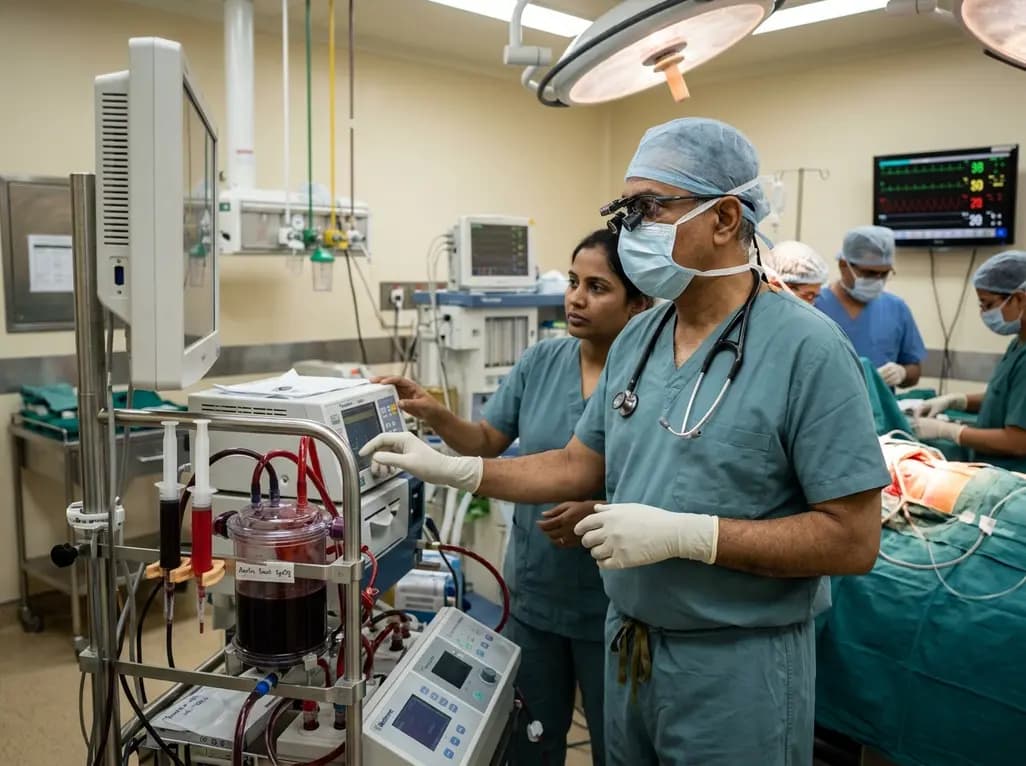
Differential oxygenation during peripheral TA-NRP can cause undetected coronary hypoxemia due to arch vessel clamping. A novel circuit with continuous aortic root monitoring detects desaturation early, facilitating left ventricular unloading and preventing allograft dysfunction and unnecessary heart discard.
Today

A randomized controlled trial compared ultrasound-guided intra-articular injections of PRP, hydrolyzed type I collagen, and hyaluronic acid in knee osteoarthritis. All therapies demonstrated significant improvements in WOMAC and pain scores at six months, supporting hydrolyzed collagen as a viable biological option.
Today

A scoping review evaluates 116 studies on AI in women's reproductive health, finding that 83.6% carry high risk of bias. While ensemble models show promise, disparities and lack of validation hinder LMIC deployment.
Today
