.webp&w=384&q=75)

Loading, please wait...
Loading, please wait...

Myelodysplastic syndromes (MDS) represent a complex group of bone marrow disorders requiring precise genomic evaluation. Because genetic markers influence therapeutic choices, TP53 mutation analysis has become a standard requirement in clinical hematology. Currently, most diagnostic centers rely on short-read sequencing (SRS) to identify these critical mutations. However, SRS platforms often struggle to provide a complete picture of the genetic landscape. Consequently, medical experts are increasingly looking toward long-read sequencing (LRS) to resolve these diagnostic gaps.
The primary challenge in MDS involves distinguishing between monoallelic and biallelic TP53 alterations. Recent data suggests that only the "multi-hit" or biallelic state confers a truly dismal prognosis. Short-read platforms frequently fail to determine whether two different mutations occur on the same chromosome or separate ones. In contrast, long-read sequencing allows for direct phasing of variants. This technology provides clarity by spanning large genomic regions in a single read. Furthermore, LRS improves the detection of complex structural variations and large deletions that often accompany TP53 dysfunction.
Accurate TP53 mutation analysis significantly impacts risk stratification and transplant eligibility. For example, patients with a single-hit mutation may achieve outcomes similar to wild-type cases. Therefore, identifying these patients helps avoid overly aggressive treatments. Additionally, long-read technologies help clinicians monitor clonal evolution during follow-up. Because TP53-mutant clones often drive disease progression, early detection of these changes is vital. Similarly, modern sequencing methods allow for better identification of germline predispositions, such as Li-Fraumeni syndrome. In conclusion, while SRS remains the current workhorse, the transition to LRS could revolutionize how we manage high-risk MDS.
It provides critical prognostic information. Specifically, it identifies multi-hit states that signify high resistance to standard treatments and a greater risk of leukemic transformation.
Long-read sequencing can phase mutations and detect large structural variants. This allows doctors to distinguish between single-copy loss and complex biallelic inactivation more accurately than short-read methods.
Disclaimer: This content is for informational and educational purposes only. It does not constitute medical advice, diagnosis, or treatment. Always seek the advice of a qualified healthcare provider with any questions regarding a medical condition. Refer to the latest local and national guidelines for clinical practice.
References

Read summarized clinical updates, watch expert medical content, and earn CME certifications right from your smartphone.
Open your smartphone camera to scan and install.





Analysis of TP53 mutations in MDS comparing long-read and short-read sequencing technologies for better prognostic evaluation....
6 months ago

The TREM-AB open-label pilot study evaluated a wearable passive nonlinear vibration absorber for essential tremor. The Nonlinear Energy Sink bracelet reduced clinical Fahn-Tolosa-Marin tremor scores by 32.1% and electrophysiological tremor power by 49.2% with no adverse effects reported.
Today

A population-based study of 20,928 children reveals that small vulnerable newborns face sex-divergent mental capital outcomes at ages 6-7: term SGA girls show higher behavioral difficulties and lower resilience, while preterm non-SGA boys experience increased behavioral problems.
Today
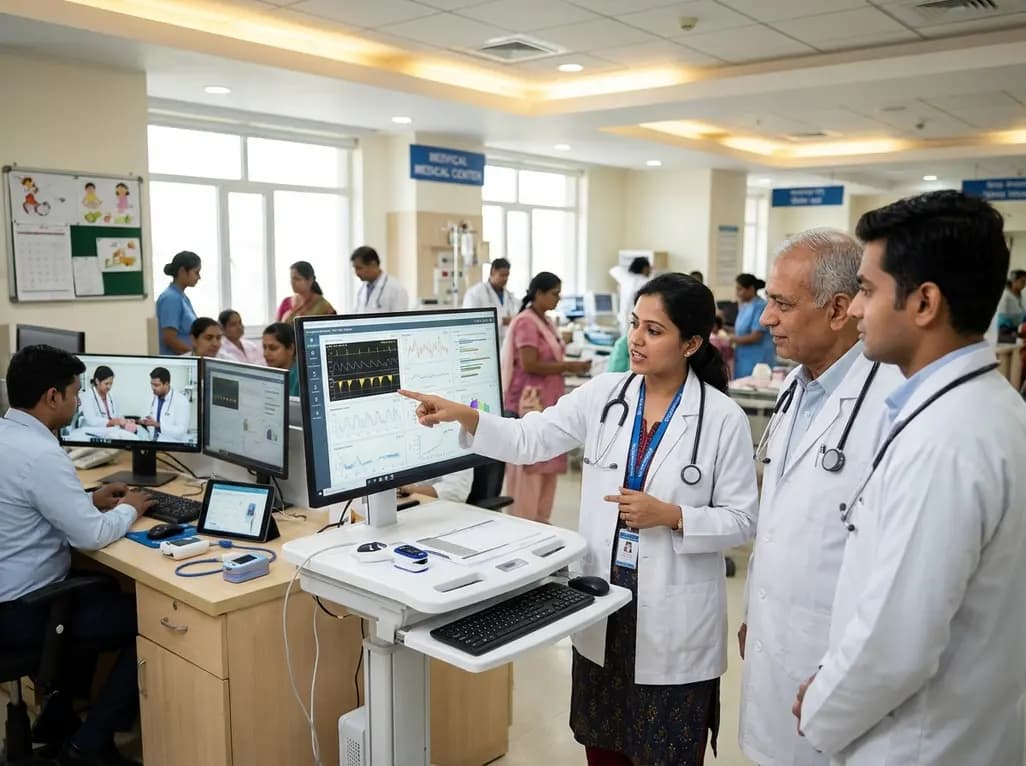
A landmark study details how an enterprise pediatric remote patient management model expanded from a single cardiology pilot to 16 diverse specialty programs by combining centralized digital operations with specialty clinical leadership.
Today

A comparative review of tension band wiring and intramedullary screw fixation in thumb metacarpophalangeal arthrodesis, evaluating union rates, hardware complications, and clinical outcomes.
Today

A breakthrough ultrathin multimodal sensor decouples physical hemodynamic monitoring from disposable electrochemical calibration, achieving long-term wearable glucose prediction with 81.36% accuracy and a 9.12% MARD. This offers a robust, drift-free solution for outpatient metabolic surveillance.
Today
