.webp&w=384&q=75)

Loading, please wait...
Loading, please wait...
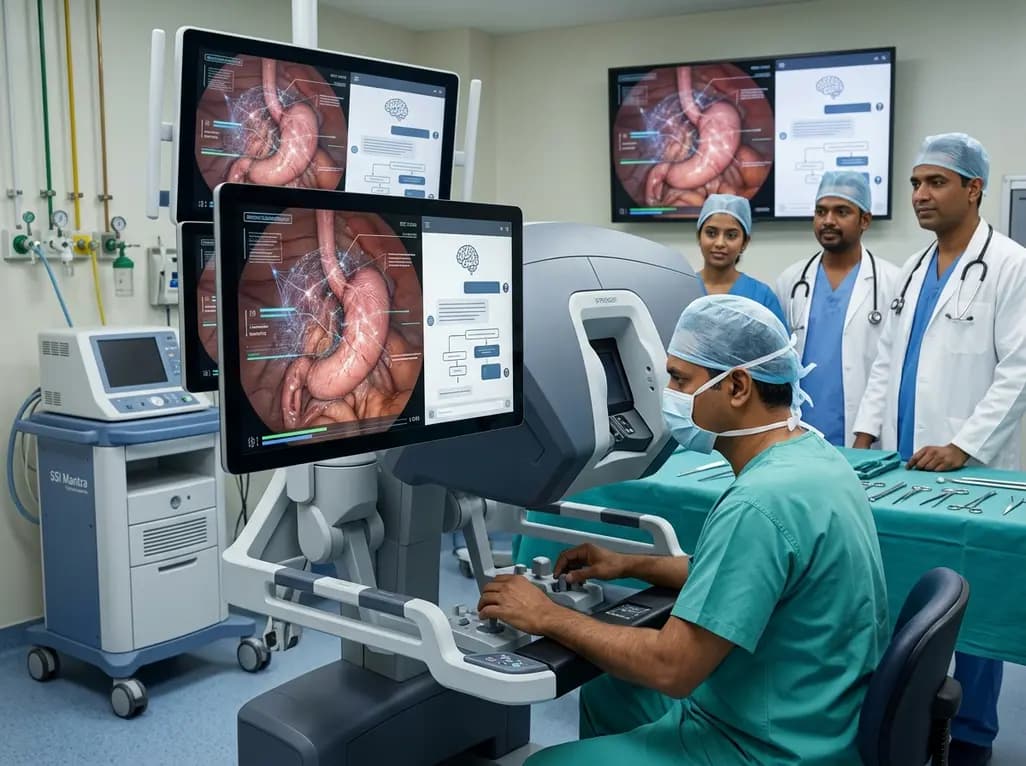
Recent breakthroughs in medical technology emphasize the power of multimodal AI. A new proof-of-concept study introduces the Surgical Vision-Language Model (Surgical-VLM) for real-time surgical support. By integrating visual and linguistic data, this model addresses the limitations of single-modality AI in robotic surgery.
Researchers analyzed 10,000 vision-question-answer pairs from 50 robotic gastrectomy cases. Consequently, they fine-tuned the model using the LLaVA framework. Furthermore, the team benchmarked the results against ChatGPT-5. The Surgical Vision-Language Model demonstrated numerically higher scores in anatomical accuracy and clinical usefulness.
The results indicate that domain-specific training significantly enhances AI performance. Specifically, Surgical-VLM achieved a benchmark score of 11.33, while ChatGPT-5 scored 10.72. Moreover, the model provides context-aware responses essential for complex surgical decisions. Therefore, surgical teams may soon benefit from specialized AI assistants during intricate procedures. However, clinicians must conduct further validation with larger datasets before integrating these tools into routine clinical practice.
The Surgical-VLM integrates visual data from surgery with linguistic reasoning. Consequently, it provides more accurate anatomical identification and clinical decision support than general-purpose AI models.
While ChatGPT-5 shows potential, this study highlights that specialized models like Surgical-VLM perform better in clinical usefulness and anatomical accuracy because they undergo domain-specific training.
Disclaimer: This content is for informational and educational purposes only. It does not constitute medical advice, diagnosis, or treatment. Always seek the advice of your physician or other qualified health provider with any questions you may have regarding a medical condition. Refer to the latest local and national guidelines for clinical practice.
References

Read summarized clinical updates, watch expert medical content, and earn CME certifications right from your smartphone.
Open your smartphone camera to scan and install.





A proof-of-concept study shows that the domain-specific Surgical-VLM outperforms ChatGPT-5 in supporting robotic gastrectomy through multimodal training....
4 months ago

Discover the crucial role of glymphatic dysfunction in stroke, where perivascular clearance failure and neuroinflammation exacerbate cerebral edema and post-stroke brain injury.
Today

A prenatal case highlights severe glutaric acidemia type II presenting as bilateral hyperechoic cystic kidneys at 18 weeks. Whole-exome sequencing revealed a novel homozygous ETFDH frameshift variant, demonstrating the power of rapid genetic testing in fetal renal anomalies.
Today

Review how tailored exercise programs benefit frail older patients with heart failure. Explore pathophysiological mechanisms, individualized training prescriptions, and strategies to overcome adherence barriers in clinical practice.
Yesterday

This comparative study evaluates posterior labral tears with and without glenohumeral instability, highlighting distinct demographic patterns, MRI underestimation in stable shoulders, and successful arthroscopic repair outcomes.
Yesterday

A clinical study demonstrates that early intervention with tocilizumab, either as monotherapy or bridged with corticosteroids, achieves significant proptosis reduction and resolves active inflammation in treatment-naive thyroid eye disease.
Yesterday
