.webp&w=384&q=75)

Loading, please wait...
Loading, please wait...
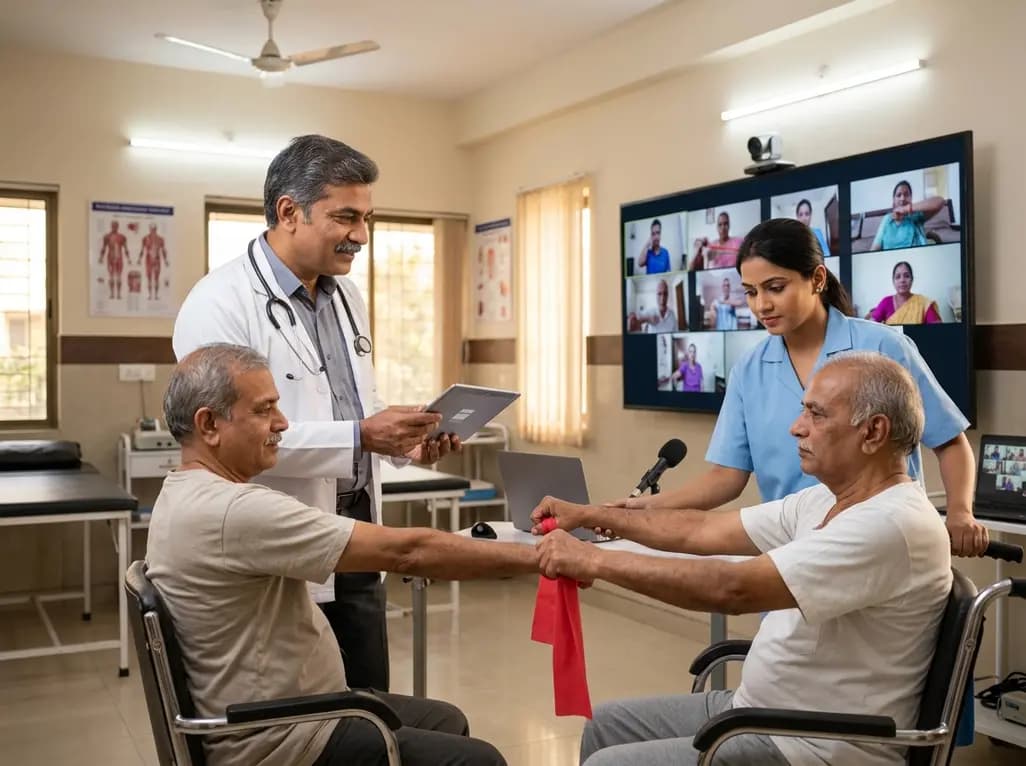
Recent clinical findings have underscored the potential of remote therapy for long-term recovery. Identifying specific stroke telerehabilitation predictors is crucial for clinicians aiming to optimize outcomes in patients with chronic impairments. A new post-hoc analysis explores how therapist-led group sessions compare to independent home exercises, focusing on physical function and psychological well-being.
The study randomized thirty-five participants into either a telerehabilitation exercise group (TEG) or a self-exercise rehabilitation group (SRG). Interestingly, the TEG participants showed significant enhancements in several key areas. Specifically, improvements were noted in the Fugl-Meyer Assessment (FMA) and the Beck Depression Inventory (BDI). Furthermore, health-related quality of life (HRQoL) scores increased notably within the group-based model. Consequently, the findings suggest that supervised, interactive digital sessions offer superior benefits over solo routines.
Understanding stroke telerehabilitation predictors allows for better patient stratification. The researchers identified baseline motor function, measured by the FMA, as a primary determinant of functional gain. Additionally, the group dynamic fostered social support, which likely contributed to the psychological improvements. Therefore, healthcare providers should consider a patient's initial physical status when prescribing these digital interventions. Moreover, the social interaction inherent in group-based models provides a protective effect against depression during the recovery process.
This evidence supports the integration of telerehabilitation into standard chronic stroke care. Because traditional in-person therapy often faces logistical hurdles, remote group programs offer a scalable solution. However, clinicians must still monitor individual progress closely. In summary, structured digital groups not only improve physical scores but also enhance overall life satisfaction for stroke survivors. Professional guidance remains the cornerstone of successful remote rehabilitation programs.
The baseline Fugl-Meyer Assessment (FMA) score is the most significant predictor of physical improvement. Patients with higher initial scores typically respond better to structured group-based telerehabilitation.
Group-based telerehabilitation provides significant advantages in both physical function and mental health. Participants in group settings often show better adherence and lower levels of depression than those exercising alone.
Yes, structured telerehabilitation has been shown to reduce depressive symptoms and improve health-related quality of life. The interactive nature of these programs helps mitigate the social isolation often felt by stroke survivors.
Disclaimer: This content is for informational and educational purposes only. It does not constitute medical advice or a professional relationship. Refer to the latest local and national guidelines for clinical practice.
References
Ro HL et al. Predictors of Functional Improvement in Patients with Chronic Stroke Participating in Group-Based Telerehabilitation: A Post-hoc Analysis of a Randomized Controlled Trial. NeuroRehabilitation. 2026 Jun 02. doi: 10.1177/10538135261455053. PMID: 42228382.
Sarfo FS, et al. Tele-rehabilitation in stroke care: A systematic review and meta-analysis. Journal of the Neurological Sciences. 2018;389:79-87.
Khan F, et al. Stroke rehabilitation: A review of the evidence for clinicians. Internal Medicine Journal. 2017;47(3):257-270.

Read summarized clinical updates, watch expert medical content, and earn CME certifications right from your smartphone.
Open your smartphone camera to scan and install.





A study identifies baseline physical function as a key predictor of recovery in chronic stroke patients participating in therapist-led group telerehabilitat...
4 months ago

Novel diimide and hydrazone scaffolds, particularly compound #C4, synergistically reactivate latent HIV-1 when combined with JQ1 or PKC activators. Demonstrating donor-matched proviral transcription ex vivo and non-canonical signaling, these findings advance shock and kill strategies toward reservoir eradication.
Today

A cross-sectional study reveals that maternal RSV vaccination coverage reached only 43.7% in Argentina, with maternal vaccine knowledge being the sole independent predictor of uptake. Clinicians play a crucial role in eliminating informational and structural barriers to optimize infant health.
Today

Review how tailored exercise programs benefit frail older patients with heart failure. Explore pathophysiological mechanisms, individualized training prescriptions, and strategies to overcome adherence barriers in clinical practice.
Yesterday

This comparative study evaluates posterior labral tears with and without glenohumeral instability, highlighting distinct demographic patterns, MRI underestimation in stable shoulders, and successful arthroscopic repair outcomes.
Yesterday

A clinical study demonstrates that early intervention with tocilizumab, either as monotherapy or bridged with corticosteroids, achieves significant proptosis reduction and resolves active inflammation in treatment-naive thyroid eye disease.
Yesterday
