

Loading, please wait...
Loading, please wait...

Epithelial tissues continually balance structural cohesion with dynamic cellular motility during embryonic morphogenesis, tissue renewal, and malignant progression. Recently, biophysical investigators demonstrated that stress anisotropy serves as a primary order parameter governing the critical transition between collective migration and individual detachment. By examining directional mechanical forces within living monolayers, clinicians and cancer researchers can now better understand how solitary cells escape the primary tumor architecture.
Epithelial collectives maintain tissue integrity through carefully coordinated intracellular contractions and intercellular adhesion complexes. Furthermore, migrating epithelial sheets naturally generate an internal force distribution that balances radial pulling forces against circumferential resisting stresses. This directional tension imbalance defines the fundamental state of stress anisotropy. Historically, oncologists and cell biologists assumed that changes in absolute force magnitude drove individual cell detachment. However, advanced biomechanical profiling demonstrates that the overall magnitude of cellular force remains essentially unchanged during detachment events. Instead, the loss of directional stress alignment specifically triggers the collective-to-solitary transition. When cells maintain elevated anisotropic stress, they preserve coordinated movement and form cohesive multicellular fingers. Conversely, when local tissue regions experience mechanical decoherence, directional tension abruptly collapses. Consequently, individual cells at the leading edge lose mechanical coupling with their neighbors. Ultimately, this localized mechanical failure directly precipitates solitary cell escape, providing a purely physical mechanism for initial tissue dissemination.
To uncover the physical forces regulating epithelial dynamics, researchers utilized traction force microscopy alongside monolayer stress microscopy. These cutting-edge optical modalities construct high-resolution spatiotemporal maps of the mechanical stress tensor across expanding monolayers. Specifically, traction force microscopy measures the microscopic deformations that cells exert on underlying extracellular substrates. Meanwhile, monolayer stress microscopy calculates the internal tension transmitted directly through cell-cell junctions. Through these combined approaches, scientists tracked prospective dissemination sites before any morphological changes became microscopically visible. Notably, cells at prospective escape zones initially build up anisotropic stress as protrusions form. However, this directional tension rapidly collapses immediately prior to overt solitary escape. In striking contrast, advancing multicellular fingers sustain high stress anisotropy throughout their collective migration. Therefore, these spatial maps prove that mechanical changes precede biological detachment. These non-invasive biophysical tools offer unprecedented insight into the early physical triggers that drive cancer cell invasion long before conventional histopathological detection.
At the molecular level, classical cadherins mediate the physical links that stabilize epithelial monolayers against mechanical distortion. In particular, P-cadherin plays an indispensable role in preserving stress anisotropy across cohesive cell sheets. Experimental investigations demonstrate that P-cadherin localizes strongly to intercellular junctions where tensile forces concentrate during collective expansion. In addition, normal P-cadherin expression stabilizes the anisotropic stress state, thereby ensuring mechanical coherence and sustained collective motion. However, genetic depletion or functional inhibition of P-cadherin abruptly disrupts this anisotropic stress distribution. As a result, the monolayer experiences widespread mechanical decoherence, which dramatically increases the frequency of solitary cell escape. Interestingly, cells devoid of P-cadherin fail to sustain collective fingering structures, displaying scattered single-cell migration instead. These findings firmly implicate P-cadherin as a molecular stabilizer of tissue stress coherence. Consequently, evaluating P-cadherin expression alongside physical stress states deepens our understanding of epithelial architecture and malignant tissue breakdown.
The transition from collective epithelial movement to solitary cell dissemination represents a pivotal milestone in malignant progression. While collective invasion allows tumor clusters to invade local stroma, solitary cells possess distinct advantages during hematogenous dissemination. Specifically, solitary circulating tumor cells can squeeze through tight capillary networks and seed distant organs with remarkable efficiency. Pathologists have long recognized that poorly differentiated carcinomas frequently display scattered individual cells rather than cohesive glands. Because stress decoherence precedes overt cellular escape, this mechanical transition may serve as an early biophysical biomarker of metastatic risk. Furthermore, understanding the loss of stress anisotropy helps explain why certain tumor margins exhibit aggressive solitary budding. Therefore, integrating mechanobiology into modern oncological pathology may improve our ability to predict metastatic velocity. Identifying primary tumors with unstable stress fields could alert clinical teams to submicroscopic dissemination before conventional staging modalities detect distant metastases.
Unraveling the mechanical parameters of epithelial dissemination unlocks exciting avenues for therapeutic intervention. Historically, pharmacological development in oncology focused almost exclusively on biochemical signaling cascades and genetic mutations. However, targeting the biophysical properties of tumor microenvironments represents an emerging paradigm known as mechanomedicine. For instance, therapeutic agents designed to reinforce cell adhesion complexes or preserve junctional tension could prevent the collapse of stress anisotropy. By chemically sustaining anisotropic stress states, clinicians might prevent primary carcinomas from shedding dangerous solitary clones into circulation. In addition, combining traditional chemotherapy with adhesion-stabilizing compounds could halt invasion while eradicating proliferating tumor cells. Although translating these biophysical discoveries into clinical practice requires extensive validation, the concept opens novel therapeutic possibilities. Ultimately, targeting the mechanical order parameters of epithelial tissues may transform aggressive metastatic malignancies into manageable, localized diseases.
Stress anisotropy represents the directional imbalance between radial tension and circumferential forces acting across an epithelial collective. In healthy cohesive tissues, cells actively maintain this tension gradient to coordinate collective migration and preserve structural continuity. However, when this mechanical balance breaks down, individual cells lose their physical alignment with adjacent neighbors. Consequently, this local loss of directional coherence permits single cells to detach and initiate invasive migration.
P-cadherin functions as a critical mechanical anchor within adherens junctions that reinforces directional force transmission across neighboring epithelial cells. In addition, it stabilizes tensile stress anisotropy at the migrating tissue edge, preventing premature focal detachment. When tissue levels of P-cadherin decline, the monolayer loses its cohesive mechanical stability. Therefore, cells at prospective dissemination sites shed their spatial constraints, which dramatically accelerates solitary detachment and promotes scattered cell invasion.
Solitary cell escape drives the hematogenous and lymphatic dissemination that underpins lethal tumor metastasis in diverse carcinomas. Although collective invasion allows grouped migration, solitary circulating tumor cells exhibit heightened plasticity and resistance to shear stress in blood vessels. Understanding how mechanical decoherence triggers this transition therefore enables oncologists to explore novel mechanomedicine therapies. These future interventions may pharmacologically preserve stress anisotropy, preventing metastatic spread before tumor cells enter systemic circulation.
Disclaimer: This content is for informational and educational purposes only... Refer to the latest local and national guidelines for clinical practice.
References
Cho Y et al. Local Decoherence of Stress Anisotropy Triggers Solitary Cell Escape From Epithelial Collectives. Adv Healthc Mater. 2026 Nov 25. doi: undefined. PMID: 43086188.
Friedl P, Gilmour D. Collective cell migration in morphogenesis, regeneration and cancer. Nat Rev Mol Cell Biol. 2009;10(7):445-457.
Trepat X, Sahai E. Mechanisms of cell migration in health and disease. Nat Rev Mol Cell Biol. 2018;19(11):675-676.

Read summarized clinical updates, watch expert medical content, and earn CME certifications right from your smartphone.
Open your smartphone camera to scan and install.





Researchers have identified stress anisotropy as a fundamental mechanical parameter governing solitary cell escape from epithelial sheets. Stabilized by P-cadherin, the loss of directional stress coherence triggers individual dissemination, providing fresh biomechanical targets for halting cancer metastasis.
Today
A massive external validation cohort of 137,149 symptomatic patients confirms that the COLOFIT risk prediction model outperforms FIT alone (c-statistic 0.90 vs 0.88), reducing urgent colonoscopy referrals by nearly 20% while identifying high-risk colorectal cancers.
Today

A 20-year population study reveals a 45% decline in non-ambulatory cerebral palsy, driven largely by significant reductions in term hypoxic-ischaemic encephalopathy cases. Explore the causal pathways, perinatal advances, and clinical implications for maternal-neonatal healthcare.
Today

Researchers have engineered a gecko-inspired microfibrillar patch featuring embedded flexible conductors and a compliant terminating film. Under minimal preload, it provides robust, reusable skin adhesion without the epidermal trauma, pain, or dermatitis caused by traditional medical adhesives.
Today
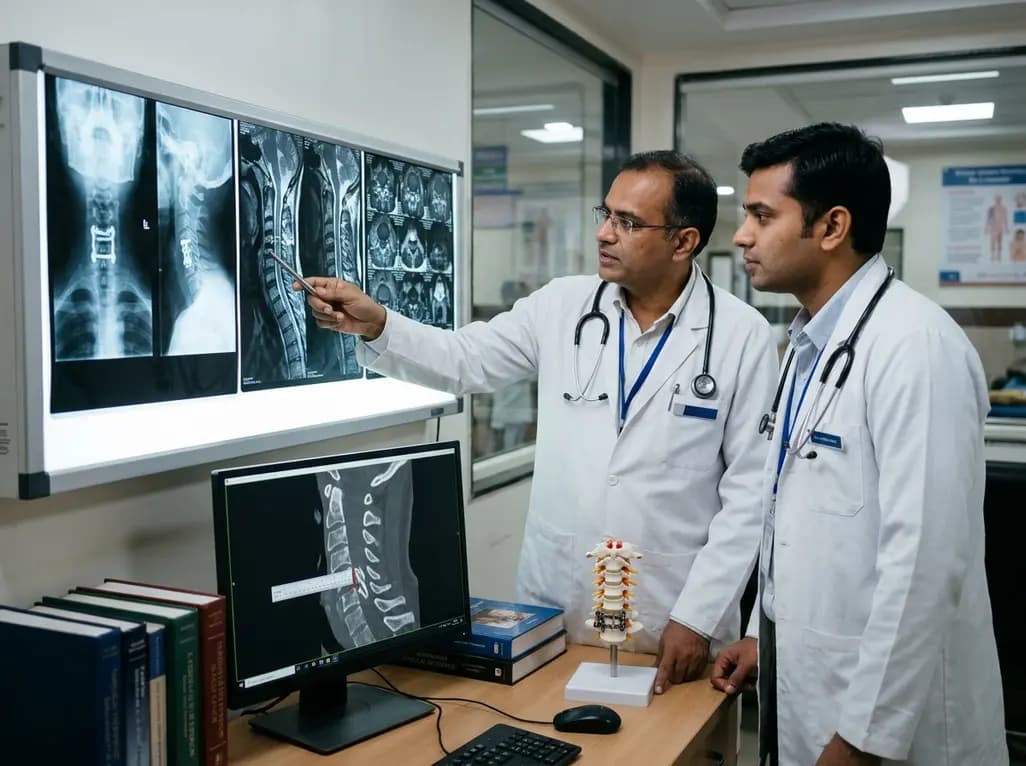
A retrospective study identifies C6 canal diameter and C3 cord-canal ratio as key predictors of secondary single-door laminoplasty after anterior cervical surgery, with progressive adjacent segment disease as the primary cause.
Today

A critical appraisal using AMSTAR 2 reveals that meta-analyses on exercise interventions for gestational diabetes have critically low methodological quality, urging cautious clinical interpretation.
Today
