.webp&w=384&q=75)

Loading, please wait...
Loading, please wait...

Motor recovery after cerebrovascular events presents significant challenges for neurorehabilitation specialists worldwide. Although clinicians frequently explore noninvasive brain stimulation, applying repetitive TMS in stroke patients has historically yielded variable therapeutic outcomes. The central issue stems from a lack of patient stratification based on surviving neural reserves. The exploratory START crossover trial offers vital clarity. By evaluating structural connectivity and clinical severity, the investigators demonstrated that baseline functional reserve dictates which cortical targets produce meaningful motor gains. Consequently, personalized stimulation targets are necessary to replace conventional uniform neuromodulation protocols in chronic motor deficit management.
Conventional rehabilitation strategies frequently rely on the interhemispheric competition model. According to this framework, stroke suppresses excitability in the ipsilesional hemisphere while unleashing excessive contralesional motor inhibition. Therefore, clinicians often attempt to suppress contralesional primary motor cortex activity to restore interhemispheric balance. However, this model breaks down when patients experience severe subcortical corticospinal tract disruption. When primary efferent tracts suffer profound destruction, surviving contralesional cortices must actively support paretic limb function through alternative pathways. This neuroarchitectural reality forms the core of the bimodal balance recovery theory. Specifically, the framework asserts that intact structural reserve determines whether contralesional networks exert maladaptive interference or beneficial motor assistance. For patients with high residual corticospinal integrity, contralesional primary motor inputs act as maladaptive interhemispheric brakes. Conversely, when structural reserve falls below a critical biological threshold, secondary non-primary motor regions, such as the contralesional dorsal premotor cortex, compensate directly for damaged motor pathways. Consequently, suppressing non-primary motor areas in severely disabled survivors impairs motor performance instead of improving functional execution. Understanding this vital dichotomy allows clinicians to tailor noninvasive stimulation accurately.
To resolve clinical ambiguity, investigators developed the Stratification Algorithm for repetitive TMS (START) framework. The team evaluated twenty-four individuals with chronic stroke across three distinct intervention sessions. Participants received inhibitory 1 Hz stimulation over the contralesional primary motor cortex, facilitatory 5 Hz stimulation targeting the contralesional dorsal premotor cortex, and sham stimulation. Investigators quantified functional upper limb dexterity using kinematic reaching tasks before and after each intervention. Additionally, the researchers performed baseline neurophysiological testing, evaluating motor evoked potentials and fractional anisotropy of corticospinal tracts. Classification and regression tree analysis revealed an upper extremity Fugl-Meyer baseline threshold score of 42. This discrete cutoff accurately separated optimal responders between the two neurostimulation strategies. Specifically, the decision tree achieved 91.6 percent accuracy in predicting therapeutic response to primary motor cortex inhibition. Furthermore, the tree predicted successful response to premotor cortex facilitation with 83.3 percent accuracy. Consequently, baseline impairment provides an objective indicator to guide clinical neuromodulation selection. Clinicians can readily utilize standardized bedside functional metrics to identify appropriate physiological targets before delivering specialized transcranial stimulation.
The clinical study demonstrated divergent behavioral responses based on initial motor impairment. Participants with mild to moderate impairment, characterized by baseline scores exceeding 42, gained superior motor speed following inhibitory contralesional motor stimulation. In contrast, these mildly impaired individuals gained minimal kinematic benefit from premotor facilitation. Conversely, individuals suffering from severe motor impairment, presenting with Fugl-Meyer scores equal to or below 42, showed the exact opposite therapeutic pattern. These severely impaired participants achieved statistically significant reaching improvements following facilitatory premotor stimulation compared to sham therapy. In addition, inhibitory primary motor stimulation failed to generate meaningful motor improvements in this severely impaired subgroup. These behavioral observations demonstrate that a single stimulation approach cannot help all stroke survivors equally. Instead, therapeutic success depends entirely upon matching the specific neuromodulatory polarity and target site to residual neural pathways. Therefore, applying inhibitory primary motor stimulation to patients with severe structural injury may inadvertently impede their recovery. Neurologists must recognize that severely impaired limbs rely heavily on contralesional premotor activation for proximal reaching movements.
The START investigation identified distinctive neurophysiological biomarkers that explain these disparate clinical responses. In patients with milder motor impairment, contralesional primary motor inhibition induced substantial increases in ipsilesional motor evoked potentials. This finding confirms that dampening contralesional primary motor activity effectively relieves pathologic transcallosal inhibition, thereby unlocking residual ipsilesional cortical excitability. However, severely injured stroke survivors frequently lack recordable ipsilesional motor evoked potentials due to profound tract disruption. In this severely affected group, facilitatory premotor stimulation elicited pronounced reductions in interhemispheric inhibition. Furthermore, diffusion tensor imaging corroborated that higher fractional anisotropy of corticospinal fibers correlated directly with positive responses to primary motor inhibition. Conversely, patients exhibiting lower fractional anisotropy and absent motor evoked potentials responded preferentially to premotor facilitation. These electrophysiological and imaging findings provide robust objective evidence for the bimodal recovery model. They demonstrate that the contralesional dorsal premotor cortex assists motor output by modulating transcallosal dynamics when direct descending pathways are severed. Thus, objective neurophysiological parameters reinforce clinical stratification metrics, providing comprehensive mechanistic support for tailored neuromodulation.
These clinical findings provide clear, practical guidance for neurorehabilitation units seeking to integrate noninvasive brain stimulation. Historically, clinicians deployed uniform low-frequency stimulation across all patient cohorts, which led to mixed clinical trial outcomes. By establishing the upper extremity Fugl-Meyer threshold of 42, the START protocol offers a rapid and validated classification tool. Neurologists and physiatrists can incorporate this evaluation immediately into routine clinical triage without requiring complex functional neuroimaging tools. For patients scoring above 42, clinicians should prioritize protocols designed to downregulate contralesional primary motor excitability. For patients scoring 42 or below, teams should explore protocols targeting contralesional dorsal premotor recruitment. Moreover, clinicians must combine targeted stimulation with task-specific motor practice to consolidate synaptic plasticity. While larger multi-center randomized controlled trials remain essential to validate long-term durability, this predictive algorithm represents a substantial paradigm shift. Tailored neuromodulation moves stroke rehabilitation away from trial-and-error protocols toward precision neurotechnology. Ultimately, applying stratified stimulation strategies promises to enhance recovery potential, decrease long-term disability, and improve overall quality of life for stroke survivors.
The START framework is a clinical stratification algorithm that optimizes repetitive transcranial magnetic stimulation for stroke recovery. It uses baseline upper extremity Fugl-Meyer scores alongside corticospinal integrity measures to categorize patients. Consequently, it guides clinicians to select either contralesional primary motor inhibition or premotor facilitation to maximize motor gains.
The threshold score of 42 reliably differentiates stroke survivors based on residual structural reserve. Patients scoring above 42 benefit predominantly from inhibitory contralesional primary motor stimulation. In contrast, survivors scoring at or below 42 show superior motor recovery with facilitatory contralesional dorsal premotor stimulation, avoiding maladaptive suppression of vital compensatory networks.
When primary corticospinal pathways suffer severe structural injury, the contralesional dorsal premotor cortex assumes vicarious motor control. Facilitatory 5 Hz stimulation to this premotor area significantly reduces pathological interhemispheric inhibition and engages alternate bilateral motor tracts. Therefore, this targeted intervention enhances proximal reaching mechanics in survivors lacking functional ipsilesional motor evoked potentials.
Disclaimer: This content is for informational and educational purposes only and should not be used as a substitute for professional medical advice, diagnosis, or treatment. Always seek the advice of your physician or other qualified healthcare provider with any questions you may have regarding a medical condition. Refer to the latest local and national guidelines for clinical practice.
References

Read summarized clinical updates, watch expert medical content, and earn CME certifications right from your smartphone.
Open your smartphone camera to scan and install.





The START crossover study reveals how baseline motor impairment and corticospinal tract integrity dictate outcomes for repetitive TMS in stroke. Using a Fugl-Meyer threshold of 42, clinicians can personalize contralesional stimulation targets to improve upper extremity rehabilitation in stroke survivors.
Today
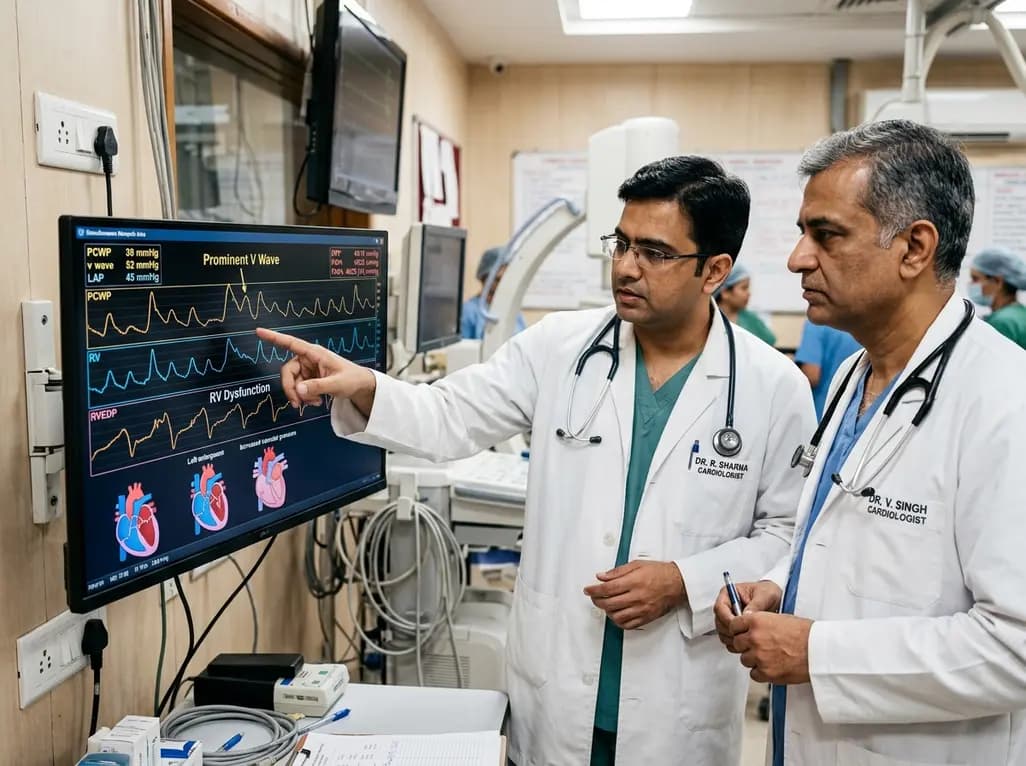
Left atrial stiffening generates prominent V waves that pressurize the pulmonary circulation and augment right ventricular afterload independently of intrinsic pulmonary vascular disease in patients with heart failure with preserved ejection fraction.
Today

A meta-analysis demonstrates that secondhand smoke exposure significantly elevates fetal loss risk by 21% among nonsmoking pregnant women. Clinicians must implement household screening and family-centered cessation interventions to prevent avoidable miscarriages and stillbirths.
Today

Preclinical validation demonstrates that a novel contact force-integrated pulsed field quantization index accurately predicts lesion depth in real time, achieving 100% durable pulmonary vein isolation without collateral injury.
Today
A new cross-sectional evaluation reveals how regional lean mass and bone mineral content interact in resistance-trained men, showing that whole-body size and allometric scaling explain shared musculoskeletal phenotypes and strength relationships.
Today

Explore the emerging role of glucose metabolic reprogramming in exercise-attenuated osteoporosis, examining how physical activity influences osteoblast glycolysis, osteoclast bioenergetics, and skeletal remodeling pathways to improve bone mineral density.
Today
