.webp&w=384&q=75)

Loading, please wait...
Loading, please wait...

KKR-backed Baby Memorial Hospital (BMH) recently announced the Star Hospitals acquisition, purchasing a 60% stake for ₹1,800 crore. This strategic move values the Hyderabad-based chain at ₹3,000 crore. Consequently, BMH continues its rapid expansion across southern India.
The transaction involves Unimed Healthcare, which is the parent company of the hospital chain. Importantly, Padma Shri recipient and cardiologist Dr. Gopichand Mannam founded Star Hospitals. KKR plans to infuse capital into BMH to facilitate this major purchase. Therefore, the deal enhances the group's regional presence significantly.
This deal represents the second major acquisition by BMH in less than a year. Previously, they acquired Meitra Hospitals in Kerala for ₹1,200 crore. Furthermore, BMH is constructing a new greenfield facility in Chennai to support organic growth. KKR aims to replicate its successful consolidation strategy previously executed with Max Healthcare. Thus, they are building a large-scale platform to potentially merge or take the entity public.
Star Hospitals operates two major facilities located in Hyderabad's prime districts. These centers compete with notable players like AIG Hospitals and Continental Hospitals. The acquisition follows interest from other major healthcare chains such as Apollo and Manipal. Ultimately, this consolidation reflects a broader trend within the Indian private healthcare sector.
Q1: What is the financial value of the Star Hospitals acquisition?
The deal is valued at ₹1,800 crore for a 60% controlling stake, which pegs the total value of Star Hospitals at ₹3,000 crore.
Q2: Which entity acquired the controlling stake in Star Hospitals?
Baby Memorial Hospital, backed by the global investment firm KKR, acquired the stake in Star Hospitals' parent company, Unimed Healthcare.
Q3: What role does KKR play in this healthcare deal?
KKR provides the necessary capital to Baby Memorial Hospital to finance acquisitions and uses the hospital as a platform for consolidating medical assets in southern India.
Disclaimer: This content is for informational and educational purposes only. It does not constitute medical advice or replace professional judgment. Refer to the latest local and national guidelines for clinical practice.
References

Read summarized clinical updates, watch expert medical content, and earn CME certifications right from your smartphone.
Open your smartphone camera to scan and install.





KKR-backed Baby Memorial Hospital acquires 60% of Star Hospitals for ₹1,800 crore, aiming to consolidate the southern Indian healthcare market....
6 months ago

Review how tailored exercise programs benefit frail older patients with heart failure. Explore pathophysiological mechanisms, individualized training prescriptions, and strategies to overcome adherence barriers in clinical practice.
Today
Recent clinical studies reveal maternal autoantibodies targeting IL-1RA as potential triggers for preterm labor, opening avenues for targeted cytokine therapies. Concurrently, new perioperative findings show inhaled cannabis increases propofol requirements during upper endoscopy compared to oral edible consumption.
Today
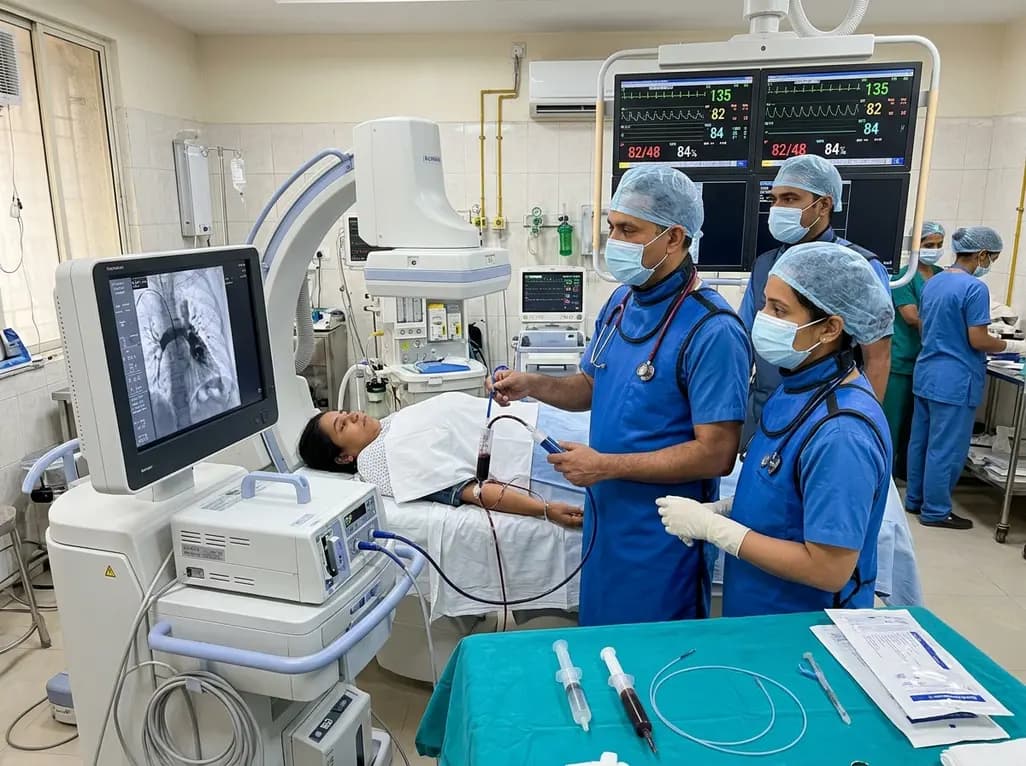
In high-risk pulmonary embolism complicated by severe anemia and active uterine bleeding, systemic thrombolysis is contraindicated. Large-bore aspiration thrombectomy provides rapid hemodynamic rescue without fibrinolysis, supported by inferior vena cava filter placement and multidisciplinary critical care.
Today

This comparative study evaluates posterior labral tears with and without glenohumeral instability, highlighting distinct demographic patterns, MRI underestimation in stable shoulders, and successful arthroscopic repair outcomes.
Today

A clinical study demonstrates that early intervention with tocilizumab, either as monotherapy or bridged with corticosteroids, achieves significant proptosis reduction and resolves active inflammation in treatment-naive thyroid eye disease.
Today
