.webp&w=384&q=75)

Loading, please wait...
Loading, please wait...

Recent research has utilized the oxDNA2 coarse-grained model to clarify the relationship between ssDNA elasticity and temperature. Scientists focused on two primary homopolymers, poly(dA) and poly(dT), to observe how they react to thermal changes. Consequently, this study provides a detailed map of how intra-strand stacking determines mechanical behavior. Understanding these properties is vital because the mechanical integrity of single-stranded DNA (ssDNA) underpins the development of modern DNA-based nanodevices and advanced molecular diagnostics.
The study found that poly(dA) is significantly stiffer than poly(dT) at lower temperatures. For instance, the persistence length of poly(dA) reached 44.8 nm at 27 °C but dropped sharply to 10.0 nm at 100 °C. Meanwhile, poly(dT) remained flexible across the entire temperature range. These macroscopic shifts closely track the loss of intra-strand stacking. Because stacking fractions decrease as heat increases, the molecules become more pliable. Therefore, researchers can now predict mechanical changes in DNA sequences used in therapeutic nanostructures more accurately.
Furthermore, the salt-aware oxDNA2 model allowed for precise measurements at 1.0 M monovalent salt. This is important because salt concentrations often fluctuate in biological environments and laboratory assays. By analyzing equilibrium observables like the radius of gyration and end-to-end distance, the team quantified how sequence-dependent stacking influences elasticity. These insights are essential for clinicians and researchers working on liquid biopsies, where the detection of short ssDNA fragments is a key metric for cancer monitoring.
In conclusion, the mechanical mapping of DNA helps bridge the gap between biophysical theory and clinical application. As nanomedicine continues to evolve in India and globally, these foundational data will guide the engineering of more stable and effective DNA-based tools.
Increasing temperature generally decreases the stiffness of ssDNA, particularly in adenine-rich sequences, by disrupting the base stacking that provides structural rigidity.
Poly(dA) exhibits much stronger intra-strand stacking at low temperatures compared to poly(dT), which remains relatively flexible and weakly stacked across a wide temperature range.
Research into ssDNA elasticity and temperature is crucial for improving the precision of DNA-based drug delivery systems, CRISPR-Cas gene editing templates, and the sensitivity of cancer liquid biopsy assays.
Disclaimer: This content is for informational and educational purposes only. It is not intended to provide medical advice or to be a substitute for professional medical advice, diagnosis, or treatment. Always seek the advice of your physician or other qualified health provider with any questions you may have regarding a medical condition. Refer to the latest local and national guidelines for clinical practice.
References
Igwe IE et al. Mechanistic mapping of temperature-dependent ssDNA elasticity with oxDNA2 coarse-grained model. Eur Phys J E Soft Matter. 2026 Apr 12. doi: undefined. PMID: 41966679.
Rico-Pasto M, Ritort F. Temperature-dependent elastic properties of DNA. Small Biosystems Lab. 2022 Sep 14. doi: 10.1093/nar/gkac735.
Challener CA. Leveraging the Therapeutic Potential of Single-Stranded DNA. Pharma's Almanac. 2025 Jul 23.

Read summarized clinical updates, watch expert medical content, and earn CME certifications right from your smartphone.
Open your smartphone camera to scan and install.





A new study using the oxDNA2 model reveals how temperature and base stacking determine the elasticity of single-stranded DNA, aiding nanodevice development....
6 months ago

Following regulatory scrutiny from FSSAI regarding promotional representations and lean muscle preservation claims, Dr. Reddy's Laboratories and Nestlé Health Science are currently reviewing the branding and marketing strategy for their joint nutritional supplement Celevida GLP+.
Today

Demanding exhaustive hormonal profiling can inadvertently discourage clinical studies involving females. Methodological standards must align with the specific scientific question to expand, not restrict, equitable evidence for women.
Today

The Directorate General of Health Services directs Indian states to halt the hazardous reuse and reprocessing of single-use medical devices. Discover regulatory implications under the Drugs and Cosmetics Act, critical infection risks, legal liabilities, and operational changes required across clinical specialties.
Today
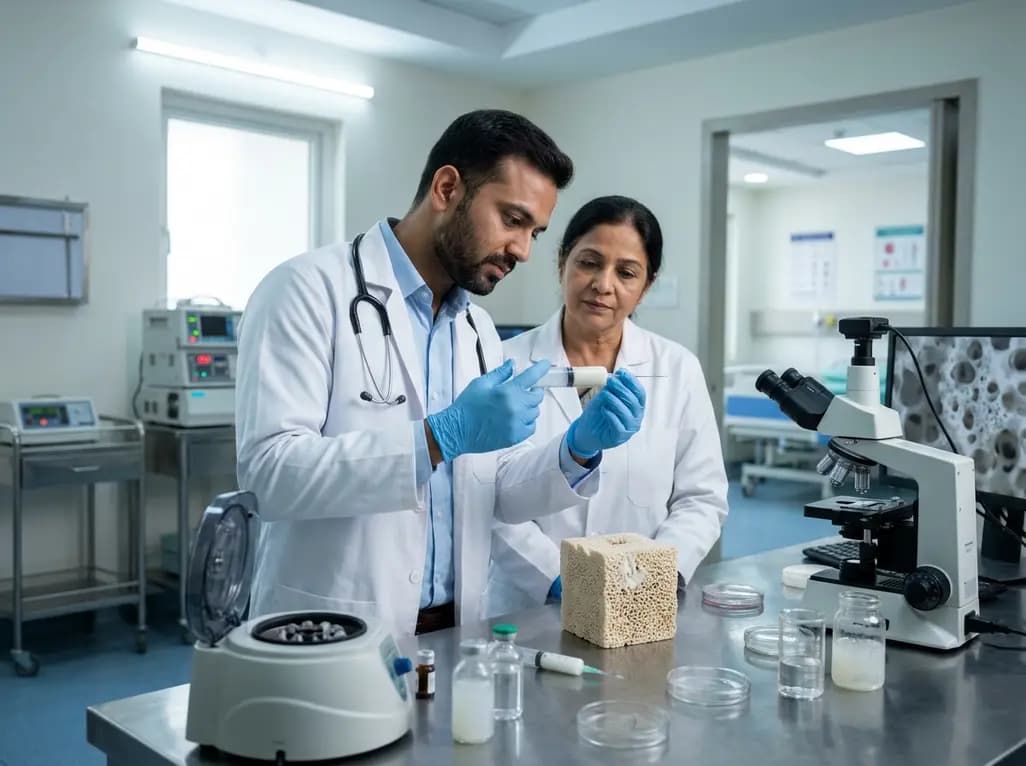
A novel calcium polyphosphate coacervate enables injectable bone implants with in situ hierarchical porosity via phase separation and gas foaming, significantly enhancing cell proliferation, energy metabolism, and osteogenic differentiation for minimally invasive bone defect repair.
Today

India is advancing preventive healthcare by integrating genomics, artificial intelligence, and quantum technologies. With the SANGAM programme sequencing one million Indian genomes, clinicians can unlock personalized therapies, detect cardiometabolic risks early, and curb the burden of diabetes and heart disease.
Today
