

Loading, please wait...
Loading, please wait...

Sleep disturbances frequently accompany acute psychiatric illness, acting as both an indicator and a driver of clinical destabilization. Consequently, mental health teams increasingly explore artificial intelligence and biomonitoring to optimize care. However, deploying sleep sensing in psychiatry involves unique environmental and ethical hurdles that outpatient clinics never encounter. Acute psychiatric facilities demand strict physical safety protocols and minimize patient encumbrance. Therefore, experts urge clinicians to prioritize intentional sufficiency over raw device capability when monitoring inpatient sleep patterns.
Acute psychiatric wards enforce strict environmental safeguards to prevent intentional self-harm and accidental injury. Consequently, conventional consumer wearables present severe hazards in these spaces. Cords, wristbands, and rigid clasps create obvious ligature risks that ward protocols prohibit. In addition, patients may ingest small batteries, sensors, or detached plastic casings. Severely agitated individuals can also use heavy electronic hardware as dangerous projectiles.
Beyond physical danger, operational realities severely limit device compliance. For example, patients experiencing acute psychosis or mania often struggle with cognitive capacity and voluntary adherence. Furthermore, distress can cause individuals to remove or destroy uncomfortable sensors. Thus, a device that performs perfectly on cooperative outpatients often fails when an inpatient becomes critically ill.
Moreover, acute wards operate under intense nursing workloads. Asking staff to charge, calibrate, and retrieve delicate electronic gadgets introduces unacceptable friction into emergency psychiatric care. Consequently, sensor design must fit existing ward realities rather than burdening frontline nurses.
The intentional sufficiency framework offers a practical design rule for acute mental health environments. Rather than maximizing technical capability, this principle identifies the minimum information necessary to guide clinical decisions. Therefore, teams establish acceptable error thresholds before choosing specific hardware or algorithms.
First, the intended clinical objective defines the required signal properties. For instance, evaluating basic response to mood stabilizers requires total nightly sleep duration rather than complex sleep architecture. Second, environmental boundaries dictate the feasible design space. These boundaries include physical ward safety, legal consent standards, and sustainable nursing workflows. Third, within this feasible space, the framework selects the least burdensome monitoring option.
Importantly, engineers frequently assume that adding more physiological sensors produces better clinical outcomes. However, unnecessary complexity often reduces device persistence. When patients reject intrusive multisensor wearables, clinicians lose continuous data entirely. By eliminating extraneous features, designers preserve patient comfort and operational reliability. Thus, intentional sufficiency protects longitudinal monitoring by rejecting needless technological overreach.
To understand intentional sufficiency, clinicians can compare two contrasting monitoring paradigms. The first approach relies on structured nocturnal sleep duration charting completed by psychiatric nurses during standard rounds. In many healthcare systems, such as inpatient units in Taiwan, routine nursing records already capture gross sleep intervals. When researchers examine these routine records, they find that existing documentation often satisfies core diagnostic needs. Therefore, healthcare systems should avoid adding costly electronic hardware when routine observations already supply sufficient clinical information.
In contrast, the second paradigm redesigns hardware specifically for acute environments. For example, researchers are developing disposable, wrist-worn sensors engineered solely to track gross rest-activity patterns. These devices omit fragile charging ports, expensive microprocessors, and battery configurations that pose ingestion hazards. Furthermore, disposable construction eliminates time-consuming disinfection protocols between admissions.
Nonetheless, technical validation requires task-level clinical proof. Demonstrating that a device agrees with laboratory polysomnography in controlled settings does not establish practical ward utility. Instead, devices must function reliably within turbulent acute psychiatric routines.
Implementing biomonitoring on acute wards requires an optimal balance between signal validity and sensor persistence. In clinical sensing, persistence measures whether a patient continuously wears a monitor throughout the hospitalization period. Bulky devices with rigid enclosures and tight skin straps often feel claustrophobic or intrusive to distressed patients. Consequently, adherence drops sharply during acute exacerbations, creating severe data gaps during the most critical clinical moments.
Furthermore, clinicians must recognize that some signal properties define diagnostic validity and cannot be sacrificed. Validated actigraphy algorithms and precise movement timestamps provide indispensable information for psychiatric evaluation. Therefore, engineers cannot compromise these fundamental properties simply to reduce hardware costs.
However, auxiliary features like electrodermal activity or frequent optical measurements add fragility without enhancing routine psychiatric management. By selecting streamlined monitoring tools, clinical teams minimize sensory discomfort and reduce ligature opportunities. Meanwhile, nurses can focus on therapeutic patient engagement rather than troubleshooting malfunctioning devices. Ultimately, intentional sufficiency ensures continuous data collection without endangering patient safety.
Adopting intentional sufficiency reshapes how healthcare leaders implement digital health innovations in psychiatric facilities. Across public and private hospitals, including inpatient mental health centers in India, clinical units face high patient volumes and limited staffing. Consequently, administrators must carefully evaluate expensive biometric platforms before deployment. Clinicians should first audit existing nursing observation workflows to determine whether standard charting meets monitoring requirements without new capital investments.
Additionally, multidisciplinary teams must conduct comprehensive safety assessments before introducing any novel hardware into acute psychiatric environments. Psychiatrists, nursing managers, and patient safety officers must verify that sensors present zero ligature, ingestion, or projectile hazards. Furthermore, institutions must maintain clear ethical frameworks governing patient assent, surrogate consent, and private health data security.
Finally, biomedical engineers must collaborate directly with frontline healthcare workers when creating psychiatric sensing technologies. By prioritizing nursing workflow integration and patient comfort, hospitals achieve sustainable digital monitoring. Rather than chasing unnecessary technical complexity, psychiatric departments should embrace intentional sufficiency to deliver safer, patient-centered care.
Intentional sufficiency prompts clinicians to identify the minimum necessary data required for clinical decision-making before purchasing technology. Instead of selecting devices with the highest technical specifications, healthcare teams evaluate ward safety, consent capacity, and nursing workflow. Consequently, this approach favors simple, non-intrusive monitoring tools or optimized routine records that minimize patient burden, reduce ligature risks, and ensure reliable longitudinal data collection during acute hospitalization.
Consumer smartwatches and fitness bands feature rigid casings, long charging cords, and detachable straps that pose severe ligature, ingestion, and projectile hazards in acute psychiatry. Additionally, acutely unwell or agitated patients frequently refuse to wear intrusive gadgets or remember to charge them. Consequently, these commercial devices suffer from poor persistence and adherence, failing to provide reliable data when patients experience peak clinical symptoms.
Yes, structured nocturnal observations conducted by nurses often provide adequate clinical information for tracking gross sleep duration and circadian disruption. When routine observation protocols are validated against clinical objectives, they deliver sufficient insight to evaluate treatment responses without adding expensive hardware. Therefore, intentional sufficiency recommends verifying the utility of existing clinical documentation before introducing complex electronic devices into acute psychiatric units.
Disclaimer: This content is for informational and educational purposes only. It is not intended to be a substitute for professional medical advice, diagnosis, or treatment. Always seek the advice of your physician or another qualified healthcare provider with any questions you may have regarding a medical condition or treatment. Refer to the latest local and national guidelines for clinical practice.
References

Read summarized clinical updates, watch expert medical content, and earn CME certifications right from your smartphone.
Open your smartphone camera to scan and install.





Intentional sufficiency prioritizes ward safety, patient compliance, and clinical utility over complex AI in acute inpatient psychiatry sleep sensing, ensuring practical, least-burdensome digital monitoring.
Today
A clinical decision-support framework using health checkup data from 231,683 adults predicts incident obesity with high discrimination (AUROC 0.918). The system integrates temporal survival analysis and risk-factor explanations to prioritize individualized preventive interventions.
Today

A large cohort study demonstrates that fetal growth restriction in a first pregnancy raises maternal cardiovascular risk within five years postpartum, including elevated rates of heart failure, stroke, and myocardial infarction. Clinicians must initiate proactive postpartum screening and cardiovascular prevention.
Yesterday
A multicenter observational study evaluated an 8-week digital health monitoring platform using wearable sensors in ambulatory heart failure. While participants achieved high daily wear-time of 11.7 hours and 80% completion, initial recruitment revealed significant technology-related onboarding barriers.
Today

A paired cadaveric study compared triple and quintuple percutaneous Achilles tendon lengthening. While quintuple hemisection showed numerically greater elongation, differences were not statistically significant.
Yesterday
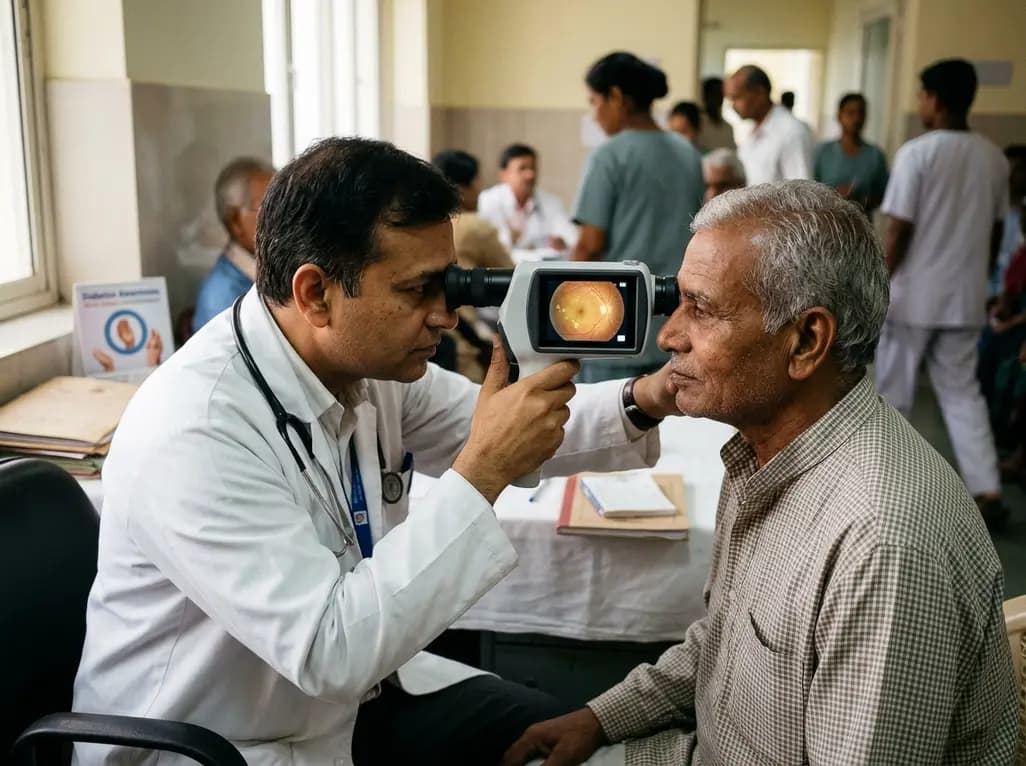
Diabetic retinopathy remains a leading cause of preventable visual impairment. This review outlines key strategies for screening, systemic risk factor control, advanced diagnostic imaging, and timely specialist referrals within primary and multidisciplinary care models.
Today
