.webp&w=384&q=75)

Loading, please wait...
Loading, please wait...

Clinicians often face a significant hurdle when evaluating workers exposed to silica. A recent study by Leite GW et al. highlights how silicosarcoidosis diagnosis remains a complex task due to overlapping clinical and radiologic features. Many workers present with similar symptoms. This makes distinguishing between silicosis and sarcoidosis particularly difficult for the treating physician.
The researchers followed 12 workers over a minimum of 12 months. They utilized high-resolution computed tomography (HRCT) and pulmonary function tests to monitor disease progression. Surprisingly, only three patients had classic silicosis. Five individuals received a sarcoidosis diagnosis. Meanwhile, four were classified under the new entity of silicosarcoidosis.
To improve diagnostic outcomes, physicians must integrate multiple evaluation tools. Although HRCT findings often overlap, specific perilymphatic nodule distributions usually suggest sarcoidosis. In contrast, silicosis typically displays centrilobular or subpleural nodules. Histopathology remains essential for confirmation. However, the study notes that smaller transbronchial biopsies might miss subtle fibrotic changes seen in larger samples.
Furthermore, longitudinal follow-up is vital for observing functional trajectories. Patients with sarcoidosis often show better responses to corticosteroid therapy compared to those with classic silicosis. Consequently, a systematic approach involving occupational history and serial imaging is necessary. This integration supports more appropriate therapeutic decisions for affected workers.
Silicosis typically presents with centrilobular or random nodules, whereas sarcoidosis often shows a perilymphatic distribution along bronchovascular bundles and fissures. However, both can feature hilar lymphadenopathy and fibrosis, leading to diagnostic confusion.
Silicosarcoidosis describes cases in workers with significant silica exposure who exhibit overlapping clinical, radiologic, and histopathologic features of both silicosis and sarcoidosis. It often involves mixed granulomatous and fibrotic patterns.
Serial evaluations help track functional trajectories and responses to treatment. For instance, sarcoidosis-related lesions may respond to steroids, while silicotic fibrosis is typically irreversible and progressive despite immunosuppression.
Disclaimer: This content is for informational and educational purposes only. It does not constitute medical advice or a professional relationship. Always seek the advice of a qualified healthcare provider regarding any medical condition. Refer to the latest local and national guidelines for clinical practice.
References
1. Leite GW et al. Silicosis, Sarcoidosis, and Silicosarcoidosis Are Overlapping Diagnoses and Difficult to Differentiate. Am J Ind Med. 2026 Feb 15. doi: 10.1002/ajim.70063. PMID: 41691440.
2. Hua J, et al. Silicosarcoidosis: a distinct occupational lung disease in workers exposed to respirable crystalline silica. Am J Ind Med. 2025;68(5):342-351.
3. Crouser ED, et al. Diagnosis and Detection of Sarcoidosis. An Official American Thoracic Society Clinical Practice Guideline. Am J Respir Crit Care Med. 2020;201(8):e26-e51.

Read summarized clinical updates, watch expert medical content, and earn CME certifications right from your smartphone.
Open your smartphone camera to scan and install.





New study highlights challenges in differentiating silicosis and sarcoidosis, introducing 'silicosarcoidosis' as a distinct overlap diagnosis for clinicians...
8 months ago
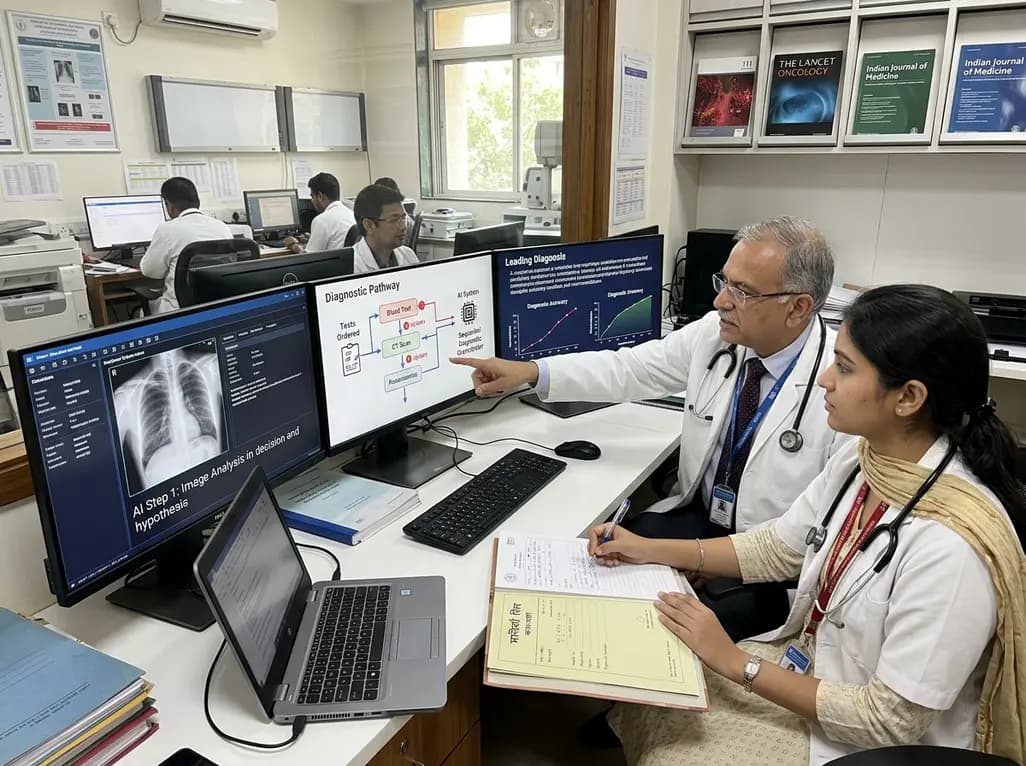
A breakthrough peer-reviewed study demonstrates that a sequential AI diagnosis system can mirror real-world clinical reasoning. By ordering stepwise tests and updating hypotheses dynamically, this multi-agent orchestrator achieved superior diagnostic accuracy while reducing investigative costs.
Today

A prenatal case highlights severe glutaric acidemia type II presenting as bilateral hyperechoic cystic kidneys at 18 weeks. Whole-exome sequencing revealed a novel homozygous ETFDH frameshift variant, demonstrating the power of rapid genetic testing in fetal renal anomalies.
Today

Review how tailored exercise programs benefit frail older patients with heart failure. Explore pathophysiological mechanisms, individualized training prescriptions, and strategies to overcome adherence barriers in clinical practice.
Yesterday

This comparative study evaluates posterior labral tears with and without glenohumeral instability, highlighting distinct demographic patterns, MRI underestimation in stable shoulders, and successful arthroscopic repair outcomes.
Yesterday

A clinical study demonstrates that early intervention with tocilizumab, either as monotherapy or bridged with corticosteroids, achieves significant proptosis reduction and resolves active inflammation in treatment-naive thyroid eye disease.
Yesterday
