.webp&w=384&q=75)

Loading, please wait...
Loading, please wait...
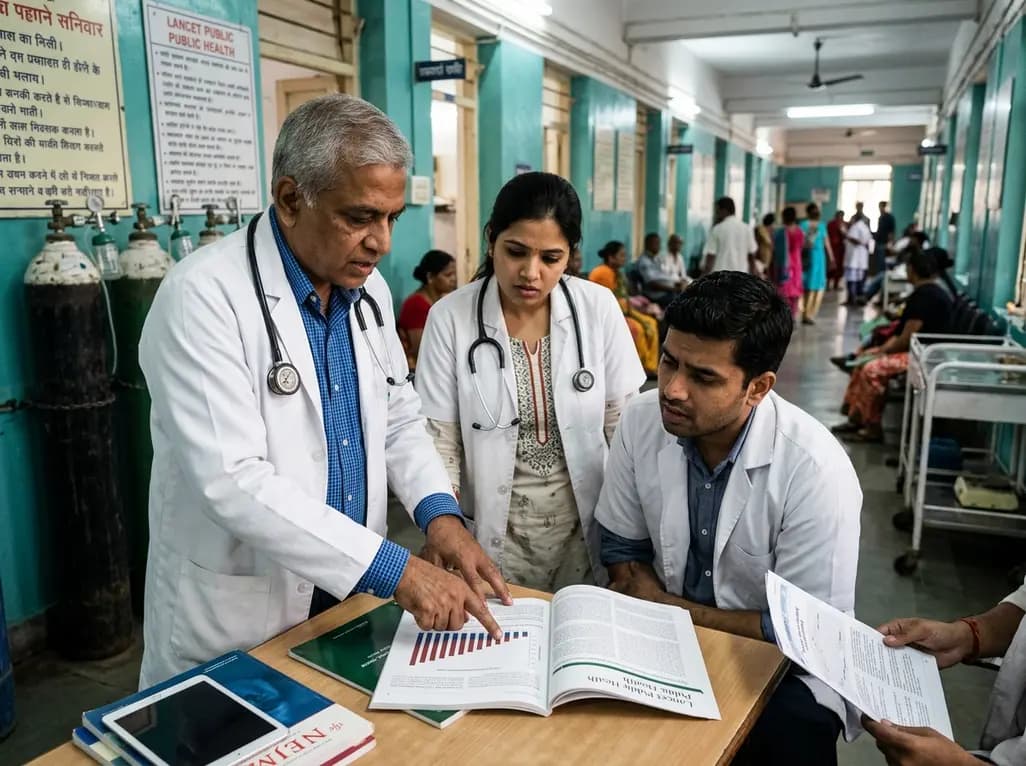
Exposure to environmental tobacco smoke represents an escalating clinical crisis across South Asia. A comprehensive study published in The Lancet Public Health reveals that passive smoking deaths in India surged by nearly 50 percent between 1990 and 2023. Consequently, healthcare providers face an immense public health challenge requiring immediate clinical attention, structured screening, and aggressive community preventive interventions.
Over the past three decades, India witnessed a paradox in tobacco epidemiology. Specifically, the age-standardised exposure prevalence to second-hand smoke dropped from 43.2% in 1990 to 30.6% in 2023. However, rapid population expansion caused the absolute number of exposed individuals to jump from 375 million to 444 million. This dramatic 18.4% increase created a massive pool of susceptible non-smokers across urban and rural communities.
Consequently, passive smoking deaths soared from 217,700 in 1990 to an alarming 325,600 in 2023 alone. India now ranks second globally in total second-hand smoke exposure, trailing only behind China. In addition, the country lost approximately 9.28 million disability-adjusted life-years in 2023 due to involuntary tobacco inhalation. These figures represent healthy years stolen by premature death, prolonged illness, and chronic debilitation. Globally, 2.71 billion people endured passive exposure in 2023, causing 1.66 million fatalities. China, India, and Indonesia together shoulder nearly half of the entire global burden. Therefore, Indian physicians must recognize that declining smoking percentages do not equate to reduced clinical vulnerability in the general population. Active exposure control remains urgent.
Second-hand smoke exerts an unequal toll across demographic groups, with women and children bearing the heaviest clinical consequences. During the study period, annual fatalities among Indian women rose from 113,400 to 156,900. Similarly, male deaths climbed from 104,300 to 168,700. While both genders suffer substantial mortality, cultural factors frequently trap women and young children in enclosed domestic spaces where male relatives smoke.
Moreover, pediatric patients suffer catastrophic respiratory injury from passive inhalation. As Dr. G. C. Khilnani from PSRI Hospital noted, children possess developing lung architecture that heightens their susceptibility to toxic aerosols. In fact, lower respiratory infections represent the single largest contributor to the disease burden among exposed youngsters. Inhaling sidestream smoke impairs developing bronchial epithelium, weakens ciliary clearance, and precipitates severe recurrent infections. Furthermore, infants exposed to passive smoke face heightened risks of sudden infant death syndrome and persistent wheezing disorders. Consequently, family physicians and pediatricians must routinely interrogate caregivers regarding household smoking habits. Clinicians cannot successfully manage pediatric recurrent bronchitis or severe asthma without completely eliminating domestic tobacco smoke exposure. Protecting these vulnerable cohorts demands vigorous household-level counseling.
Non-smokers often believe that passive exposure carries negligible systemic danger, but molecular evidence refutes this misconception. Sidestream smoke contains unfiltered toxins that enter the bloodstream with higher concentrations of specific carcinogens than mainstream smoke. Consequently, the Lancet study links second-hand smoke directly to ischaemic heart disease, cerebrovascular stroke, and lung cancer. Inhaled particulate matter triggers immediate endothelial dysfunction, plateaus vascular nitric oxide production, and activates severe platelet aggregation.
Additionally, chronic passive exposure induces persistent systemic inflammation and oxidative stress throughout the human body. These biochemical cascades accelerate atherogenesis and plaque instability, dramatically increasing acute coronary syndrome risks among non-smokers. Furthermore, the study formally links passive smoke to chronic obstructive pulmonary disease, invasive breast cancer, and type 2 diabetes mellitus. The metabolic link is particularly critical for Indian clinicians, given the country's existing diabetes epidemic. Nicotine metabolites and reactive oxygen species impair pancreatic beta-cell function and worsen peripheral insulin resistance. Therefore, secondary smoke exposure acts as an independent cardiovascular and metabolic disruptor. Clinicians evaluating non-smokers with premature atherosclerosis must consider involuntary environmental exposure as a primary causative driver.
These sobering epidemiological findings demand immediate changes in daily clinical outpatient workflows across India. Currently, most physicians only enquire about active smoking habits during routine clinical history taking. However, medical teams must now incorporate structured questions about home and workplace passive exposure for every single patient. Primary care physicians should document environmental smoke contact when assessing non-smokers with uncontrolled asthma, chronic cough, or unexplained cardiovascular complaints.
Moreover, clinicians must recognise that no safe threshold of second-hand smoke exposure exists. Even brief exposures can trigger platelet reactivity and microvascular dysfunction. Consequently, hospital systems should implement clear screening protocols in cardiology, pulmonology, and obstetrics departments. When doctors identify passive exposure in a household, they must offer comprehensive cessation support to the active smokers residing there. Family-centered smoking cessation interventions produce substantially better adherence than isolated individual counseling. Furthermore, clinicians can utilize spirometry, inflammatory markers, and cardiovascular risk calculators to demonstrate tangible organ damage to exposed non-smokers and their families. Proactive clinical engagement bridges the gap between epidemiological statistics and individual patient survival.
Stemming the surge in passive smoke fatalities requires decisive policy enforcement alongside aggressive public education. India enacted the Cigarettes and Other Tobacco Products Act to restrict public smoking, yet private domestic spaces remain completely unprotected. Because millions of citizens live in multi-generational, compact housing, domestic smoking exposes vulnerable family members to lethal concentrations of toxic fumes continuously.
Therefore, medical societies and health authorities must champion extensive educational campaigns that de-normalize indoor smoking entirely. Smokers must comprehend that opening a window or smoking in another room does not protect their children or spouses. Toxic particulate matter lingers on furniture, drapes, and walls as harmful third-hand smoke for weeks. Consequently, clinicians must consistently reinforce the golden rule: smoking must occur exclusively outdoors, well away from shared living areas. In addition, public health bodies should expand smoke-free zoning to communal residential areas, building stairwells, and outdoor public gathering spaces. Stricter taxation on bidis and cigarettes could also discourage tobacco use among lower-income households. By combining rigid policy execution with pervasive grassroots health literacy, India can reverse this devastating thirty-year mortality trajectory.
Q1: Why did passive smoking deaths in India rise despite a drop in exposure prevalence?
Although India's age-standardised exposure rate dropped from 43.2% to 30.6%, rapid national population growth expanded the absolute number of exposed citizens from 375 million to 444 million. Consequently, this substantial increase in the total pool of vulnerable non-smokers drove annual fatalities from 217,700 up to 325,600 over three decades. Thus, absolute demographic expansion completely outweighed individual prevalence improvements across the nation.
Q2: What are the primary health complications linked to chronic second-hand smoke exposure?
Chronic second-hand smoke inhalation triggers severe vascular and respiratory complications across all age groups. In adults, it directly causes ischaemic heart disease, stroke, lung cancer, chronic obstructive pulmonary disease, and type 2 diabetes. Among children, passive exposure serves as a leading driver of severe lower respiratory tract infections. In addition, it triggers recurrent asthma attacks and diminished pulmonary capacity due to toxic chemical absorption.
Q3: How can clinicians help protect pediatric patients from domestic second-hand smoke?
Clinicians should systematically evaluate environmental tobacco exposure during every routine pediatric consultation. When exposure is identified, physicians must explain that domestic smoking leaves persistent toxic residues that standard ventilation cannot eliminate. Consequently, medical teams should offer structured smoking cessation resources to active smokers. Furthermore, they must advise families that all tobacco use must occur exclusively outdoors, far from household living environments.
Disclaimer: This content is for informational and educational purposes only. It does not constitute medical advice or replace professional judgment. Refer to the latest local and national guidelines for clinical practice.
References

Read summarized clinical updates, watch expert medical content, and earn CME certifications right from your smartphone.
Open your smartphone camera to scan and install.





A landmark Lancet Public Health analysis reveals a 50% surge in second-hand smoke mortality across India since 1990. Despite declining prevalence rates, population growth has exposed 444 million non-smokers, escalating risks for cardiovascular disease, respiratory infections, and metabolic disorders.
last month

Explore why official drug package inserts fail to reflect modern evidence for clozapine prescribing. Learn how legal standards of care, case law, slow titration, and vital adverse event monitoring empower clinicians to prioritize evidence-based medical practice over outdated manufacturer labeling.
Today

Occult maternal malignancy accounts for 3.82% of persistent unreportable NIPT results with genomic noise. Multiple chromosomal aberrations, notably on chromosome 18, warrant thorough oncological evaluation and whole-body MRI to ensure timely maternal diagnosis while preserving fetal care.
Today

This article reviews the forensic and clinical complexities of acute myocarditis arising on left ventricular hypertrophy in children, highlighting early diagnostic red flags and multidisciplinary postmortem autopsy protocols.
Today
A randomized controlled trial demonstrates that an eight-week dual-task training intervention significantly improves static and dynamic postural control over standard balance exercises in individuals with chronic ankle instability, addressing critical neurocognitive deficits during athletic and daily activities.
Today

A retrospective cohort study of 7,716 ICU patients from the MIMIC-IV database demonstrates that Gradient Boosting Decision Trees significantly outperform traditional SOFA scores in predicting in-hospital mortality among patients with sepsis and diabetes, with SHAP analysis providing clinical interpretability.
Today
