

Loading, please wait...
Loading, please wait...
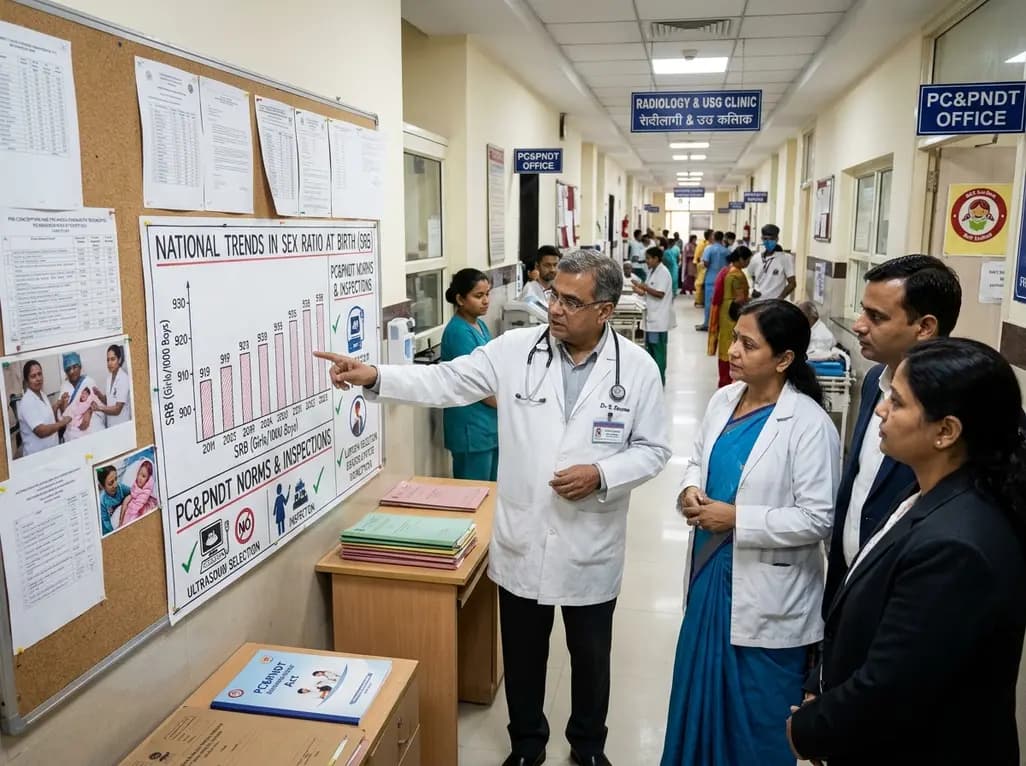
National healthcare governance consistently prioritizes demographic equity and maternal-child health metrics. Recently, Union Health Minister J P Nadda emphasized the urgent need to stabilize and elevate the sex ratio at birth across all Indian territories. Addressing administrators at the thirty-second Central Supervisory Board meeting, leadership called for renewed inter-state collaboration. Furthermore, authorities highlighted regional variations requiring proactive clinical oversight and community engagement.
According to the latest Sample Registration System report, India's national sex ratio at birth reached 918 females per 1,000 males during 2022 to 2024. Consequently, this statistic demonstrates gradual historical progress, yet it highlights significant geographic disparities. For example, Chhattisgarh demonstrated outstanding performance by registering a ratio of 978 girls per 1,000 boys. Therefore, the ministry urged other states and Union Territories to analyze and adapt these successful community-level strategies.
However, several northern and western regions still report numbers well below the national average. Societal son preference, economic pressures, and illegal fetal sex determination continue to hinder rapid progress. In response, public health experts emphasize that improving this demographic indicator requires synchronized grassroots interventions. Moreover, reproductive healthcare teams must combine stringent diagnostic oversight with sustained community advocacy. When institutional delivery rates rise alongside clinical transparency, neonatal gender balance naturally strengthens over time. Additionally, district health officers must scrutinize birth registration records quarterly. Thus, robust data collection remains vital for timely corrective actions across diverse healthcare jurisdictions.
The thirty-second meeting of the Central Supervisory Board marked a pivotal moment for reproductive health governance. Union Minister J P Nadda led rigorous deliberations regarding the statutory framework of the Pre-conception and Pre-natal Diagnostic Techniques Act of 1994. In addition, the board assessed nationwide enforcement mechanisms designed to prevent gender-biased sex selection. The minister commended high-performing administrative areas while urging slower regions to intensify regulatory enforcement.
Furthermore, the health ministry conducted extensive state-level sensitisation workshops spanning all thirty-six states and Union Territories. These workshops educated enforcement officials and healthcare providers regarding legal compliances and administrative protocols. Notably, a premier national workshop on October 1 gathered key representatives to harmonize regulatory approaches across borders. Consequently, the board underscored that constructive dialogue between judicial authorities and medical councils remains imperative. Minister of State for Women and Child Development Savitri Thakur also highlighted synergies with the Beti Bachao Beti Padhao initiative. Hence, multisectoral collaboration ensures that administrative enforcement directly reinforces long-term social empowerment programs.
Technological advancement presents unique opportunities alongside serious regulatory challenges in maternal healthcare. Portable ultrasound devices, non-invasive prenatal genetic testing, and digital media channels can inadvertently facilitate illicit sex determination. Therefore, regulatory authorities are modernizing monitoring mechanisms to address these sophisticated loopholes. Minister Nadda affirmed that diagnostic innovations must support social inclusion rather than foster sex-selective practices.
Specifically, the central government established a dedicated nodal agency pursuant to explicit Supreme Court directives. This nodal body actively monitors digital platforms, e-commerce portals, and search engines for commercial promotions of sex selection. As a result, authorities have tracked and taken down numerous violative web addresses, illicit advertisements, and prohibited keywords. Additionally, legal notices were served to digital intermediaries failing to censor unlawful diagnostic marketing. Meanwhile, public awareness campaigns have expanded aggressively into conventional broadcasting channels. For instance, All India Radio FM channels broadcast educational audio jingles across the nation for twenty consecutive days. Furthermore, dedicated television commercials promoting gender equality are scheduled to air widely on national networks.
Medical practitioners and diagnostic center operators bear strict statutory responsibilities under the existing legislative framework. Obstetricians, radiologists, and registered sonologists must comply with all provisions governing prenatal diagnostics. First, every ultrasound facility must maintain valid formal registration with the designated district Appropriate Authority. Moreover, practitioners must meticulously complete Form F for every antenatal ultrasound examination without exception.
Additionally, medical clinics must maintain detailed physical or electronic registers for at least two years. Clinicians must never disclose or intimate fetal sex to prospective parents under any clinical circumstance. Furthermore, clinics must prominently display mandatory statutory notices declaring that sex determination is prohibited and illegal. Failure to maintain these records accurately can lead to severe criminal prosecution, machine seizure, and license suspension. Consequently, state enforcement teams are executing unannounced clinical audits and decoy operations with greater frequency. Clinicians must therefore view strict statutory documentation as both a legal safeguard and an ethical obligation. In addition, professional medical associations frequently offer guidance to assist registered ultrasound centers with compliance verifications.
Modern regulatory governance requires a careful balance between robust statutory oversight and administrative efficiency. During the recent supervisory deliberations, members evaluated recommendations submitted by the High-Level Committee on Non-Financial Regulatory Reforms. Consequently, the Union health ministry is prioritizing comprehensive digital transformation to simplify administrative compliance for registered healthcare facilities. Digital portals will soon streamline renewal procedures, clinic registrations, and statutory monthly reporting.
Moreover, transitioning to standardized digital platforms substantially reduces administrative burdens for law-abiding physicians. Electronic submission of diagnostic records eliminates cumbersome paperwork while offering transparent audit trails for regulatory inspectors. However, digital systems also equip supervisory bodies with automated algorithms capable of flagging unusual demographic patterns. Therefore, state monitoring agencies can identify dubious ultrasound operators with unprecedented speed and accuracy. Ultimately, sustained progress depends upon deep community engagement combined with robust administrative vigilance. District authorities must conduct regular physical inspections of registered facilities while pursuing prompt follow-up on reported violations. Similarly, clinicians must actively support local awareness activities to celebrate the girl child.
Q1: What does the latest SRS report reveal about India's sex ratio at birth?
The latest Sample Registration System report reveals that India's national sex ratio at birth stood at 918 female births per 1,000 male births during the 2022 to 2024 period. While this figure demonstrates incremental demographic recovery compared to previous survey periods, substantial regional variation persists nationwide. For example, Chhattisgarh achieved an impressive ratio of 978, serving as a successful national benchmark for other states and territories.
Q2: What are the primary compliance duties for ultrasound clinics under the PC and PNDT Act?
Ultrasound clinics must maintain active registration with the local Appropriate Authority and prominently display statutory anti-sex-selection notices. Furthermore, clinicians must diligently complete Form F for every pregnant patient undergoing ultrasonography and securely preserve all examination records for two years. Under no circumstances may healthcare personnel determine, communicate, or hint at fetal sex, as violations trigger immediate equipment seizure, heavy fines, and potential imprisonment.
Q3: How is the government monitoring digital spaces for illegal sex determination services?
In accordance with Supreme Court directives, the Union government established a dedicated nodal agency to continuously track online spaces. This agency systematically scans digital portals, social media platforms, and search engines for unlawful promotions related to prenatal gender determination. Consequently, authorities identify violative uniform resource locators, remove prohibited advertisements, and initiate stringent legal proceedings against non-compliant website administrators and unauthorized digital advertisers across the country.
Disclaimer: This content is for informational and educational purposes only. It does not constitute medical advice or replace professional judgment. Refer to the latest local and national guidelines for clinical practice.
References

Read summarized clinical updates, watch expert medical content, and earn CME certifications right from your smartphone.
Open your smartphone camera to scan and install.





At the 32nd Central Supervisory Board meeting, Union Health Minister J P Nadda reviewed national demographic trends under the PC and PNDT Act. He called upon states to reinforce clinic inspections, curb online violations, and replicate high-performing strategies to ensure long-term gender balance.
Today

A Bayesian component network meta-analysis of 130 RCTs reveals that self-monitoring and gamification provide the clearest positive effects in mHealth physical activity interventions, while social comparison may have adverse psychological trade-offs.
Today

The GESS-AEEM consensus establishes a clear clinical implementation framework for testosterone therapy in postmenopausal women with hypoactive sexual desire disorder, focusing on transdermal dosing, precise laboratory monitoring, and safety communication.
Today

A multicenter observational study evaluated an 8-week digital health monitoring platform using wearable sensors in ambulatory heart failure. While participants achieved high daily wear-time of 11.7 hours and 80% completion, initial recruitment revealed significant technology-related onboarding barriers.
Today

A paired cadaveric study compared triple and quintuple percutaneous Achilles tendon lengthening. While quintuple hemisection showed numerically greater elongation, differences were not statistically significant.
Yesterday

A clinical decision-support framework using health checkup data from 231,683 adults predicts incident obesity with high discrimination (AUROC 0.918). The system integrates temporal survival analysis and risk-factor explanations to prioritize individualized preventive interventions.
Today
