.webp&w=384&q=75)

Loading, please wait...
Loading, please wait...
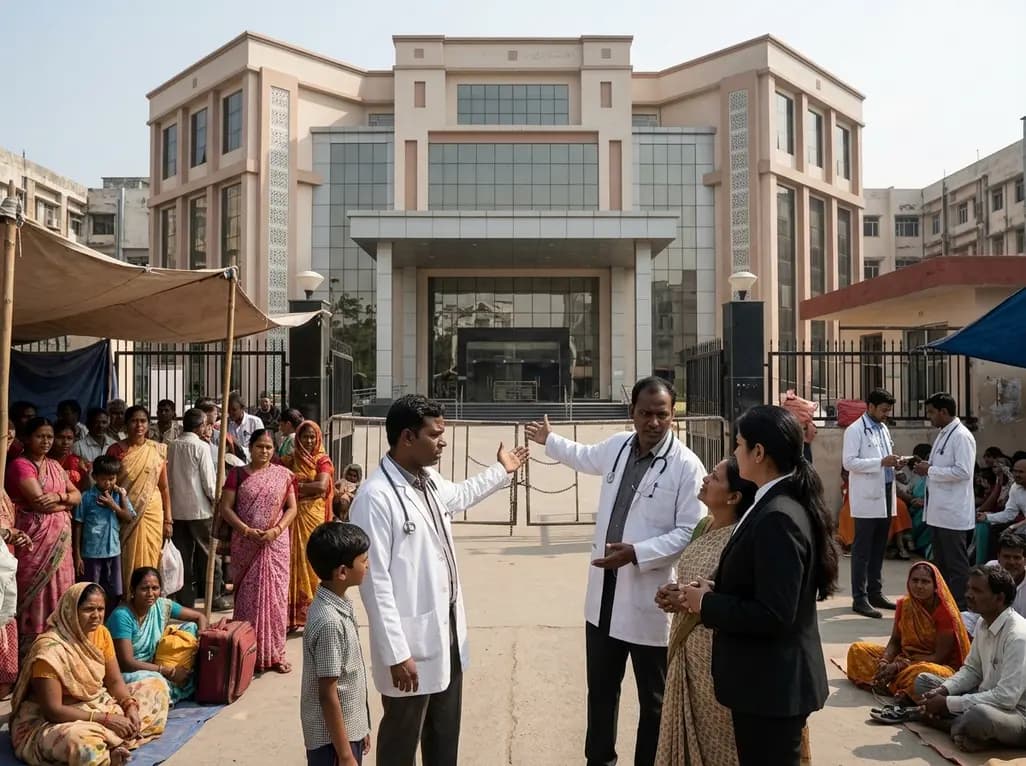
The civil rights group, Social Jurist, initiated this legal battle by filing the petition through dedicated advocates Ashok Agarwal and Kumar Utkarsh. Specifically, the petitioner claims that the ongoing delay in commissioning the new wing violates fundamental rights. Public hospitals in Delhi consistently face extreme overcrowding, which severely degrades the quality of patient care. Therefore, keeping a completed medical facility closed seems highly irresponsible and wasteful. The litigation seeks immediate directions to both the Union of India and the Atal Bihari Vajpayee Institute of Medical Sciences. Additionally, it highlights how poor coordination between government bodies has resulted in the wastage of public taxpayers' funds. Patients who heavily rely on subsidised public healthcare continue to suffer daily. Meanwhile, advanced clinical equipment worth crores of rupees remains packed and unutilized inside the closed facility. This critical block could immediately relieve pressure on the main hospital building if opened without delay. Consequently, the advocates argue that judicial intervention is now the only way to break the administrative deadlock and ensure the immediate welfare of patients.
The highly anticipated expansion project was meticulously designed to revolutionize Delhi's public health infrastructure. Initially, the project aimed to boost the total bed capacity of the hospital from 1,532 to 2,198 beds. This expansion effectively adds 666 critical care and general beds to the overcrowded government facility. Furthermore, the massive eleven-storey structure features eighteen advanced operation theatres and modern diagnostic laboratories. Crucially, the block incorporates a dedicated oncology department complete with a modern PET-CT scanner. This specialized equipment is highly valuable for cancer diagnostic procedures, which are often unaffordable in private clinics. Consequently, underprivileged cancer patients are currently forced to wait months for simple diagnostic scans. The newly built block also boasts multiple intensive care units and advanced waste management systems. Hospital authorities designed the facility to deliver premium services that closely match private sector healthcare. Despite the complete readiness of this modern clinical infrastructure, the doors remain locked to the public. As a result, hundreds of patients are turned away from the hospital daily due to a persistent shortage of clinical beds and specialized treatment areas.
Several bureaucratic complications have severely delayed the formal launch of the massive hospital wing. For instance, the Delhi Urban Arts Commission recently refused to grant the mandatory completion no-objection certificate. The commission raised serious concerns regarding minor discrepancies in the project plans and inadequate parking provisions. Specifically, the master plan failed to fully incorporate a previously approved multi-level car parking scheme. Additionally, the facility suffered from an unbelievable year-long delay in securing a high-voltage electricity connection. This basic utility issue prevented authorities from testing expensive clinical equipment and air conditioning systems. Fortunately, the local municipal council finally released the required power supply in early April 2026. However, the newly appointed hospital director, Dr. L. Shyam Singh, noted that testing and calibration will require several more weeks. Hospital management is currently working diligently to resolve the remaining parking objections raised by regulatory authorities. They plan to submit a fresh request for clearances very soon. Meanwhile, the administration must also accelerate staff recruitment to fully operationalise the clinical departments. Without adequate doctors, nurses, and technical staff, the completed infrastructure cannot function safely.
The high court petition argues that the current administrative inaction directly violates basic constitutional rights. Specifically, the advocates state that denying citizens access to completed healthcare facilities breaches Article 14 and Article 21 of the Indian Constitution. Article 21 guarantees the fundamental right to life, which legally includes the right to timely and affordable medical care. Therefore, leaving a massive public facility idle constitutes a clear violation of this constitutional mandate. Additionally, the petition heavily relies on the landmark Supreme Court decision in Paschim Banga Khet Mazdoor Samity v. State of West Bengal. In this historic case, the apex court explicitly recognized the state's constitutional obligation to provide adequate medical treatment. Consequently, government authorities cannot justify prolonged delays in launching healthcare facilities using administrative excuses. Overcrowded wards and long treatment waiting lists directly compromise the right to live with dignity. The legal petition urges the judiciary to hold administrative heads personally accountable for these delays. By doing so, the court can establish a powerful precedent against administrative negligence in the public health sector. Public funds must translate directly into public welfare without bureaucratic interference.
To resolve the ongoing healthcare crisis, the legal petition outlines several urgent demands for the respondents. First, the authorities must immediately obtain all pending statutory approvals, including the final completion certificate. Second, the hospital administration needs to resolve the lingering parking discrepancies flagged by the arts commission. Furthermore, the petition requests a clear, legally binding timeline for the commencement of clinical services in the new block. This timeline must include the rapid deployment of qualified medical, nursing, technical, and support staff. Currently, acute staff shortages in existing departments prevent the simple transfer of medical personnel to the new wing. Therefore, a dedicated recruitment drive is absolutely essential to ensure safe and efficient clinical operations. The petitioner emphasizes that further delay will only lead to the deterioration of the expensive medical equipment already installed. Consequently, immediate action is required from the Union Ministry of Health to coordinate the final launch. The Delhi High Court's active monitoring of this situation could finally force the authorities to act. Ultimately, the immediate opening of this block will provide immense relief to the burdened healthcare system of the capital city.
Q1: Why has the activation of the new block at RML Hospital been delayed?
The activation suffered severe delays primarily due to pending administrative approvals and utility issues. Specifically, the building lacked a stable electricity connection for over a year. Additionally, the Delhi Urban Arts Commission withheld the mandatory clearance due to discrepancies in parking layouts. Authorities are currently working to resolve these regulatory bottlenecks and complete equipment testing.
Q2: What clinical services will the new wing offer once it is operational?
The newly constructed block will offer highly specialized services across multiple critical fields. It will house ninety-six super-speciality outpatient departments, including cardiology, neurology, gastroenterology, and oncology. Furthermore, the facility includes eighteen operation theatres, advanced diagnostic labs, intensive care units, and a dedicated cancer unit equipped with a PET-CT scanner.
Q3: How will this new facility benefit patients in Delhi and neighboring regions?
This massive expansion will significantly reduce the patient load on existing municipal departments. By adding nearly 666 beds, the facility will directly combat severe hospital overcrowding and reduce long treatment waitlists. Consequently, underprivileged patients will gain immediate access to high-quality, affordable super-speciality care that is usually only available in expensive private hospitals.
Disclaimer: This content is for informational and educational purposes only. It does not constitute medical advice or replace professional judgment. Refer to the latest local and national guidelines for clinical practice.
References

Read summarized clinical updates, watch expert medical content, and earn CME certifications right from your smartphone.
Open your smartphone camera to scan and install.





A Public Interest Litigation has been filed in the Delhi High Court seeking immediate operationalisation of the Rs 400-crore Super Speciality Block at RML Hospital. The petition highlights how administrative delays in commissioning this major medical facility have severely impacted thousands of needy patients.
3 months ago

Discover the crucial role of glymphatic dysfunction in stroke, where perivascular clearance failure and neuroinflammation exacerbate cerebral edema and post-stroke brain injury.
Today

A prenatal case highlights severe glutaric acidemia type II presenting as bilateral hyperechoic cystic kidneys at 18 weeks. Whole-exome sequencing revealed a novel homozygous ETFDH frameshift variant, demonstrating the power of rapid genetic testing in fetal renal anomalies.
Today

Review how tailored exercise programs benefit frail older patients with heart failure. Explore pathophysiological mechanisms, individualized training prescriptions, and strategies to overcome adherence barriers in clinical practice.
Yesterday

This comparative study evaluates posterior labral tears with and without glenohumeral instability, highlighting distinct demographic patterns, MRI underestimation in stable shoulders, and successful arthroscopic repair outcomes.
Yesterday

A clinical study demonstrates that early intervention with tocilizumab, either as monotherapy or bridged with corticosteroids, achieves significant proptosis reduction and resolves active inflammation in treatment-naive thyroid eye disease.
Yesterday
