.webp&w=384&q=75)

Loading, please wait...
Loading, please wait...
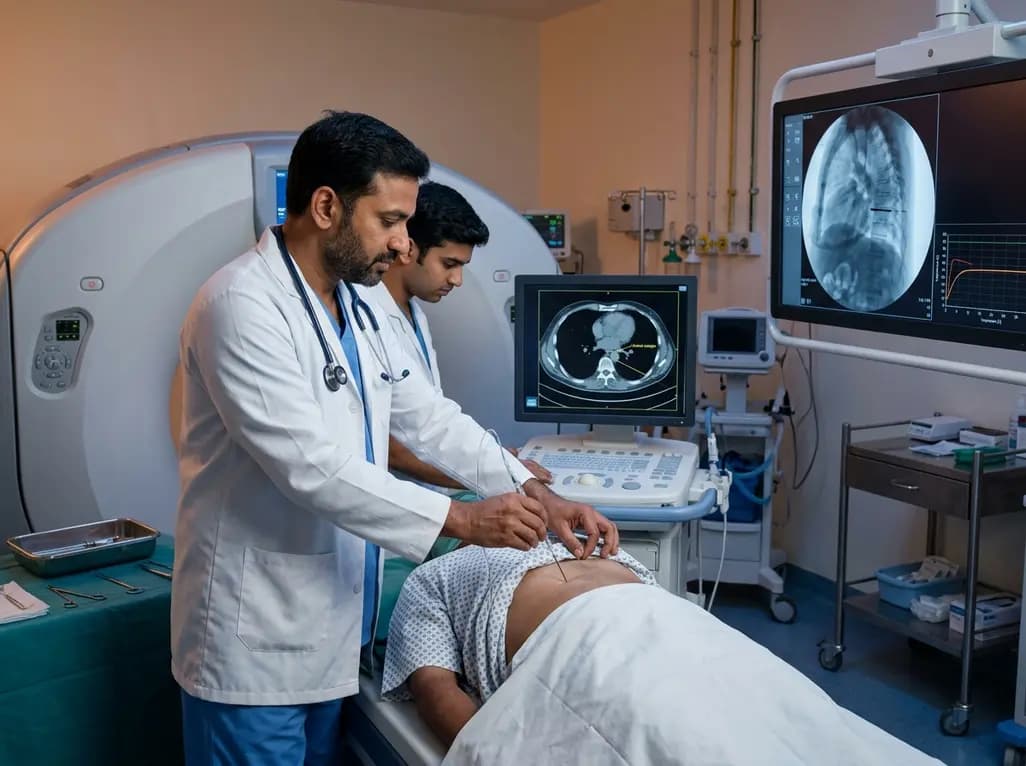
Severe primary palmar hyperhidrosis causes debilitating sweat secretion that impairs occupational and social functioning. While conservative medical therapies provide temporary relief, interventional approaches offer durable sympathectomy. Clinicians frequently utilize computed tomography-guided percutaneous radiofrequency thermocoagulation to disrupt upper thoracic sympathetic pathways. However, the optimal rib-based anatomical puncture target remains debated. Selecting between the upper margin and lateral margin of the fourth rib head directly influences procedural precision and clinical durability. Therefore, comparative trial data helps clinicians optimize therapeutic protocols for refractory palmar hyperhidrosis.
Excessive sympathetic cholinergic stimulation of eccrine glands drives the clinical pathology of primary palmar hyperhidrosis. The sympathetic outflow to the upper limbs arises primarily from the T2 to T4 thoracic ganglia. Consequently, interventional ablation aims to disrupt these preganglionic and postganglionic neural fibers. Video-assisted thoracoscopic surgery historically served as the definitive surgical treatment. Nevertheless, surgery requires general anesthesia and carries substantial risks of pneumothorax and severe compensatory sweating.
In contrast, computed tomography-guided percutaneous radiofrequency thermocoagulation provides an effective, minimally invasive alternative. Clinicians perform this neurolytic procedure under local anesthesia in an outpatient setting. Operators advance a radiofrequency cannula toward the sympathetic chain resting along the rib heads. However, anatomical variations complicate needle placement. Consequently, selecting precise rib-guided anatomical targets is crucial to maximize denervation success and avoid somatic nerve injury.
To identify the superior puncture target, investigators conducted a randomized controlled trial evaluating 110 bilateral procedures across 55 patients per cohort. The study allocated patients with severe disease into two intervention groups. Group U received radiofrequency thermocoagulation targeting the upper margin of the fourth rib head. Meanwhile, Group L underwent targeted thermocoagulation at the lateral margin of the fourth rib head.
Both cohorts underwent preprocedural computed tomography scanning to plan needle trajectories. Clinicians continuously monitored intraoperative palm skin temperature and finger perfusion index. Following real-time imaging confirmation, operators delivered controlled thermal energy to ablate sympathetic fibers. Investigators followed all participants prospectively for twelve months to evaluate symptom resolution, recurrence rates, and quality-of-life outcomes.
Immediate intraoperative physiological markers provide reliable confirmation of successful sympathetic denervation. Specifically, interruption of sympathetic tone causes rapid cutaneous vasodilation in the distal upper extremity. This autonomic response produces a marked increase in palm skin temperature and finger perfusion index. In the randomized trial, baseline perfusion indices did not differ significantly between cohorts before intervention.
However, immediately following radiofrequency ablation, Group L exhibited significantly higher finger perfusion index values than Group U across both upper limbs. This acute physiological elevation indicates that targeting the lateral margin achieves more comprehensive thermal disruption of sympathetic vasomotor fibers. Conversely, upper margin targeting may yield submaximal neurolysis. Therefore, real-time perfusion index monitoring serves as a valuable indicator of acute procedural efficacy.
Evaluating sustained symptom relief is essential when comparing interventional modalities. During early follow-up intervals at one day, two weeks, one month, and three months, both anatomical cohorts achieved comparable reductions in hyperhidrosis severity scores. Both groups experienced immediate cessation of excessive sweating, confirming initial procedural efficacy.
Nevertheless, significant clinical differences emerged during extended follow-up. At six and twelve months post-procedure, patients in Group L maintained significantly lower Hyperhidrosis Disease Severity Scale grades compared to Group U. Furthermore, twelve-month symptom recurrence was significantly lower in the lateral margin cohort. Over time, incomplete lesions at the upper margin may permit sympathetic nerve regeneration. Conversely, lateral margin ablation ensures durable long-term suppression of excessive palmar sweating.
Severe hyperhidrosis profoundly impairs emotional well-being, interpersonal relationships, and daily productivity. Therefore, patient-reported outcome measures represent vital endpoints in clinical evaluation. Investigators utilized the Dermatology Life Quality Index alongside validated satisfaction scales to evaluate functional recovery.
During the first six months of follow-up, both cohorts reported substantial and comparable improvements in quality of life. However, at twelve months, Group L achieved significantly lower Dermatology Life Quality Index scores, reflecting superior disease control. In addition, patient satisfaction at twelve months was significantly higher in the lateral margin cohort. Importantly, the incidence of compensatory hyperhidrosis remained low and comparable between groups. Thus, lateral margin targeting delivers superior long-term clinical benefits without increasing adverse effects.
The trial findings establish the lateral margin of the fourth rib head as the preferred anatomical target for computed tomography-guided radiofrequency sympatholysis. For interventional radiologists, anesthesiologists, and surgeons managing palmar hyperhidrosis, adopting this target optimizes long-term symptom control and minimizes recurrence.
Additionally, percutaneous radiofrequency thermocoagulation offers an appealing alternative to surgical sympathectomy. Patients benefit from local anesthesia, rapid post-procedural recovery, and reduced complication rates. Selecting the lateral rib head minimizes incomplete lesioning, thereby avoiding repeat interventions. Clinicians should routinely integrate high-resolution cross-sectional imaging and intraoperative perfusion monitoring to confirm cannula placement. By implementing this refined target, healthcare teams can maximize therapeutic durability and elevate patient outcomes in clinical practice.
Radiofrequency thermocoagulation applies controlled thermal energy to disrupt sympathetic nerve pathways along the thoracic chain. Interventional radiologists guide a specialized needle electrode under computed tomography to the target rib head. The thermal lesion interrupts hyperactive sympathetic signals transmitted to the palmar eccrine glands. Consequently, the procedure effectively ceases excessive sweat secretion and restores normal vasomotor balance in the hands.
The lateral margin of the fourth rib head aligns more directly with the anatomical course of the thoracic sympathetic chain. Targeting this specific location achieves more complete coagulative necrosis of sympathetic fibers. As a result, patients experience greater acute perfusion index increases, lower twelve-month symptom recurrence rates, and superior long-term quality-of-life scores compared to upper margin targeting.
Percutaneous thoracic radiofrequency sympatholysis carries a favorable safety profile with minimal major complications. Some patients develop mild compensatory hyperhidrosis on the trunk or lower extremities. Additionally, minor procedural discomfort or transient intercostal soreness may occur at the puncture site. Fortunately, severe complications like pneumothorax or Horner syndrome remain exceedingly rare when performing the procedure under precise computed tomography guidance.
Disclaimer: This content is for informational and educational purposes only and is not intended to provide or substitute for professional medical advice, diagnosis, or treatment. It is designed solely for healthcare professionals. Medical knowledge is constantly evolving, and clinical judgment must always guide patient management decisions. Clinicians must independently evaluate all patient care interventions and verify any diagnostic strategies, therapies, and clinical methodologies discussed. Refer to the latest local and national guidelines for clinical practice.
References

Read summarized clinical updates, watch expert medical content, and earn CME certifications right from your smartphone.
Open your smartphone camera to scan and install.





An RCT reveals that CT-guided thoracic sympathetic radiofrequency thermocoagulation targeting the lateral margin of the fourth rib head achieves lower 1-year recurrence, superior symptom relief, and higher satisfaction than upper margin targeting in patients with severe primary palmar hyperhidrosis.
last month
Computational screening identified five potent NCI compounds acting as chikungunya virus nsP2pro inhibitors with superior binding affinity over reference agents, offering hope for targeted antiviral therapy against debilitating chikungunya disease.
Today

A large UK cohort study of 1.4 million women shows that pregnancy complications, including gestational diabetes, hypertension, and preterm birth, substantially raise long-term risks for hypertension, chronic kidney disease, type 2 diabetes, and cardiovascular events, highlighting early postpartum intervention needs.
Today

Giant cardiac hemangiomas are rare benign vascular tumors that can cause severe hemodynamic compromise and arrhythmias through mass effect. This comprehensive review covers clinical presentation, advanced multimodality imaging, histopathological diagnosis, surgical resection, and long-term surveillance protocols.
Today
This clinical overview examines recent advancements in lumbar disc herniation surgery, comparing microscopic and full-endoscopic discectomy while highlighting biportal techniques and emerging motion-preserving innovations for spine specialists.
Today

The World Health Organization has issued its first global guidelines for managing child and adolescent obesity. The recommendations strongly endorse family-based dietary interventions, regular physical activity, and behavioral support as frontline therapy, reserving GLP-1 therapies and surgery for select cases.
Today
