.webp&w=384&q=75)

Loading, please wait...
Loading, please wait...
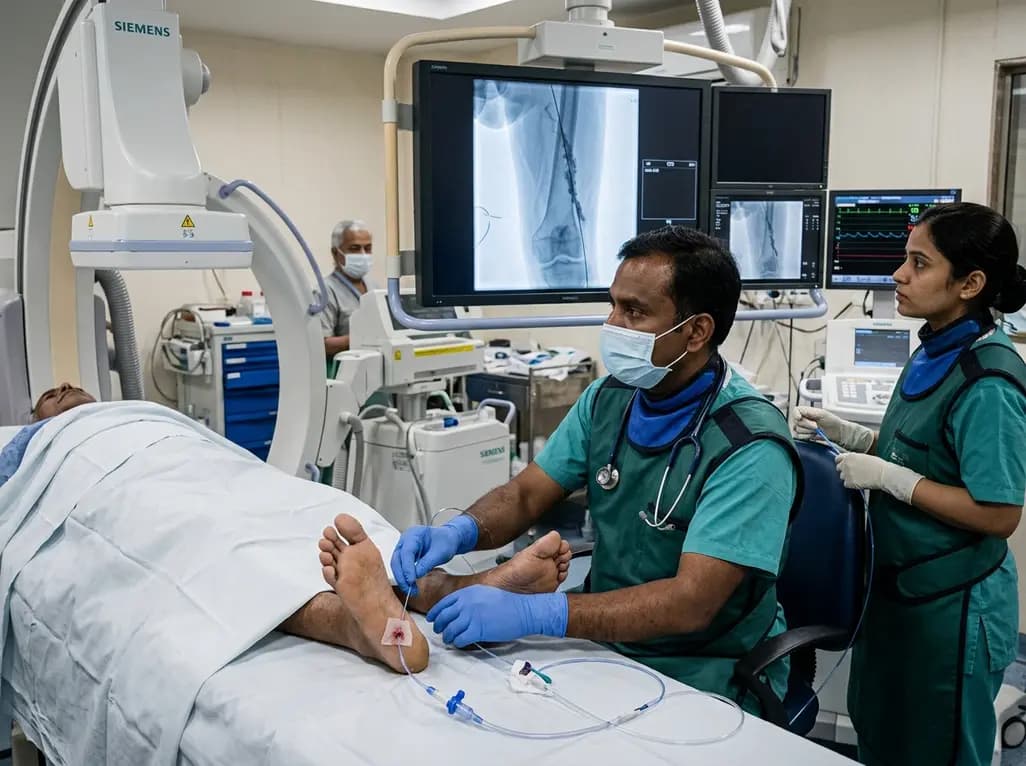
Peripheral artery disease remains a major public health challenge across India and globally. Vascular specialists frequently encounter advanced chronic limb-threatening ischemia in elderly and diabetic patients. For these challenging cases, retrograde pedal access offers an innovative solution when conventional antegrade approaches fail to cross tough chronic total occlusions. By establishing distal arterial entry, endovascular operators can salvage ischemic extremities and avoid catastrophic major amputations.
Infrainguinal chronic total occlusions represent the most complex anatomical subset of peripheral artery disease. Severe calcification, extensive lesion length, and flush proximal occlusions frequently hinder traditional antegrade crossing attempts. Consequently, femoral-based wire manipulation often leads to extensive subintimal dissection or abrupt procedural failure. When standard re-entry devices fail, operators risk abandoning revascularization entirely. This failure markedly increases the likelihood of limb loss. Furthermore, patients presenting with chronic limb-threatening ischemia typically possess significant comorbidities, such as end-stage renal disease and diabetic microangiopathy. Therefore, surgical bypass may pose an unacceptably high perioperative risk. In this demanding scenario, endovascular teams require dependable bailout techniques. Retrograde entry establishes direct mechanical leverage against distal caps, which are characteristically softer than proximal caps. Consequently, interventionalists can navigate occluded vessels with greater tactile precision, preserving critical distal landing zones for subsequent therapies.
Specialists execute retrograde pedal access using ultrasound guidance or fluoroscopic roadmapping to puncture distal runoff vessels safely. Interventionalists typically cannulate the posterior tibial artery or anterior tibial artery using micropuncture systems. In addition, the dorsalis pedis or distal peroneal branches can serve as alternative entry targets when primary runoff vessels remain severely diseased. Operators introduce low-profile microcatheters and hydrophilic guidewires through sheathless or four-French setups to minimize vessel trauma. Because the distal cap exhibits less fibrotic resistance, retrograde wires penetrate the true arterial lumen much more reliably. Once the wire traverses the occlusion retrogradely, operators snare it into an antegrade femoral sheath to establish continuous flossing access. Alternatively, operators apply transcollateral crossing and subintimal arterial flossing techniques. Therefore, this dual-access platform creates exceptional mechanical support, allowing smooth delivery of angioplasty balloons, atherectomy devices, and modern drug-eluting stents across previously impassable anatomical lesions.
Recent clinical evidence highlights remarkable efficacy when applying this retrograde strategy. In a focused clinical study evaluating 33 consecutive patients with refractory chronic occlusions, operators achieved successful intraluminal recanalization in 90.9% of cases. The posterior tibial artery provided access in 39.4% of limbs, whereas clinicians utilized the anterior tibial artery in 36.4% of limbs. These robust figures demonstrate that distal cannulation turns anticipated procedural failures into clear clinical successes. In contrast to subintimal dissection recanalization, maintaining a true intraluminal path preserves vital side branches and native collateral networks. Moreover, true intraluminal wire position prevents distal vessel rupture during high-pressure balloon dilatation. Consequently, patients receive more durable endovascular reconstructions. These technical achievements reinforce the fundamental concept that distal puncture sites provide superior pushability and control when traversing densely calcified infrainguinal vascular segments.
Safety considerations remain paramount when puncturing small-caliber tibial vessels in compromised ischemic legs. Interventionalists historically feared that pedal puncture could induce irreversible spasm, thrombosis, or pseudoaneurysm formation, which might sacrifice the final remaining runoff vessel. Fortunately, contemporary clinical data show an exceptionally benign safety profile. Among successfully treated patients, flow-limiting dissection occurred in only 16.7% of individuals, and operators promptly corrected each case using prolonged low-pressure balloon tamponade or bailout focal stenting. Remarkably, clinicians observed no arterial perforations, distal embolization, pseudoaneurysms, or arteriovenous fistulas. Furthermore, no procedure-related deaths occurred throughout the perioperative follow-up period. Meticulous ultrasound guidance and careful sheathless catheter manipulation prevent severe local vascular trauma. In addition, routine administration of intra-arterial vasodilators and weight-adjusted systemic heparin protects distal vessels against catastrophic thrombotic occlusions during prolonged instrumentation.
The ultimate goal of infrainguinal revascularization is durable functional preservation rather than mere immediate anatomical crossing. Long-term follow-up demonstrates outstanding durability following successful retrograde procedures. Kaplan-Meier survival curves showed freedom from clinically driven target lesion revascularization of 96.7% at 12 months and 75.5% at 24 months. More importantly, no patients underwent major limb amputations during long-term surveillance. Every patient presenting with baseline ischemic ulcers achieved complete wound healing, requiring only minor digital amputations in select cases. Rutherford ischemia scores improved substantially across the treated cohorts. Consequently, patients experienced durable relief from rest pain and returned to ambulatory independence. These sustained functional improvements indicate that retrograde crossing provides hemodynamic perfusion sufficient for tissue granulation and infection clearance. Thus, endovascular specialists should consider tibiopedal recanalization as an indispensable primary bailout tool rather than a desperate last resort.
Interventionalists should consider this approach immediately when conventional antegrade crossing attempts fail because of flush ostial occlusions, severe calcification, or unsuccessful subintimal re-entry. Rather than persisting with repetitive antegrade attempts that risk vessel perforation or extensive dissection, operators introduce retrograde wires through distal tibial arteries to penetrate the softer distal cap directly and preserve critical collateral runoffs.
The posterior tibial artery and anterior tibial artery serve as the primary access vessels, accounting for approximately three-quarters of all retrograde punctures. Operators choose the specific target vessel based on pre-procedural duplex imaging and angiographic runoffs. When these vessels are extensively diseased, experienced operators can also successfully cannulate the dorsalis pedis, plantar arteries, or peroneal branches.
Potential complications include flow-limiting dissection, arterial spasm, access site hematoma, and vessel occlusion. Operators mitigate these hazards by utilizing high-resolution duplex ultrasound for initial arterial puncture and avoiding oversized introducer sheaths. Furthermore, interventionalists administer weight-adjusted systemic anticoagulation and intra-arterial vasodilators, such as nitroglycerin or verapamil, to preserve distal perfusion and prevent vessel thrombosis throughout the procedure.
Disclaimer: This content is for informational and educational purposes only. It is not intended to provide medical advice or substitute for the professional judgment of a healthcare provider. Refer to the latest local and national guidelines for clinical practice.
References
Aydın S et al. Retrograde pedal access to facilitate intraluminal recanalization in complex infrainguinal chronic total occlusions. Turk Gogus Kalp Damar Cerrahisi Derg. 2026 Oct 07. doi: 10.4274/tjtcs.2026.2026-4-22. PMID: 42840081.
Abdelmonem M, Shahat M, Elashry MG, Ali H. Retrograde Tibiopedal Access for Chronic Limb-Threatening Ischemia. Indian Journal of Vascular and Endovascular Surgery. 2022;9(1):3-10.
Conte MS, Bradbury AW, Kolh P, et al. Global vascular guidelines on the management of chronic limb-threatening ischemia. Journal of Vascular Surgery. 2019;69(6S):3S-125S.e40.

Read summarized clinical updates, watch expert medical content, and earn CME certifications right from your smartphone.
Open your smartphone camera to scan and install.





A clinical study demonstrates that retrograde pedal access achieves a 90.9% technical success rate for intraluminal crossing in complex infrainguinal chronic total occlusions, securing outstanding limb salvage, complete wound healing, and durable patency in patients with chronic limb-threatening ischemia.
Today

Small airway dysfunction affects over 64% of asthma patients across GINA steps. Utilizing impulse oscillometry provides crucial diagnostic insight, revealing persistent peripheral resistance linked to frequent exacerbations, suboptimal asthma control, and impaired patient quality of life.
Today

A large UK cohort study of 1.4 million women shows that pregnancy complications, including gestational diabetes, hypertension, and preterm birth, substantially raise long-term risks for hypertension, chronic kidney disease, type 2 diabetes, and cardiovascular events, highlighting early postpartum intervention needs.
Today
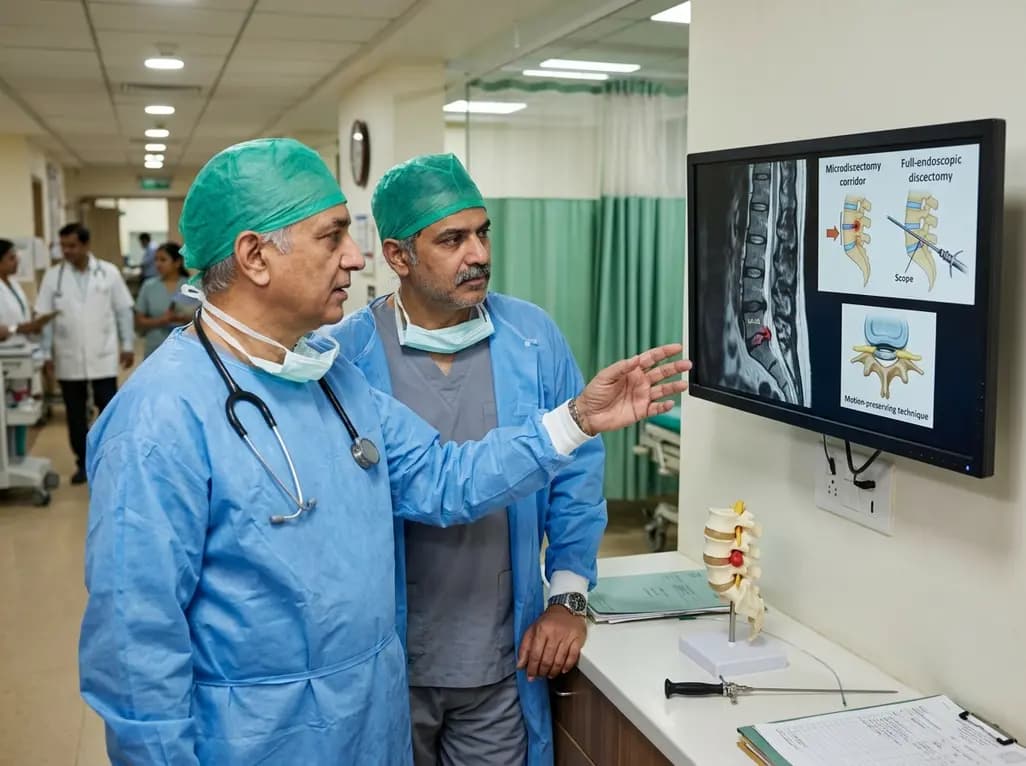
This clinical overview examines recent advancements in lumbar disc herniation surgery, comparing microscopic and full-endoscopic discectomy while highlighting biportal techniques and emerging motion-preserving innovations for spine specialists.
Today

The World Health Organization has issued its first global guidelines for managing child and adolescent obesity. The recommendations strongly endorse family-based dietary interventions, regular physical activity, and behavioral support as frontline therapy, reserving GLP-1 therapies and surgery for select cases.
Today
