.webp&w=384&q=75)

Loading, please wait...
Loading, please wait...
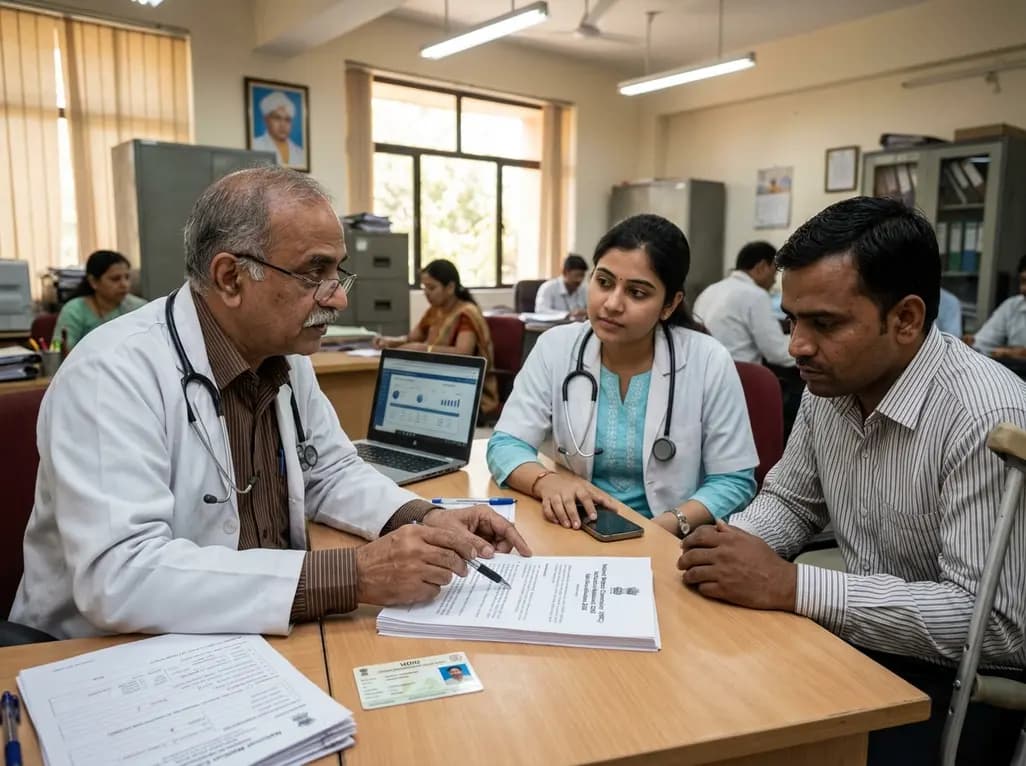
The National Medical Commission has formally released a pivotal addendum regarding PwBD MBBS admission rules for the academic session 2026. Published on August 5, 2026, this notification provides critical clarifications to the original guidelines dated July 27, 2026. Specifically, the regulatory body addresses candidate eligibility under the Persons with Benchmark Disabilities category. Consequently, medical aspirants holding temporary Unique Disability Identity cards now receive much-needed legal clarity. Moreover, this policy decision harmonizes medical education rules with directives from the Ministry of Social Justice and Empowerment. Therefore, candidates and institutions must understand these binding provisions prior to medical counseling.
The primary goal of this addendum is to establish uniform implementation across all medical institutions in India. Previously, confusion existed regarding whether a temporary disability certificate disqualified an applicant from quota benefits. Consequently, many deserving candidates faced unexpected rejection during seat allocation. To eliminate ambiguity, the commission integrated Office Memorandum No. 18-25/2024-Policy dated December 17, 2025 into the admission framework.
Furthermore, the addendum aligns admission protocols with the Rights of Persons with Disabilities Act of 2016. It also incorporates the Rights of Persons with Disabilities (Amendment) Rules of 2024. As a result, statutory benefits cannot be denied merely because a candidate possesses a temporary document. Instead, the focus shifts toward verifying the nature of the candidate's physical or sensory impairment.
Additionally, this clarification protects candidate rights while maintaining rigorous standards in medical training. Medical boards must now evaluate applicants through standardized procedures. Consequently, state counseling authorities and central boards must immediately adopt these instructions. You can review official National Medical Commission updates for underlying regulatory guidelines. Therefore, all stakeholders must familiarize themselves with these regulatory updates without delay.
Under the revised PwBD MBBS admission rules, a temporary UDID card or disability certificate is no longer an automatic ground for rejection. Specifically, clause 9.2 must now be interpreted in harmony with social justice directives. Candidates whose disability condition is classified as progressive, non-progressive, or not likely to improve will retain eligibility for consideration. Therefore, medical assessment boards cannot reject an applicant solely based on the temporary status of their certificate.
However, this protection remains subject to rigorous verification by designated Medical Assessment Boards. Evaluators must confirm that the recorded medical condition satisfies benchmark disability thresholds. Furthermore, this policy prevents unnecessary bureaucratic barriers for students with lifelong or stable conditions. Consequently, candidates can participate in NEET UG counseling with greater confidence and legal protection.
Moreover, this mandate simplifies document verification for administrative officers across designated medical centers. Previously, authorities struggled to process temporary certificates during tight counseling timelines. Now, clear statutory guidance ensures smooth administrative execution. Additionally, candidates should explore relevant internal content on undergraduate medical counseling procedures to stay updated. As a result, eligible students receive equitable access to reserved seats.
The NMC addendum establishes explicit evaluation protocols based on disability categorization. Specifically, conditions categorized as progressive, non-progressive, or not likely to improve do not require repeated medical re-assessments for benchmark status. Instead, the assessment board focuses on verifying existing documentation and practical functional capacity. Consequently, this streamlines the admission process for candidates with permanent functional limitations.
In contrast, candidates holding a temporary UDID with a condition recorded as "likely to improve" face a distinct evaluation procedure. For these specific cases, Medical Assessment Boards must conduct a fresh re-assessment of benchmark disability. Furthermore, evaluators must follow the assessment methodology prescribed in the Ministry notification dated March 12, 2024. Therefore, candidates in this category undergo both disability status verification and functional capability testing.
Additionally, this two-tier approach balances equity with educational readiness. It ensures that students receiving reservation benefits meet statutory thresholds at the time of admission. However, it also prevents candidates with transient conditions from securing reserved seats permanently without verification. Consequently, medical boards retain complete oversight while upholding fairness. For official counselling guidelines, candidates may consult the Medical Counselling Committee portal.
A crucial aspect of the addendum emphasizes the independent role of designated Medical Assessment Boards. Regardless of whether a candidate holds a permanent or temporary UDID, the board must independently evaluate functional competency. Specifically, evaluators assess whether an applicant can fulfill the practical demands of the MBBS curriculum. Therefore, possessing a valid disability certificate is necessary but not solely sufficient for final admission.
Furthermore, boards conduct this functional evaluation according to the guidelines notified on July 27, 2026. Evaluators examine physical, sensory, and motor abilities required for clinical training and patient care. Consequently, modern assistive devices and ergonomic accommodations are factored into the candidate's assessment. As a result, the evaluation focuses on operational capability rather than strict numerical thresholds.
Moreover, after completing the assessment, the board issues an official Eligibility Certificate. This document replaces older disability certificates for counseling purposes. Consequently, participating institutes rely on this certificate to confirm candidate eligibility during admission rounds. Therefore, applicants must attend designated assessment centers prepared for comprehensive physical and functional examinations.
This regulatory update delivers profound relief to thousands of medical aspirants across India. Historically, applicants with temporary UDID cards faced significant stress due to conflicting guidelines across state boards. Now, uniform national standards guarantee equal treatment regardless of geographic location. Therefore, candidates can focus on preparing necessary self-certification affidavits and clinical documentation.
Furthermore, medical institutions and counseling authorities gain clear legal boundaries. Designated centers can now process applications without fear of procedural non-compliance. Consequently, admission delays and legal disputes during counseling rounds will decrease significantly. Additionally, institutions must ensure that designated assessment boards operate with qualified medical specialists and accessibility infrastructure.
In conclusion, the NMC addendum represents a major step forward for inclusive medical education. By harmonizing administrative rules with social justice principles, the commission protects student rights while upholding professional standards. Therefore, candidates should carefully verify their UDID details and schedule assessment appointments promptly. Consequently, this policy ensures a fair, transparent, and standardized pathway into the medical profession.
Disclaimer: This content is for informational and educational purposes only and does not constitute formal legal or clinical advice. Medical candidates, institutions, and practitioners must refer to official notifications from the National Medical Commission and relevant governing bodies for updated legal and regulatory guidelines. Refer to the latest local and national guidelines for clinical practice.
References

Read summarized clinical updates, watch expert medical content, and earn CME certifications right from your smartphone.
Open your smartphone camera to scan and install.





The National Medical Commission has published an addendum clarifying PwBD MBBS admission rules for NEET UG candidates. Discover key updates on temporary UDID cards, functional assessments, and disability classification guidelines.
last month

Neurocognitive disorders, including mild cognitive impairment and dementia, frequently complicate heart failure, worsening patient outcomes and treatment adherence. This clinical review explores shared pathophysiology, early screening approaches, and integrated multidisciplinary interventions.
Today

A multicentre RCT in China shows that the PAICS AI system significantly boosts sonographer sensitivity in detecting fetal intracranial malformations by 8.7% without compromising specificity, offering promising diagnostic support for prenatal neurosonography.
Today

Transcatheter edge-to-edge repair offers a safe, minimally invasive alternative for older adults with severe mitral and tricuspid regurgitation. Integrating comprehensive geriatric assessment and delirium prevention aligns procedural success with functional longevity.
Today

A retrospective cohort study demonstrates that patients with anorexia nervosa and bulimia nervosa face significantly higher risks of lower extremity soft tissue injuries, including ACL tears and ligament sprains, along with heightened rates of orthopedic revision surgery, highlighting the need for systemic screening.
Today

A propensity-matched study shows ultrasound-guided pulsed radiofrequency of the lumbar sympathetic ganglion is non-inferior to fluoroscopy for painful diabetic neuropathy, reducing needle passes, procedure time, and radiation exposure while achieving equal pain relief.
Today
