.webp&w=384&q=75)

Loading, please wait...
Loading, please wait...
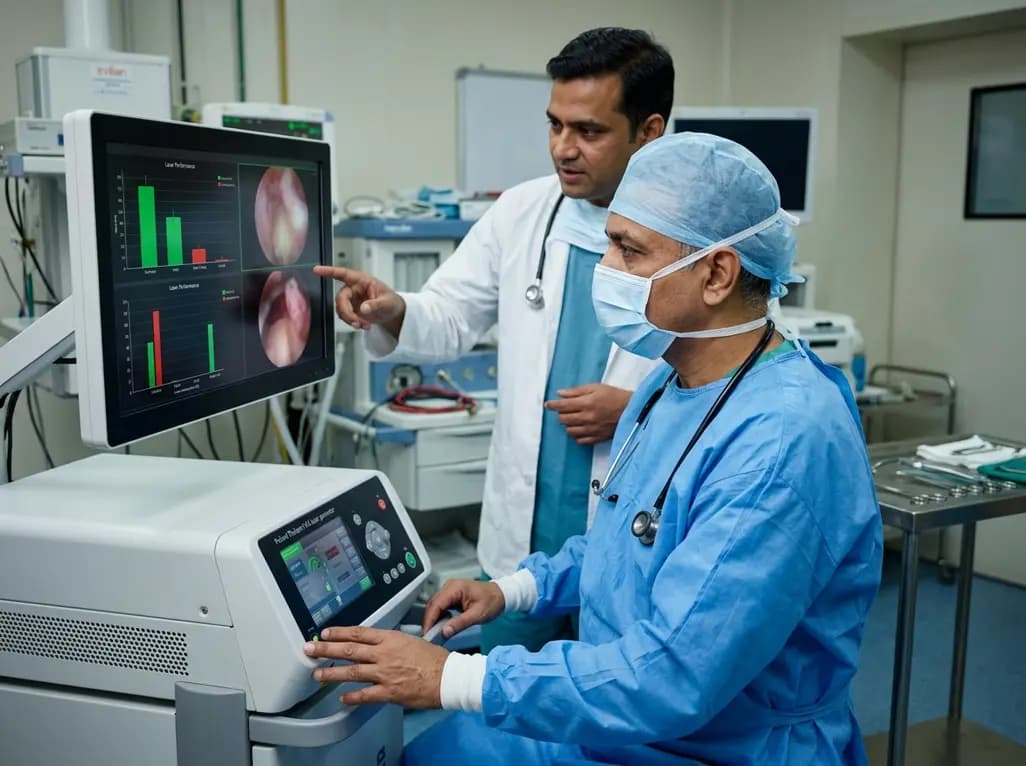
Transurethral anatomical enucleation represents a premier surgical option for managing benign prostatic hyperplasia, especially in moderate-to-large adenomas. Historically, Holmium:YAG and continuous-wave Thulium:YAG systems have dominated clinical practice worldwide. However, technological progress has introduced solid-state pulsed Thulium:YAG systems that broaden surgical possibilities. These novel devices combine the mechanical dissection strength of holmium lasers with the precise vaporization and coagulation of thulium wavelengths. Consequently, pulsed Thulium:YAG EEP has emerged as a promising technique that delivers high surgical efficiency, minimal blood loss, and rapid postoperative functional recovery.
Benign prostatic hyperplasia frequently causes progressive lower urinary tract symptoms that significantly diminish quality of life. While conventional transurethral resection remains widespread, endoscopic enucleation provides complete adenoma removal along the surgical capsule regardless of prostate size. As energy platforms advance, pulsed thulium devices optimize both tissue plane separation and hemostatic control. A comprehensive systematic review in the World Journal of Urology evaluated the clinical safety, operative feasibility, and functional efficacy of these novel generators, providing evidence-based insights for endourologists.
The physical properties of laser energy dictate tissue interaction during transurethral enucleation. Continuous-wave thulium platforms operate at a 2013-nanometer wavelength, matching water absorption peaks to achieve excellent hemostasis. However, continuous-wave emission lacks the acoustic mechanical impulses required for swift mechanical tissue cleaving. In contrast, novel pulsed Thulium:YAG generators deliver high peak power across ultrashort pulses. These pulses generate localized micro-cavitation bubbles in irrigation fluid, producing mechanical dissection forces alongside precise thermal cutting.
Current clinical research evaluates two primary pulsed configurations. The solid-state Dornier Thulio generator functions in a purely pulsed mode with peak power up to 3700 watts, providing tissue separation dynamics similar to holmium lasers. Meanwhile, the hybrid LISA RevoLix HTL platform integrates both continuous-wave and pulsed emissions up to 300 Hertz. This dual functionality allows surgeons to adjust energy output dynamically based on tissue vascularity and adenoma architecture. Both platforms aim to minimize collateral thermal damage to surrounding periprostatic tissue while preserving exceptional visual clarity.
The systematic review adhered strictly to PRISMA guidelines and an a priori registered protocol on the Open Science Framework. Investigators screened PubMed, Scopus, and the Cochrane Library from database inception through May 2026. Applying the PICO framework, the authors identified eight relevant clinical trials. Six studies utilized the purely pulsed Dornier Thulio platform, while two evaluated the hybrid LISA RevoLix HTL system. Furthermore, five studies were comparative designs and three were non-comparative series.
Across the included cohorts, procedural feasibility was consistently demonstrated. Mean operative times ranged from 40.8 ± 21.7 to 101.7 ± 18.5 minutes. Enucleation duration varied between 18.3 ± 8.9 and 83.7 ± 17.2 minutes, primarily reflecting baseline gland volume and surgeon experience. Meanwhile, morcellation times ranged from 10.2 ± 10.1 to 18.0 ± 5.1 minutes without major intravesical complications. Additionally, one comparative study confirmed that miniaturized resectoscopes achieved efficiency equivalent to standard calibers, demonstrating the versatility of pulsed thulium energy across diverse surgical instrumentation.
Functional recovery is a crucial metric when evaluating surgical interventions for benign prostatic obstruction. Across the reviewed studies, pulsed Thulium:YAG systems produced substantial improvements in both subjective and objective voiding parameters. Postoperative follow-ups demonstrated marked reductions in International Prostate Symptom Scores, reflecting rapid relief from storage and voiding complaints. Concurrently, disease-specific Quality of Life scores improved markedly across all patient cohorts.
Objective urodynamic assessments aligned with these symptomatic improvements. The systematic review identified pronounced increases in maximum urinary flow rates (Qmax), confirming the elimination of bladder outlet obstruction. Simultaneously, post-void residual urine volumes decreased significantly following surgery. Importantly, these functional gains remained stable during extended follow-up intervals. These findings indicate that complete anatomical capsular clearance with pulsed thulium energy restores physiological bladder emptying and provides durable long-term symptomatic benefit.
Perioperative safety remains a primary consideration when adopting new surgical technologies. The systematic review assessed adverse events using the standardized Clavien-Dindo classification. Minor complications (Grade I–II), including transient hematuria, mild dysuria, and self-limiting urinary tract infections, occurred in 1.0% to 8.1% of patients. In contrast, major adverse events (Grade III–IV) requiring secondary intervention ranged from 0% to 15.6% across the analyzed cohorts.
Postoperative urinary continence represents another vital quality-of-life endpoint. In the evaluated literature, transient postoperative incontinence rates ranged from 0% to 18.4%. Most occurrences involved temporary stress or urge leakage that resolved spontaneously within weeks following pelvic floor rehabilitation. The low rate of permanent sphincteric impairment stems from the precise cutting depth and limited thermal dispersion of thulium energy. Consequently, the technique protects the apical anatomy and external urinary sphincter from inadvertent thermal injury.
Four comparative studies in the systematic review directly contrasted pulsed Thulium:YAG platforms with the established Holmium:YAG gold standard. Results demonstrated comparable enucleation efficiency, total operative time, and symptom improvement between both technologies. However, pulsed thulium devices frequently provided enhanced optical visibility during dissection due to superior water absorption and instantaneous superficial hemostasis. This characteristic reduces the need for repeated secondary coagulation during the procedure.
These clinical characteristics offer substantial advantages in modern urology practice, where patients frequently present with massive adenomas and concurrent cardiovascular comorbidities. Meticulous hemostasis is especially critical for individuals receiving ongoing anticoagulation therapy. Furthermore, the compact footprint, low noise level, and standard electrical requirements of solid-state pulsed thulium units simplify operating room integration. Because these platforms also support intracorporeal lithotripsy, they provide comprehensive versatility for hospital departments.
Pulsed Thulium:YAG generators combine high water absorption with short, high-peak-power energy pulses. Unlike continuous-wave platforms that rely solely on thermal vaporization, pulsed systems generate micro-cavitation acoustic effects. This mechanical action enables rapid anatomical plane dissection with less mechanical traction, reducing collateral thermal damage to surrounding capsule structures while preserving clear visibility.
Based on systematic review findings, minor Clavien-Dindo Grade I–II complications occur in 1.0% to 8.1% of patients, consisting mainly of transient dysuria, minor bleeding, or mild infections. Major Grade III–IV complications range from 0% to 15.6%. Transient urinary incontinence occurs in 0% to 18.4% of cases, typically resolving rapidly due to minimal thermal spread near the urinary sphincter.
Yes, pulsed Thulium:YAG enucleation is an effective, size-independent procedure suitable for large glands exceeding 80 grams. By following true anatomical capsular planes, surgeons achieve complete adenoma removal with minimal blood loss. Clinical studies show significant improvements in urinary flow rates and post-void residual volumes, offering durable relief comparable to open surgery.
Disclaimer: This content is for informational and educational purposes only, and should not be taken as medical advice. It is not intended to replace professional medical advice, diagnosis, or treatment. Always seek the advice of a physician or other qualified healthcare professional regarding any medical condition or before making any changes to your healthcare regimen. Refer to the latest local and national guidelines for clinical practice.
References

Read summarized clinical updates, watch expert medical content, and earn CME certifications right from your smartphone.
Open your smartphone camera to scan and install.





A systematic review evaluates pulsed Thulium:YAG generators for endoscopic enucleation of the prostate (EEP). Findings show excellent operative efficiency, significant symptom improvement, low complication rates, and outcomes comparable to Holmium:YAG laser platforms.
last month

Chronic eosinophilic pneumonia can present with atypical bronchoalveolar lavage findings and an organizing pneumonia pattern, necessitating surgical lung biopsy.
Today

Discover the crucial distinctions between mesonephric and mesonephric-like proliferations of the female genital tract. Learn the key histomorphologic, immunohistochemical, and molecular differences essential for accurate diagnosis and clinical management.
Today
Kikuchi-Fujimoto disease rarely presents with refractory shock and sinus bradycardia in children. This case report highlights life-threatening hemodynamic instability requiring intensive care, preserved cardiac contractility, and the critical diagnostic role of early excisional lymph node biopsy.
Today

A narrative review investigates whether the articularis genus muscle functions as an independent anatomical entity or blends with the vastus intermedius. We evaluate its morphology, role in retracting the suprapatellar bursa, and direct clinical significance in anterior knee pain and arthroplasty.
Today

A Bayesian multilevel meta-analysis reveals that aerobic training combined with moderate carbohydrate restriction modestly lowers HbA1c in type 2 diabetes. However, sparse data and very low certainty leave incremental benefits over exercise or diet alone unproven, highlighting the need for individualized care.
Today
