.webp&w=384&q=75)

Loading, please wait...
Loading, please wait...

Ultraviolet radiation exposure during adolescence and young adulthood represents a major modifiable trigger for cutaneous carcinogenesis and chronic photoaging. Unfortunately, university students consistently demonstrate poor adherence to routine photoprotection. Many young individuals overlook daily application or fail to carry protective lotions during spontaneous outdoor activities. In response, institutions have introduced public sunscreen dispensers to encourage sun-safe habits across outdoor campus environments. This community-level intervention aims to normalize ultraviolet defense by removing financial and logistical hurdles. However, evaluating whether automated dispensers alter baseline photoprotective behaviors requires careful clinical appraisal.
Cumulative solar ultraviolet exposure induces severe DNA photoproducts, promotes premature cutaneous elastosis, and accelerates melanoma risk. Consequently, preventive dermatologists advocate for regular, broad-spectrum sunscreen application among active young adults. College students spend extensive hours traversing expansive campuses, engaging in intercollegiate athletics, and socializing in uncovered open spaces. Nevertheless, national surveys indicate that fewer than one-third of young adults apply topical photoprotection daily. Furthermore, midday UV index values frequently reach hazardous thresholds when students commute between lecture halls.
Public sunscreen dispensers offer an intuitive structural solution to this ongoing public health dilemma. By positioning automated touchless units in high-footfall areas, academic institutions reduce individual logistical friction. Students no longer need to purchase expensive personal products or remember to pack bulky lotion bottles into their bags. Moreover, prominent outdoor dispensers operate as ambient behavioral nudges. Their visual presence reminds passersby of invisible solar hazards, prompting spontaneous application prior to prolonged exposure. Therefore, these installations address both educational awareness and physical availability simultaneously, laying the vital groundwork for proactive community-level photoprotection.
Recent observational investigations provide valuable insight into how university communities interact with automated sunscreen stations. In a notable campus study, investigators established that 35.5% of surveyed students and staff noticed the dispensers. However, only 22.7% of participants actually dispensed and applied the complimentary lotion. While this utilization rate shows encouraging initial engagement, it highlights a substantial gap between passive awareness and active adoption. Similarly, another observational study of public outdoor settings reported that 17.4% of observed individuals engaged with free dispensers.
Importantly, researcher observations revealed distinct temporal and spatial patterns governing student uptake. Utilization climbed substantially during high UV index hours and unclouded, sunny afternoons. Passersby also utilized dispensers more frequently near recreational sports fields, dining terraces, and swimming facilities where prolonged outdoor stays were anticipated. Furthermore, over 90% of individuals who sampled the dispensers acknowledged heightened consciousness regarding personal sun safety. Approximately 41% reported increased vigilance regarding self-skin examinations. Thus, point-of-care dispensing units serve not only as functional product distribution points but also as effective catalysts for preventive health literacy.
Although public dispenser programs provide undeniable convenience, several persistent friction points hinder universal student adoption. First, inadequate physical visibility severely undermines uptake. Dispensers placed in shadowy corridors or architectural blind spots frequently go unnoticed by preoccupied students navigating crowded pathways. In addition, ambiguous signage often fails to communicate that the product is free, hypoallergenic, and safe for universal use.
Second, cosmetic acceptability represents a formidable barrier for discerning young adults. Many students express hesitation regarding greasy topical vehicles, heavy fragrances, or chalky mineral residues that clash with personal grooming standards. For individuals with darker skin phototypes, visible white residue causes cosmetic dissatisfaction and deters subsequent usage. Similarly, students with acne-prone complexions worry that communal formulations might provoke comedogenesis or facial breakouts. Moreover, a significant subset of students prefers relying on familiar personal skincare regimens, choosing proprietary facial moisturizers with integrated SPF over communal bulk lotions. Addressing these sensory objections through lightweight, broad-spectrum, oil-free formulations is essential for sustaining campus-wide engagement.
Despite encouraging pilot feasibility data, critical clinical questions remain unanswered regarding the true preventive efficacy of campus dispensers. Specifically, current literature lacks robust longitudinal evidence demonstrating measurable reductions in acute erythema or lifetime sunburn incidence. Most available investigations rely on cross-sectional surveys or brief observational periods. Consequently, researchers cannot definitively confirm whether dispensers encourage photoprotection among high-risk individuals who otherwise forgo sun safety, or merely serve existing sunscreen adherents.
Furthermore, researchers have not evaluated whether sporadic dispenser usage translates into habitual, durable photoprotective behavior. Applying sunscreen once before walking across campus does not replace regular two-hour reapplication during sustained midday outdoor sports. Additionally, administrative teams require clear cost-effectiveness data before allocating permanent institutional budgets. Maintenance demands, including frequent cartridge refills, battery replacements, and weatherproofing, impose recurring operational expenses. Without prospective, randomized studies tracking objective clinical endpoints, public health authorities cannot easily quantify the exact return on investment for university-wide dispenser networks.
The lessons derived from college campus initiatives provide vital guidance for primary care physicians, dermatologists, and municipal health authorities. Ultraviolet damage is cumulative, and preventing severe sunburns during young adult years significantly mitigates lifetime melanoma and non-melanoma skin cancer risks. Therefore, integrating environmental modifications with routine clinical counseling creates a mutually reinforcing preventive ecosystem. Clinicians should proactively inquire about outdoor recreation habits and actively encourage patients to utilize municipal photoprotection amenities.
Moreover, campus dispenser initiatives offer a scalable template for broader public venues, including municipal parks, public transit hubs, sports complexes, and construction zones. To maximize operational success, healthcare leaders must advocate for strategic unit positioning, clear instructional signage, and aesthetically refined formulations. Combining physical dispensers with digital awareness campaigns, such as smartphone UV alerts and peer-led educational outreach, further solidifies healthy photoprotective routines. Ultimately, automated dispensers represent a practical structural nudge. When supported by robust educational frameworks and sound institutional policies, they substantially advance community-wide skin cancer prevention.
Current clinical evidence shows that public dispensers raise immediate photoprotective awareness and facilitate point-of-care sun protection during unplanned outdoor exposure. However, published observational trials have not yet established a statistically significant reduction in seasonal sunburn incidence. Consequently, while these installations clearly eliminate physical and financial access barriers, clinicians emphasize that dispensers must integrate with broader educational initiatives, skin safety policies, and routine reapplication counseling to achieve measurable long-term photoprotective efficacy.
Young adults frequently reject topical sunscreens that feel greasy, cause facial shine, or leave an undesirable white residue on darker skin phototypes. Therefore, providing lightweight, non-comedogenic, broad-spectrum chemical or transparent mineral formulations significantly improves voluntary compliance. Furthermore, institutions should consider mounting small mirrors alongside dispenser stations. This simple structural modification allows users to apply the lotion cleanly and evenly without risking ocular irritation or visible cosmetic smearing.
Healthcare administrators should position units along high-traffic pedestrian arteries, athletic stadiums, recreational greens, and campus transit terminals where prolonged solar exposure commonly occurs. In addition, clear promotional signage and prominent architectural cues dramatically elevate student visibility. Combining physical stations with real-time UV index dashboards and digital campus health reminders also reinforces preventive habits, ensuring students actively utilize free photoprotection before engaging in midday sports or outdoor study sessions.
Disclaimer: This content is for informational and educational purposes only. It is not intended as medical advice or a substitute for professional clinical judgment. Healthcare professionals must assess each case individually. Refer to the latest local and national guidelines for clinical practice.
References

Read summarized clinical updates, watch expert medical content, and earn CME certifications right from your smartphone.
Open your smartphone camera to scan and install.





Public sunscreen dispensers offer a scalable approach to promote UV photoprotection among university students. While pilot studies show good feasibility and heightened awareness, barriers like cosmetic texture and visibility remain. Clinicians must evaluate real-world adherence and long-term behavioral change.
Today
A multicity study highlights that over 80% of acute respiratory infections remain outside hospitals. Patients frequently choose community pharmacies and digital platforms. Integrating digital health data and retail pharmacy sales can fill critical surveillance gaps and improve early outbreak detection.
Today

Scandinavian register evidence reveals that neonatal birth length strongly predicts adult health and mortality, whereas birth weight dictates cognitive capacity. Symmetric growth restriction causes far more severe long-term deficits than asymmetric restriction, underscoring the need for comprehensive anthropometry.
Today

Discover how rescue cutting balloon angioplasty successfully modifies heavily calcified carotid stenosis, enabling stent delivery without baroreceptor instability and ensuring favorable long-term neurologic outcomes.
Today
A breakthrough study reveals that digoxin alleviates osteoarthritis by targeting LSP1 in synovial macrophages, preventing harmful extracellular trap formation and restoring SOD1 activity. This dual-action mechanism protects joint cartilage and offers a promising repurposing strategy for disease modification.
Today
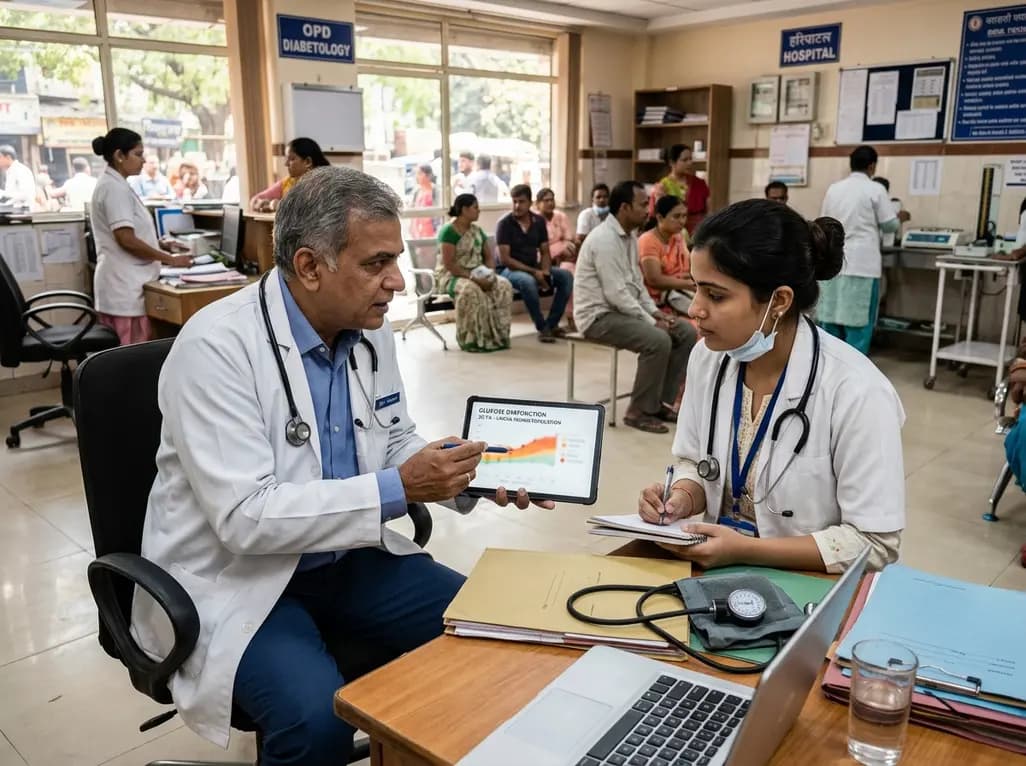
Data from the 2026 Workforce Health Index reveals that 38.7% of urban employees and dependents exhibit abnormal glycemic control. Emerging at increasingly younger ages, this metabolic shift intersects with severe vitamin deficiencies, highlighting the urgent need for early workplace screenings and targeted clinical care.
Today
