

Loading, please wait...
Loading, please wait...

Mass casualty events place an unprecedented psychological burden on civilian survivors and healthcare personnel. Consequently, medical leaders must establish evidence-based mass casualty psychosocial interventions immediately following large-scale disasters. Traumatic exposures during transportation accidents, industrial fires, and natural disasters frequently trigger debilitating psychiatric consequences. Affected individuals often develop posttraumatic stress disorder, major depression, and generalized anxiety. Therefore, clinicians must look beyond initial physical triage to protect long-term mental health. In the acute aftermath, confusion and acute stress can overwhelm conventional hospital resources. Furthermore, emergency responders face unique secondary trauma as they manage distressing clinical scenarios. Historically, disaster response systems relied on informal debriefing, which demonstrated inconsistent clinical benefits. Recent network meta-analytic data synthesize findings from fifty-four clinical trials involving over ten thousand participants across twenty-five nations. This robust evidence clarifies which specific clinical strategies reduce psychological morbidity most effectively. As a result, healthcare systems can now deploy targeted psychological therapies rather than unproven general counseling models. By recognizing acute post-disaster distress promptly, clinicians can initiate timely support before chronic psychiatric disorders become deeply entrenched.
The network meta-analysis demonstrates remarkable differences among therapeutic modalities when addressing posttraumatic stress symptoms. Specifically, early eye movement desensitization and reprocessing demonstrated the highest ranking for symptom resolution. When researchers compared this modality against inactive controls, early desensitization achieved an impressive standardized mean difference of 2.48. Moreover, the therapy maintained substantial superiority against active controls, demonstrating an effect size of 2.36. Prolonged exposure therapy and cognitive behavioral therapy also demonstrated exceptional clinical value. Exposure protocols yielded an effect size of 1.60 against inactive controls. Meanwhile, cognitive behavioral therapy achieved an effect size of 1.40 versus inactive controls and 1.28 against active comparators. Consequently, both modalities ranked consistently high across primary posttraumatic outcomes. Trauma-focused approaches help survivors systematically process terrifying memories, reduce cognitive avoidance, and recalibrate autonomic hyperarousal. Because survivors confront severe cognitive disruption after catastrophic events, structured desensitization facilitates rapid neurological reprocessing. Therefore, mental health teams should prioritize these structured, trauma-focused interventions over non-directive supportive listening. Early deployment of evidence-based trauma therapy actively prevents chronic disability and restores psychological functioning among disaster victims.
Survivors of catastrophic events experience extensive affective disruption alongside posttraumatic stress. In the comprehensive network comparison, exposure therapy achieved the greatest symptom reduction for post-disaster depression, yielding a standardized mean difference of 1.36 against inactive controls. Interpersonal psychotherapy followed closely with an effect size of 1.15. Mind-body practices, cognitive behavioral therapy, and integrative therapies also outperformed control conditions significantly, recording effect sizes of 1.01, 0.85, and 0.67, respectively. Furthermore, exposure therapy, mind-body interventions, and cognitive behavioral therapy retained statistical significance when investigators evaluated them against active controls. With respect to anxiety, exposure therapy, cognitive behavioral therapy, and integrative interventions consistently outperformed both control types. However, researchers noted less precise statistical estimates for anxiety outcomes, highlighting the need for larger confirmatory trials. These clinical findings emphasize that comorbid depressive and anxiety symptoms respond favorably to targeted behavioral activation and cognitive reframing. Consequently, clinicians should not treat post-disaster depression as an isolated clinical entity. Instead, providers should implement integrated multimodal care plans that address trauma triggers, interpersonal grief, and somatic anxiety simultaneously.
Frontline personnel, including paramedics, emergency physicians, and disaster relief workers, endure acute operational stress during mass casualty incidents. Responders frequently encounter gruesome trauma, extreme physical exhaustion, and profound ethical dilemmas during triage. Nevertheless, institutional disaster frameworks rarely provide structured, evidence-based psychological support for their own workforce. Historically, organizations implemented critical incident stress debriefing, yet empirical trials show that mandatory psychological debriefing often fails to prevent chronic trauma. In contrast, evidence-based cognitive behavioral therapy and early desensitization protocols offer robust protection against burnout and acute stress reactions. Medical institutions must overcome pervasive operational barriers, such as occupational stigma, mental health secrecy, and demanding shift work. Healthcare systems should establish designated mental health support officers within emergency medical services to facilitate proactive screening. Additionally, leadership must normalize psychological first aid and confidential behavioral health consultations. When institutions train emergency workers in emotional regulation and resilience strategies before disasters strike, staff members demonstrate superior psychological endurance. Ultimately, protecting healthcare responder well-being preserves overall clinical capacity during national public health emergencies.
Hospital emergency frameworks must integrate psychological triage directly alongside physical trauma algorithms. Because severe physical injuries dominate initial medical attention, healthcare teams often overlook acute psychological shock during emergency resuscitation. However, clinical staff can easily administer rapid screening instruments during post-stabilization observation or discharge planning. Early identification enables clinical teams to stratify survivors into distinct risk tiers. Patients exhibiting severe acute dissociation or marked autonomic hyperarousal require immediate referral for structured trauma-focused psychotherapy. Conversely, individuals experiencing milder distress benefit from supportive monitoring, sleep education, and structured mind-body practices. Furthermore, disaster response authorities should train multidisciplinary mobile mental health teams to deliver brief cognitive behavioral modules in field shelters and clinics. In addition, health systems must address persistent research gaps by evaluating tele-mental health platforms and long-term symptom trajectories beyond twelve months. By embedding specialized behavioral health professionals into disaster response plans, healthcare systems protect psychological well-being as effectively as physical survival.
Early eye movement desensitization and reprocessing demonstrates the highest statistical efficacy for posttraumatic stress disorder following catastrophic disasters. In rigorous network meta-analyses, early desensitization achieved an impressive standardized mean difference of 2.48 over inactive controls and 2.36 over active comparators. Additionally, trauma-focused cognitive behavioral therapy and prolonged exposure therapy demonstrated powerful, reliable therapeutic effects. Clinicians should prioritize these structured, evidence-based trauma modalities over unstructured, non-directive counseling for acute post-disaster trauma.
Mind-body practices and integrative therapies demonstrate significant therapeutic utility, particularly for secondary depressive symptoms and generalized anxiety. In comparative network meta-analyses, mind-body interventions achieved a notable standardized mean difference of 1.01 against controls, outperforming general supportive care. However, cognitive behavioral therapy and exposure protocols demonstrate broader efficacy across comorbid trauma, anxiety, and depression. Consequently, clinicians frequently employ mind-body practices as valuable adjuncts within a comprehensive stepped-care model for disaster survivors.
Healthcare institutions should establish stepped psychological care immediately following catastrophic events rather than waiting for chronic disability to develop. Initially, organizations must deliver basic psychological first aid, secure rest cycles, and provide operational debriefing. If frontline responders exhibit persistent intrusive memories, sleep disturbances, or emotional detachment past two to four weeks, clinicians should initiate evidence-based cognitive behavioral therapy. Early intervention halts symptom progression, preserves emergency workforce resilience, and prevents long-term occupational attrition.
Disclaimer: This content is for informational and educational purposes only and does not constitute formal medical advice. Healthcare professionals must exercise independent clinical judgment. Refer to the latest local and national guidelines for clinical practice.
References
Macgowan MJ et al. Psychosocial interventions for adult survivors and responders exposed to mass casualty events: A systematic review and network meta-analysis. J Trauma Stress. 2026 Oct 22. doi: 10.1002/jts.70128. PMID: 42908503.
World Health Organization. Mental health in emergencies. Geneva: World Health Organization; 2025.
World Health Organization. Mass casualty management systems: Strategies and guidelines for building health sector capacity. Geneva: World Health Organization; 2007.

Read summarized clinical updates, watch expert medical content, and earn CME certifications right from your smartphone.
Open your smartphone camera to scan and install.





A network meta-analysis of 54 studies highlights evidence-based psychosocial interventions after mass casualty events. Early EMDR, exposure therapy, and CBT demonstrate superior efficacy in alleviating PTSD, depression, and anxiety among adult survivors and frontline emergency responders.
Today
Explore vital recurrent stroke predictors in lacunar stroke patients managed with intensive blood pressure lowering. This analysis examines trial findings from SPS3 to uncover residual vascular risks, metabolic factors, and targeted secondary prevention strategies for high-risk neurological patients.
Today

Odisha has established India's first state-level clinical protocol specifically tailored for pregnant women with sickle cell disease. Developed with NHM and UNICEF, the framework provides structured antenatal screening, crisis mitigation, standardized referral pathways, and specialized interdisciplinary care.
Today

India is advancing preventive healthcare by integrating genomics, artificial intelligence, and quantum technologies. With the SANGAM programme sequencing one million Indian genomes, clinicians can unlock personalized therapies, detect cardiometabolic risks early, and curb the burden of diabetes and heart disease.
Today
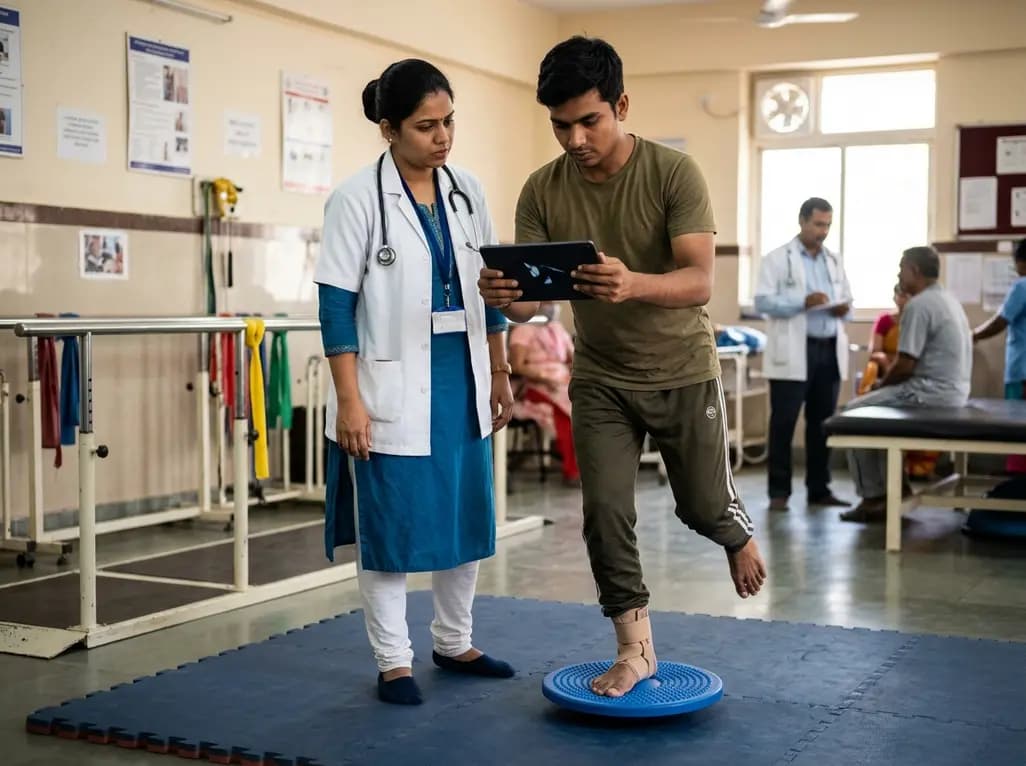
A randomized controlled trial demonstrates that an eight-week dual-task training intervention significantly improves static and dynamic postural control over standard balance exercises in individuals with chronic ankle instability, addressing critical neurocognitive deficits during athletic and daily activities.
Today

A retrospective cohort study of 7,716 ICU patients from the MIMIC-IV database demonstrates that Gradient Boosting Decision Trees significantly outperform traditional SOFA scores in predicting in-hospital mortality among patients with sepsis and diabetes, with SHAP analysis providing clinical interpretability.
Today
