.webp&w=384&q=75)

Loading, please wait...
Loading, please wait...
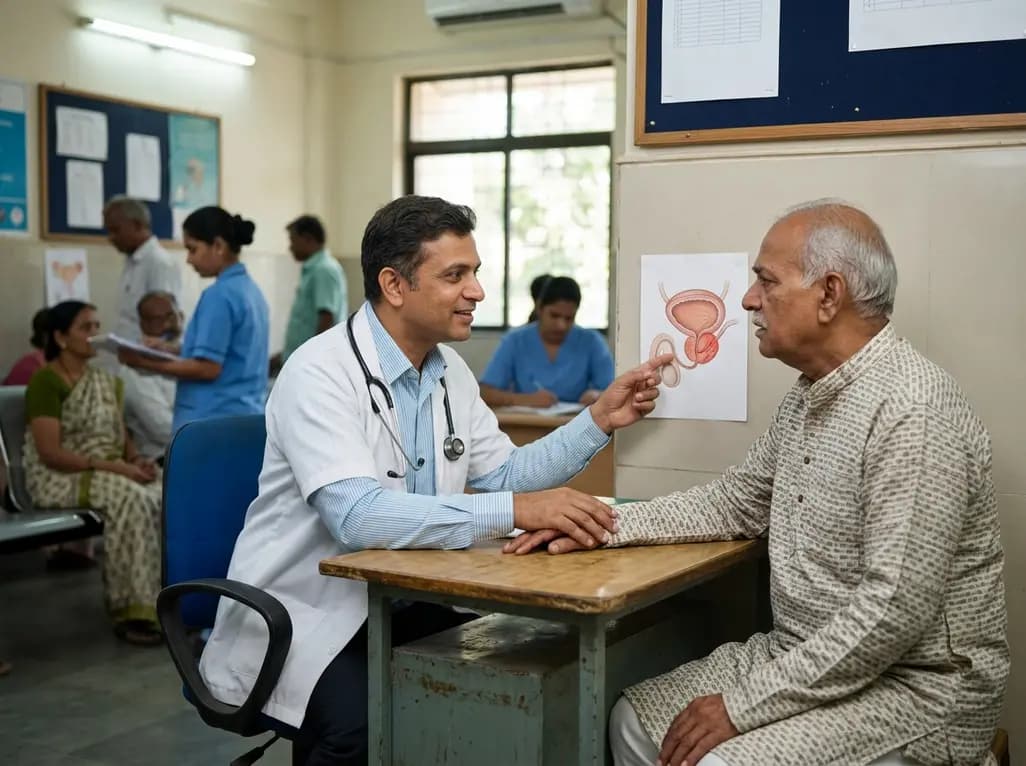
Prostate malignancy is an increasing health concern among aging Indian males. Unfortunately, proactive prostate cancer screening remains underutilized in outpatient clinics. A recent national survey indicates substantial public unawareness regarding risk factors and diagnostic tests. Consequently, clinicians must actively initiate early screening discussions.
A nationwide survey conducted by the Heal Foundation evaluated 1,036 men aged 45 and above across major regions. These regions included Delhi NCR, Maharashtra, Tamil Nadu, Karnataka, and Telangana. The investigation revealed that six in 10 men do not know whether they have ever undergone screening. Furthermore, 84 percent of respondents are either unscreened, uncertain of their status, or convinced that screening is unnecessary.
Equally alarming is the widespread lack of risk factor awareness among these surveyed individuals. Nearly 69 percent of participants could not name a single factor predisposing them to prostate malignancy. Additionally, only about 13 percent recognized a family history of malignancy as an established risk. Approximately 75 percent of men incorrectly assumed that monitoring becomes relevant only after age 50. Consequently, only one in six men reported ever completing any prostate-specific examination. These figures clearly demonstrate an urgent clinical need for structured doctor education. Physicians must proactively address these widespread misconceptions during ordinary clinic visits before symptoms actually appear. Therefore, healthcare providers must take active ownership of preventive conversations rather than waiting for patients to request testing.
A critical barrier to early detection is public unfamiliarity with the prostate-specific antigen test. The national survey discovered that only 31 percent of men had ever heard of the PSA test. Moreover, a mere 14 percent of respondents had ever specifically requested the test from their doctor. This low testing literacy severely restricts patient self-advocacy in urban and semi-urban settings alike.
In routine clinical practice, serum PSA testing serves as an accessible first-line biochemical marker. When doctors combine serum PSA assessments with digital rectal examinations, diagnostic accuracy increases substantially. However, many men harbor anxiety regarding invasive examinations or misunderstand the purpose of a routine blood draw. Furthermore, social stigma and cultural reticence often prevent men from discussing lower urinary tract symptoms openly.
Consequently, early localized lesions frequently go unnoticed during initial stages when curative interventions are most successful. Clinicians should therefore explain that a simple blood test can provide invaluable baseline data. In addition, healthcare teams must normalize preventive prostate discussions within regular health evaluations. Ultimately, proactive testing enables early intervention and preserves long-term quality of life for vulnerable Indian men.
The clinical consequences of delayed detection in the Indian healthcare landscape are severe and well-documented. Data from the National Cancer Registry Programme reveals a distressing reality regarding disease stage at diagnosis. In Western nations, active screening programs identify the majority of prostate tumors in localized, treatable phases. In stark contrast, Indian registries report that more than 40 percent of patients present with distant metastases.
This delayed presentation leads to a significantly higher mortality-to-incidence ratio compared to global benchmarks. Furthermore, Indian patients frequently display higher Gleason scores and aggressive histopathological features at initial presentation. When malignancy spreads beyond the prostatic capsule, curative therapeutic options diminish rapidly. As a result, treatment shifts from curative surgical resection or localized radiotherapy to systemic androgen deprivation therapy.
Additionally, managing advanced metastatic disease imposes immense physical, emotional, and economic burdens on families. Many men mistakenly believe that prostate disorders only affect elderly individuals beyond their seventh decade. However, significant biological heterogeneity means aggressive forms can emerge much earlier in life. Therefore, closing the diagnostic window through vigilance in primary care is crucial for reducing preventable mortality. Clinicians must recognize this vulnerability and screen high-risk individuals actively during regular clinic visits.
A striking paradox in modern healthcare is the missed opportunity during general executive health checkups. Dr. Nitesh Rohatgi from Fortis Memorial Research Institute emphasized this critical systemic disconnect. He observed that men actively participate in annual physical checkups, yet prostate evaluations remain absent. Consequently, standard diagnostic packages frequently omit serum PSA testing and rectal examinations.
This clinical inertia stems from fragmented consultation protocols and brief encounter times in busy outpatient settings. Furthermore, primary care physicians often prioritize metabolic markers such as lipid panels, fasting glucose, and creatinine. While these tests are undeniably vital, genitourinary health requires equal diagnostic attention in aging males. Omitting prostate discussions gives patients a false reassurance that their genitourinary system is healthy.
Therefore, institutional healthcare providers must redesign executive wellness packages to incorporate age-appropriate prostate evaluations. In addition, doctors must actively ask male patients about subtle urinary hesitations or nocturia. Clinicians should not assume that a quiet patient is an unaffected patient. Instead, physicians must take the initiative to bridge this gap during every comprehensive preventive health encounter. Ultimately, proactive institutional integration will reliably identify localized tumors before irreversible clinical progression occurs.
Standardizing clinical workflows according to established guidelines is essential for effective early detection. The Urological Society of India recommends personalized, risk-stratified screening for well-informed men. Specifically, asymptomatic men aged 50 and above with a life expectancy exceeding ten years warrant evaluation. Moreover, men with a proven familial history of prostate malignancy should begin shared decision-making at age 45.
Clinicians should perform an initial serum PSA test alongside a thorough digital rectal examination. If the baseline serum PSA remains below 1 ng/mL, clinicians can safely repeat testing at longer intervals. However, when PSA levels range between 4 and 10 ng/mL, clinicians must consider secondary evaluations. Adjunctive tests include free-to-total PSA ratio, PSA velocity, and multiparametric magnetic resonance imaging. Multiparametric MRI provides exceptional anatomical resolution, reliably distinguishing indolent lesions from clinically significant neoplasms.
Consequently, targeted MRI-ultrasound fusion biopsies minimize unnecessary tissue sampling while maximizing cancer detection accuracy. Family physicians must actively counsel patients on the benefits and limitations of screening. By adopting these structured guidelines, clinicians can successfully avert late-stage diagnoses across India. Furthermore, organized screening ensures that vulnerable individuals receive prompt, life-saving therapeutic interventions.
Q1: Why are most Indian men unaware of their prostate screening status?
The widespread lack of awareness stems from systemic gaps in preventive care. Routine adult health checkups rarely include prostate-specific antigen testing or rectal examinations. Furthermore, public health campaigns seldom highlight male genitourinary malignancies, leaving individuals uninformed about baseline risk. Cultural embarrassment also discourages patients from discussing subtle urinary symptoms. Consequently, men assume that evaluation is unnecessary unless severe clinical difficulties emerge.
Q2: At what age should men in India start discussing prostate screening?
Standard urological guidelines recommend that men at average risk begin screening discussions at age 50. However, individuals with a family history of prostate or related cancers should initiate shared decision-making at age 45. While many men mistakenly believe monitoring starts much later, early assessment establishes critical baseline values. Therefore, clinicians must routinely evaluate family history to determine appropriate screening schedules for each patient.
Q3: How does PSA blood testing assist in early prostate cancer diagnosis?
The prostate-specific antigen test detects elevated glycoprotein levels released by damaged prostate tissue. Although PSA elevation is not exclusive to cancer, it serves as an effective screening indicator. Combining serum testing with digital rectal examination identifies localized tumors before symptomatic advancement. Furthermore, baseline values help stratify patient risk and guide biopsy decisions. Consequently, physicians should encourage timely testing during routine checkups.
Disclaimer: This content is for informational and educational purposes only. It does not constitute medical advice or replace professional judgment. Refer to the latest local and national guidelines for clinical practice.
References

Read summarized clinical updates, watch expert medical content, and earn CME certifications right from your smartphone.
Open your smartphone camera to scan and install.





A recent national survey reveals that 60% of Indian men aged 45 and above remain unaware of their prostate cancer screening status. Discover key findings on PSA test familiarity, underlying clinical barriers, and actionable guidance for primary physicians to bridge early diagnosis gaps across Indian outpatient care.
Today

Novel biomimetic flexible polypyrrole sensors integrate mechanical hemodynamics with exhaled ammonia detection, offering noninvasive monitoring for chronic kidney disease and remote clinical care.
Today

Maharashtra has initiated the appointment of two dedicated special public prosecutors in every district alongside a joint police-health SOP to fast-track PCPNDT and MTP cases. Medical imaging centers, radiologists, and obstetricians must strengthen statutory documentation and audit preparedness.
Today
A prospective study evaluates percutaneous renal denervation in high-risk patients with resistant hypertension, demonstrating significant short-term blood pressure reduction alongside notable procedural considerations.
Today

A landmark global analysis of over six million people reveals that pain does not increase steadily with aging. Instead, pain accelerates fastest before age 55, affects women disproportionately across anatomical sites, and imposes a much heavier burden on populations in developing countries.
Today
A modified Delphi study identified crucial clinical and research priorities for older transgender adults. Key findings emphasize provider education, screening for social isolation, navigation of community resources, and long-term evaluation of gender-affirming hormone therapy safety during the aging process.
Today
