.webp&w=384&q=75)

Loading, please wait...
Loading, please wait...
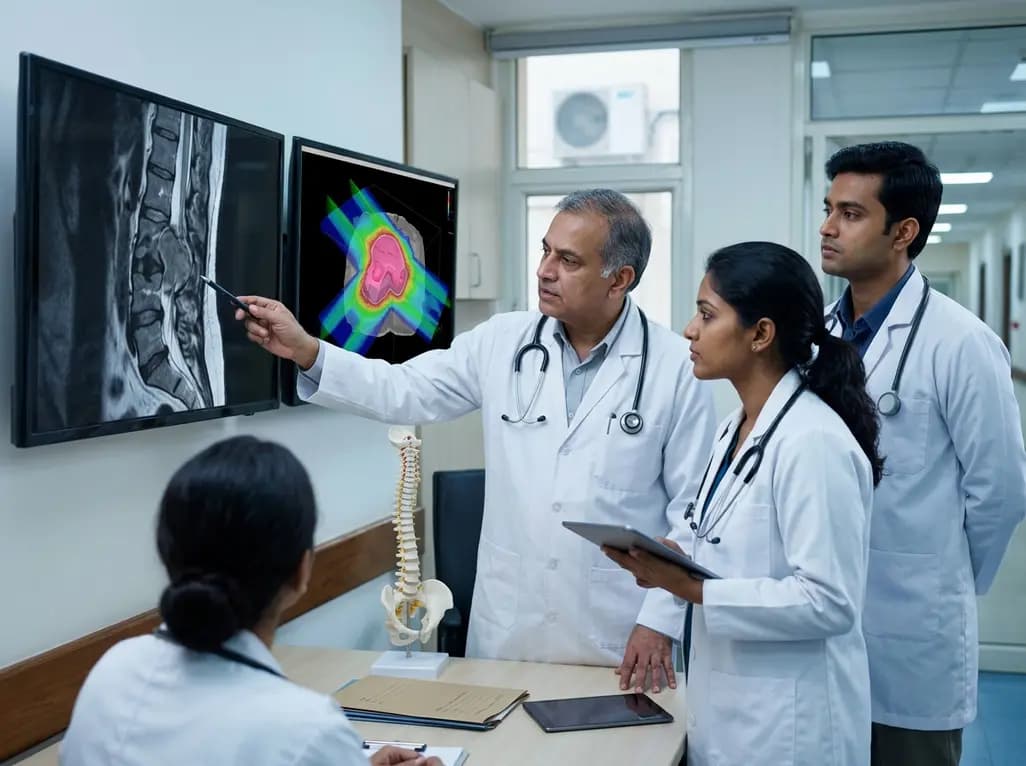
Primary spinal tumor management remains a significant clinical challenge for oncologists and surgeons across the globe. While en bloc resection with wide margins is the established gold standard for achieving local control, many cases involve anatomical complexities that make this approach impossible. Consequently, clinical teams are increasingly exploring the efficacy of intralesional excision combined with advanced adjuvant therapies. A recent retrospective analysis provides valuable insights into how combining surgery with charged-particle radiation therapy (CPRT) can improve survival and disease control in these difficult cases.
Researchers analyzed a cohort of 36 patients treated for primary tumors of the mobile spine between 2015 and 2024. Most cases involved chordomas, which are known for their aggressive local behavior. Because these patients were not eligible for en bloc resection, they underwent intralesional surgery. This included either intracapsular excision or gross total extracapsular resection. Notably, 75% of the participants used CFR-PEEK posterior instrumentation to facilitate postoperative imaging and radiation planning.
Following surgery, all patients received adjuvant charged-particle therapy, such as Carbon Ion Radiation Therapy (CIRT) or Proton Beam Therapy (PBT). These specialized modalities allow for precise dose escalation while sparing adjacent critical structures like the spinal cord. Furthermore, the study focused on whether these treatments could provide acceptable outcomes even for patients with recurrent tumors. Results showed a 3-year survival probability of 88.3%, highlighting the importance of multidisciplinary care in primary spinal tumor management.
The analysis revealed that local recurrence (LR) is a critical factor in patient prognosis. Specifically, the occurrence of LR during follow-up emerged as a significant predictor for mortality. Fifty percent of the patients experienced one or more post-operative recurrences. However, the study noted that the specific type of intralesional surgery did not significantly impact the rate of recurrence. This suggests that the biological behavior of the tumor and the efficacy of the adjuvant radiotherapy play more dominant roles in long-term control than the surgical technique alone.
Charged-particle therapies, like protons and carbon ions, offer superior dose distribution. They deliver high energy directly to the tumor site with a rapid fall-off, which protects the spinal cord from radiation damage and allows for higher, more effective doses.
In spinal tumor cases, local recurrence is strongly linked to higher mortality rates. Because the spine houses the central nervous system, recurring tumors can cause devastating neurological deficits and complicate further surgical interventions.
While en bloc resection is preferred, it is often not feasible due to the tumor\'s proximity to major vessels or nerves. For these patients, intralesional surgery followed by CPRT provides an acceptable alternative that balances oncological control with the preservation of functional quality of life.
Disclaimer: This content is for informational and educational purposes only and does not constitute medical advice. Always seek the advice of a qualified healthcare provider with any questions regarding a medical condition. Refer to the latest local and national guidelines for clinical practice.
References
Pipola V et al. Does intralesional excision plus adjuvant charged- particles radiation therapy matter on local disease control and survival in the management of primary spinal tumors not eligible for en bloc resection? retrospective analysis of a cohort of 36 patients from a single institution. Eur Spine J. 2026 Jun 04. doi: 10.1007/s00586-026-10027-x. PMID: 42237047.
DeLaney TF, et al. Proton Beam Radiotherapy for Chordoma and Chondrosarcoma of the Skull Base and Spine. International Journal of Radiation Oncology*Biology*Physics. 2014.
Boriani S, et al. Primary tumors of the mobile spine: a European multicenter study. European Spine Journal. 2010.
"
Read summarized clinical updates, watch expert medical content, and earn CME certifications right from your smartphone.
Open your smartphone camera to scan and install.





A retrospective study evaluates intralesional excision and charged-particle therapy for spinal tumors not eligible for en bloc resection, showing positive d...
4 months ago

Novel diimide and hydrazone scaffolds, particularly compound #C4, synergistically reactivate latent HIV-1 when combined with JQ1 or PKC activators. Demonstrating donor-matched proviral transcription ex vivo and non-canonical signaling, these findings advance shock and kill strategies toward reservoir eradication.
Today

A cross-sectional study reveals that maternal RSV vaccination coverage reached only 43.7% in Argentina, with maternal vaccine knowledge being the sole independent predictor of uptake. Clinicians play a crucial role in eliminating informational and structural barriers to optimize infant health.
Today

Review how tailored exercise programs benefit frail older patients with heart failure. Explore pathophysiological mechanisms, individualized training prescriptions, and strategies to overcome adherence barriers in clinical practice.
Yesterday

This comparative study evaluates posterior labral tears with and without glenohumeral instability, highlighting distinct demographic patterns, MRI underestimation in stable shoulders, and successful arthroscopic repair outcomes.
Yesterday

A clinical study demonstrates that early intervention with tocilizumab, either as monotherapy or bridged with corticosteroids, achieves significant proptosis reduction and resolves active inflammation in treatment-naive thyroid eye disease.
Yesterday
