.webp&w=384&q=75)

Loading, please wait...
Loading, please wait...
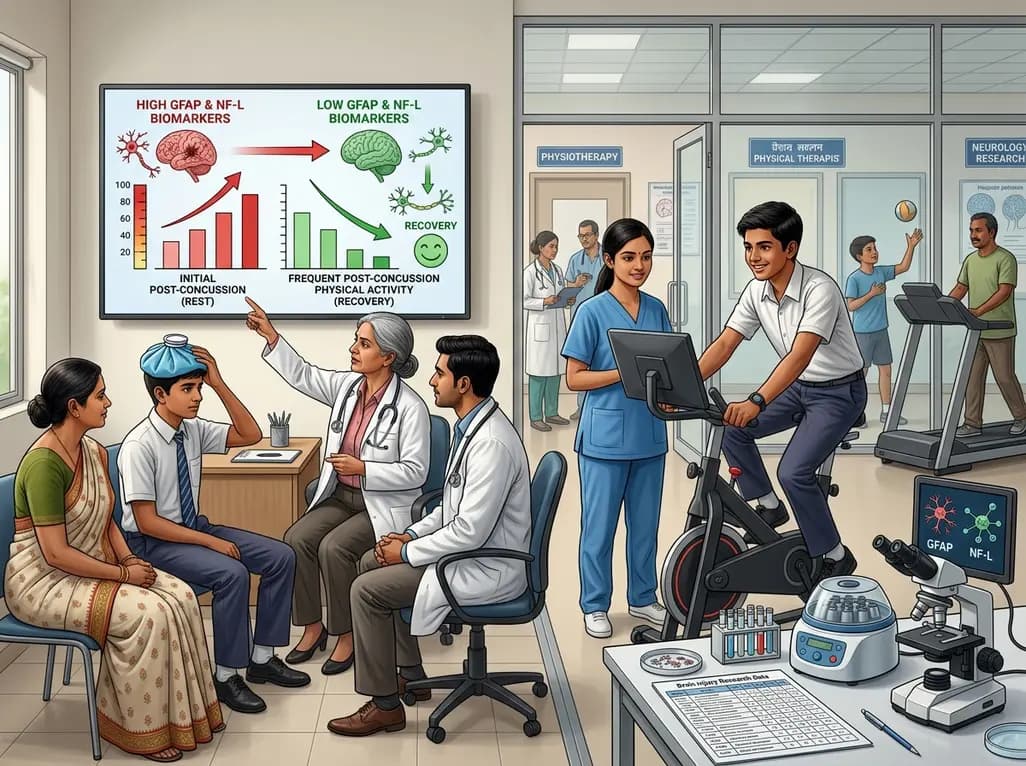
For decades, clinicians recommended strict rest following a head injury. However, recent evidence suggests that postconcussion physical activity may actually accelerate the healing process. A new study published in the Journal of Neurosurgery: Pediatrics explores how the frequency of activity influences specific blood biomarkers of brain injury. Specifically, researchers investigated whether engaging in early movement correlates with lower levels of proteins that signal neurological damage.
Researchers conducted a cross-sectional analysis involving 57 adolescents evaluated within 21 days of injury. They measured plasma concentrations of glial fibrillary acidic protein (GFAP) and neurofilament light chain (NF-L). These biomarkers serve as objective indicators of astrocyte damage and axonal injury, respectively. Notably, the study found that participants who engaged in more frequent physical activity exhibited significantly lower concentrations of these biomarkers. After adjusting for age and symptom severity, every 10% increase in the percentage of active days led to a 5.1% decrease in GFAP and a 7.9% decrease in NF-L.
These findings provide a biological basis for the shift toward active recovery protocols. Furthermore, the reduction in GFAP and NF-L suggests that postconcussion physical activity promotes ongoing neurobiological repair processes rather than causing further harm. Consequently, clinicians should consider personalized activity plans for adolescents to optimize recovery trajectories. While the intensity of exercise must remain sub-symptomatic, the frequency of movement appears to be a critical factor in reducing secondary neurobiological stress.
Moreover, the study emphasizes that physical activity is associated with improved clinical outcomes. Because these biomarkers reflect structural damage to the central nervous system, their decline indicates a more robust recovery. Therefore, integrating managed activity into the early post-injury phase can mitigate the deconditioning often associated with prolonged rest. This approach not only addresses physical health but also supports the psychological well-being of adolescent athletes who often struggle with the isolation of traditional rest protocols.
Engaging in frequent, managed physical activity helps lower plasma levels of GFAP and NF-L. These reductions suggest that activity supports neurobiological healing and reduces the overall burden of brain injury biomarkers in the bloodstream.
The study highlights GFAP (a marker of astrocyte damage) and NF-L (a marker of axonal injury). Both biomarkers show significant decreases as the frequency of post-injury physical activity increases.
Disclaimer: This content is for informational and educational purposes only and does not constitute medical advice. It is not intended to be a substitute for professional medical advice, diagnosis, or treatment. Always seek the advice of your physician or other qualified health provider with any questions you may have regarding a medical condition. Refer to the latest local and national guidelines for clinical practice.
References
Moseley RR et al. Postconcussion physical activity frequency and plasma biomarker associations among adolescents. J Neurosurg Pediatr. 2026 Jun 12. doi: 10.3171/2026.2.PEDS25624. PMID: 42284615.
Grool AM, et al. Association Between Early Participation in Physical Activity Following Acute Concussion and Persistent Postconcussive Symptoms. JAMA. 2016;316(23):2504-2514. doi:10.1001/jama.2016.17396.
Tabor JB, et al. Plasma Biomarkers of Traumatic Brain Injury in Adolescents With Sport-Related Concussion. JAMA Netw Open. 2024;7(9):e2431959. doi:10.1001/jamanetworkopen.2024.31959.
"
Read summarized clinical updates, watch expert medical content, and earn CME certifications right from your smartphone.
Open your smartphone camera to scan and install.





A study of 57 adolescents reveals that frequent physical activity after a concussion correlates with significantly lower plasma levels of GFAP and NF-L. These findings indicate that postconcussion physical activity may actively support neurobiological repair and improve clinical recovery outcomes.
4 months ago

Discover the crucial role of glymphatic dysfunction in stroke, where perivascular clearance failure and neuroinflammation exacerbate cerebral edema and post-stroke brain injury.
Today

A prenatal case highlights severe glutaric acidemia type II presenting as bilateral hyperechoic cystic kidneys at 18 weeks. Whole-exome sequencing revealed a novel homozygous ETFDH frameshift variant, demonstrating the power of rapid genetic testing in fetal renal anomalies.
Today

Review how tailored exercise programs benefit frail older patients with heart failure. Explore pathophysiological mechanisms, individualized training prescriptions, and strategies to overcome adherence barriers in clinical practice.
Yesterday

This comparative study evaluates posterior labral tears with and without glenohumeral instability, highlighting distinct demographic patterns, MRI underestimation in stable shoulders, and successful arthroscopic repair outcomes.
Yesterday

A clinical study demonstrates that early intervention with tocilizumab, either as monotherapy or bridged with corticosteroids, achieves significant proptosis reduction and resolves active inflammation in treatment-naive thyroid eye disease.
Yesterday
