.webp&w=384&q=75)

Loading, please wait...
Loading, please wait...

Depressive symptoms medical students experience have emerged as a significant concern within global health professions education. Medical training demands rigorous academic dedication, long clinical hours, and continuous exposure to high-stress environments. Consequently, trainees often encounter psychological strain that can compromise personal well-being and clinical care quality. While structural pressures are well-recognized, individual psychological factors play an equally vital role in shaping mental health outcomes. Recent research highlights how underlying personality trait dimensions significantly influence vulnerability or resilience to emotional distress during medical school.
Understanding the pathways that link personality traits to psychological distress is crucial for early intervention. Broad personality dimensions, such as neuroticism, extraversion, and conscientiousness, shape how individuals perceive external demands and utilize coping mechanisms. Furthermore, internal psychological resources, such as hope, efficacy, resilience, and optimism, collectively known as psychological capital, serve as pivotal buffers. Investigating how these personal characteristics interact with perceived stress offers essential insights into preventing depressive symptoms medical students face during their critical training years.
The Five-Factor Model of personality provides a comprehensive framework for examining psychological distress in medical undergraduates. Neuroticism consistently emerges as a primary predictor of negative emotional outcomes. Students scoring high in neuroticism tend to experience heightened emotional reactivity and vulnerability to daily stressors. Consequently, higher neuroticism directly correlates with elevated rates of depressive symptoms medical students report during clinical rotations.
Conversely, traits like extraversion, conscientiousness, agreeableness, and openness to experience demonstrate protective effects. Conscientious students typically employ organized problem-solving strategies, while extraverted individuals actively seek social support networks. These positive trait dimensions foster constructive engagement with academic workloads and clinical duties. Furthermore, agreeableness and openness facilitate healthy interpersonal communication and adaptive coping strategies. Therefore, recognizing these baseline personality profiles enables educators to identify vulnerable students early and implement targeted supportive interventions tailored to individual risk profiles.
Psychological capital represents a positive developmental state characterized by self-efficacy, optimism, hope, and resilience. Rather than remaining static, psychological capital operates as a dynamic resource that individuals can actively develop and strengthen over time. Research demonstrates that positive personality traits, particularly conscientiousness and extraversion, strongly bolster a student's psychological capital reservoir. Students possessing high psychological capital maintain a firm belief in their ability to overcome complex clinical challenges and achieve academic success.
In contrast, elevated neuroticism significantly diminishes psychological capital reserves. When students lack confidence in their problem-solving abilities or hold pessimistic views regarding their outcomes, emotional distress escalates rapidly. Psychological capital acts as a key mediator because it converts underlying personality dispositions into practical coping behaviors. By enhancing psychological capital through deliberate educational workshops and mentorship programs, medical institutions can effectively mitigate the negative impacts of personality-related vulnerabilities on student mental health.
Perceived stress measures the degree to which an individual evaluates life situations as overwhelming or uncontrollable. In medical education, the actual workload often matters less than how students subjectively perceive and evaluate that workload. Students with diminished psychological capital frequently perceive daily academic responsibilities as unmanageable threats rather than constructive challenges. Consequently, heightened perceived stress directly accelerates the onset and severity of depressive symptoms medical students experience.
Sequential mediation modeling illustrates that personality traits influence depressive symptoms through a two-step psychological chain. First, underlying traits dictate the depth of a student's psychological capital. Next, the level of psychological capital directly shapes how much stress the student perceives in daily clinical training. Finally, sustained perceived stress translates into overt depressive symptoms. Recognizing this sequential pathway underscores the necessity of addressing both internal psychological strengths and cognitive stress appraisals when designing wellness initiatives for medical trainees.
The identification of sequential mediation pathways provides actionable strategies for medical faculty and student support services. Rather than attempting to alter fixed personality traits, institutional interventions should target modifiable intermediate factors. Programs specifically designed to build psychological capital, such as cognitive-behavioral resilience training, peer mentorship, and mindfulness-based stress reduction, offer substantial therapeutic value. Strengthening efficacy and optimism equips medical undergraduates with robust coping mechanisms before acute distress escalates.
Additionally, medical schools must implement proactive screening and early detection systems for medical trainees displaying signs of high perceived stress. Reducing administrative burdens, establishing flexible study schedules, and fostering a supportive institutional culture significantly alleviate external stressors. Combining systemic curricular modifications with personalized psychological skill-building creates a healthier educational ecosystem. Ultimately, prioritizing student well-being protects future physicians, improves academic retention, and enhances long-term healthcare quality.
Neuroticism is the primary personality trait positively associated with depressive symptoms due to increased emotional reactivity and stress sensitivity. Conversely, extraversion, conscientiousness, agreeableness, and openness to experience are negatively associated with depressive symptoms, acting as protective psychological buffers through adaptive coping mechanisms and social engagement.
Psychological capital combines self-efficacy, hope, optimism, and resilience to enhance a student's capacity to navigate complex challenges. By fostering constructive coping strategies and problem-solving skills, psychological capital lowers perceived stress levels, directly reducing vulnerability to severe depressive symptoms during intensive medical training.
Yes, medical institutions can modify perceived stress by implementing structural curricular reforms, managing academic workloads, and offering dedicated mental health support services. Furthermore, delivering structured resilience workshops and stress-management training empowers students to appraise academic demands as manageable challenges rather than threats.
Disclaimer: This content is for informational and educational purposes only. It does not constitute professional medical advice, diagnosis, or treatment. Always seek the advice of a qualified healthcare provider or mental health professional with any questions regarding a medical condition. Refer to the latest local and national guidelines for clinical practice.
References
Wang Z et al. Personality Trait Dimensions and Depressive Symptoms Among Medical Students: Sequential Mediation Through Psychological Capital and Perceived Stress. Depress Anxiety. 2026 undefined undefined. doi: 10.1155/da/9727081. PMID: 42564616.

Read summarized clinical updates, watch expert medical content, and earn CME certifications right from your smartphone.
Open your smartphone camera to scan and install.





A cross-sectional study reveals how personality traits influence depressive symptoms among medical students, sequentially mediated by psychological capital and perceived stress.
last month

A prospective discrete choice experiment reveals that patients with chronic lymphocytic leukemia prioritize progression-free survival and quality of life over dosing convenience, highlighting vital trade-offs between cardiac, renal, and neurologic toxicities in collaborative oncology decision-making.
Today
A recent longitudinal study evaluated the link between prenatal loss of control eating and cardiovascular health using Life's Essential 8 frameworks. While direct associations across pregnancy were non-significant, the high prevalence of dysregulated eating highlights critical implications for obstetric practice.
Today
A cross-sectional analysis of NHANES 2013-2020 reveals that depressive symptoms and sleep disturbance significantly elevate the odds of cardiometabolic multimorbidity in adults with arthritis. Comprehensive clinical screening and integrated multi-organ interventions are vital to reduce overall cardiovascular burden.
Today
Systematic review comparing labral repair and reconstruction in primary hip arthroscopy shows comparable short- to mid-term patient-reported outcomes, with lower THA conversion after repair but superior outcomes for reconstruction in patients aged 40 and older.
Yesterday
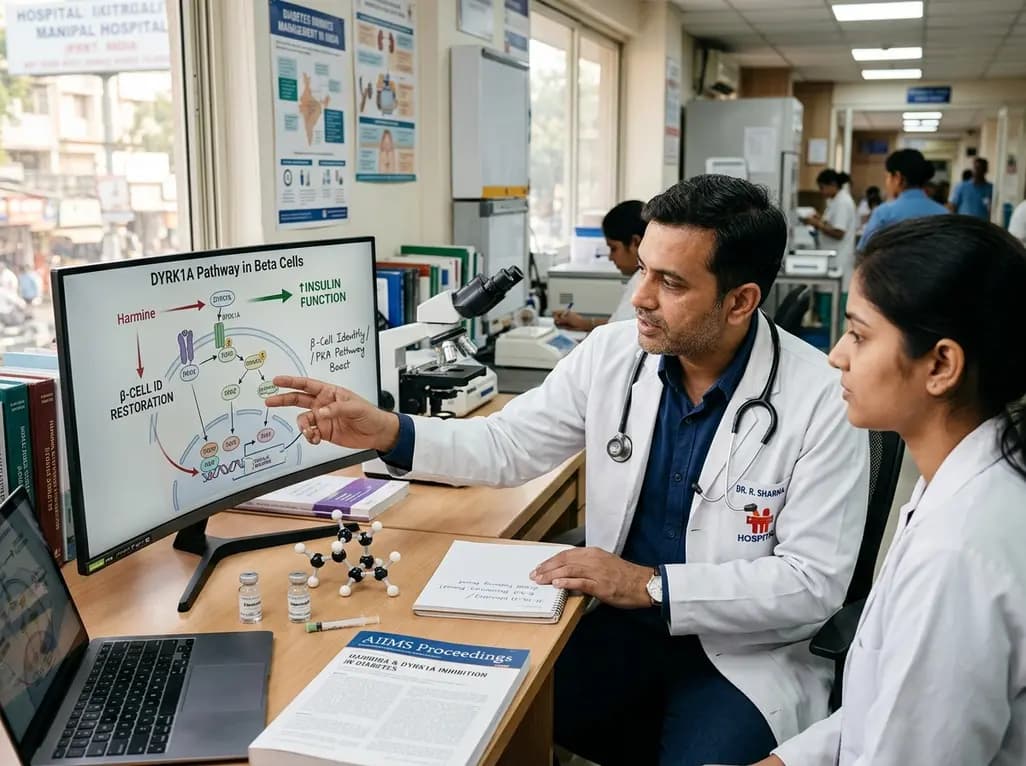
A breakthrough study shows that harmine restores insulin-producing beta cell mass and boosts functional identity markers through an unexpected protein kinase A pathway. This finding demonstrates that small-molecule DYRK1A inhibitors possess divergent therapeutic capabilities in diabetes management.
Today
