.webp&w=384&q=75)

Loading, please wait...
Loading, please wait...

Pancreatic ductal adenocarcinoma remains one of the most lethal gastrointestinal malignancies globally. Most patients present with advanced disease driven by complex multi-gene mutations. Researchers continually strive to understand how co-occurring genetic alterations dictate therapeutic vulnerabilities. Recent breakthroughs in whole-animal genetic screens have identified conserved PDAC kinase vulnerabilities across diverse driver backgrounds. These findings offer actionable insights for clinical oncologists. By evaluating kinase dependencies across multigenic tumor contexts, investigators have uncovered key pathways that maintain tumor cell viability despite extensive genomic heterogeneity.
Pancreatic ductal adenocarcinoma frequently harbors multiple concurrent genetic alterations. Nearly all clinical tumors display activating mutations in the KRAS oncogene. In addition, inactivating alterations in TP53, CDKN2A, and SMAD4 regularly emerge during malignant transformation. These multi-hit genetic configurations foster aggressive local invasion and systemic metastasis. Moreover, they create pronounced therapeutic resistance against conventional cytotoxic chemotherapy regimens. Clinicians recognize that single-agent targeted therapies often fail because parallel signaling cascades compensate rapidly. Therefore, identifying essential signaling nodes across distinct mutational profiles represents a vital oncological priority. Understanding how complex combinations of driver mutations reshape kinome dependencies can reveal common enzymatic targets. Consequently, mapping these shared pathways allows investigators to circumvent intertumoral and intratumoral heterogeneity. Ultimately, this molecular mapping provides a rational framework for developing broader and more durable targeted interventions for patients facing advanced pancreatic cancer.
To systematically interrogate genotype-dependent kinase dependencies, researchers developed innovative Drosophila melanogaster models. These living animal models faithfully recapitulated dominant human pancreatic cancer driver contexts. Specifically, investigators established 2-hit models combining KRAS activation with TP53 loss. Furthermore, they constructed 3-hit genotypes incorporating additional alterations in either CDKN2A or SMAD4. Utilizing whole-organism viability as the primary phenotypic readout, the research team conducted comprehensive in vivo kinome screens. This organismal approach offers substantial advantages over isolated cell culture systems. It preserves complex physiological interactions within a functional living tissue microenvironment. Consequently, the screen differentiated between genotype-specific modifiers and universally required kinase regulators. Notably, the screening pipeline highlighted a focused subset of conserved kinases. Silencing these specific kinases consistently rescued animal viability across all tested driver configurations, establishing robust candidates for mammalian translational validation.
Among the top candidates identified in the whole-animal screen, the Drosophila kinase Drak emerged as a central therapeutic vulnerability. Importantly, Drak represents the direct evolutionary ortholog of human STK17A and STK17B. Genetic suppression of this kinase consistently improved organismal survival regardless of whether the tumor carried two-hit or three-hit mutations. This finding demonstrates that certain kinase dependencies remain conserved across diverging genetic landscapes. Furthermore, STK17B functions as a serine/threonine kinase involved in regulating cellular stress and programmed cell death. Rather than acting strictly within a single pathway, STK17B appears to integrate multiple survival signals in oncogene-stressed cells. Therefore, targeting such shared PDAC kinase vulnerabilities bypasses the requirement to tailor kinase inhibitors to every individual mutational profile. Consequently, STK17B inhibition presents a broadly applicable approach to impair neoplastic progression across clinically prevalent driver subtypes.
To validate these cross-species findings in human systems, researchers evaluated three-dimensional spheroid cultures of human pancreatic cancer cell lines. These patient-derived cell models represented distinct combinations of KRAS, TP53, CDKN2A, and SMAD4 alterations. Notably, targeted perturbation of STK17B significantly suppressed spheroid growth and organoid architecture across all tested genotypes. Furthermore, detailed transcriptomic profiling revealed the underlying molecular mechanisms driving this growth inhibition. Knockdown of STK17B induced coordinated downregulation of gene sets essential for DNA replication. In addition, it suppressed critical E2F-driven cell-cycle transcriptional programs. Because uncontrolled cell division relies heavily on continuous E2F pathway activation, STK17B depletion effectively halts mitotic progression. As a result, tumor spheroids experienced cell-cycle arrest and reduced proliferative capacity. These mechanistic insights confirm that STK17B serves an indispensable role in sustaining pancreatic cancer proliferation.
Translating these laboratory discoveries into clinical oncology holds substantial promise for future drug development pipelines. Current treatment strategies for advanced pancreatic cancer rely primarily on cytotoxic combinations such as FOLFIRINOX or gemcitabine plus nab-paclitaxel. However, clinical responses remain transient, and acquired chemoresistance develops rapidly. Therefore, the identification of STK17B as an actionable target opens new possibilities for combinatorial therapy. Pharmacological inhibitors directed against STK17B could potentially sensitize multi-mutant tumors to existing chemotherapeutic agents or emerging RAS-directed therapies. Moreover, because STK17B vulnerability spans diverse mutational backgrounds, clinical trials could potentially enroll broader patient cohorts without excluding rare driver combinations. Continued preclinical development of potent, selective STK17B small-molecule inhibitors remains an essential next step. Consequently, this genotype-informed discovery pipeline validates the power of cross-species screening to uncover hidden therapeutic targets in recalcitrant solid tumors.
For practicing oncologists and gastroenterologists, these findings reinforce the value of integrated genomic and functional kinome profiling. Pancreatic cancer biology is notoriously complex, with redundant signaling networks driving aggressive clinical behavior. However, discovering conserved dependencies such as STK17B provides hope that common molecular Achilles' heels exist despite widespread genomic divergence. Furthermore, cross-species whole-animal screening accelerates target identification by testing candidates in living organisms before advancing to mammalian validation. As precision oncology moves beyond single-gene paradigms, targeting nodal kinases that coordinate cell-cycle progression and DNA replication will become increasingly important. Therefore, clinicians should follow emerging translational trials evaluating STK17B and cell-cycle checkpoint modulators. Integrating targeted kinase inhibition with comprehensive genomic stratification will ultimately enhance therapeutic precision and improve survival outcomes for patients with pancreatic adenocarcinoma.
STK17B is a serine/threonine kinase that functions as a conserved survival dependency across diverse pancreatic cancer mutational backgrounds. Experimental models demonstrate that STK17B suppression impairs tumor spheroid growth regardless of specific co-occurring mutations in KRAS, TP53, CDKN2A, or SMAD4. Furthermore, inhibiting STK17B downregulates essential DNA replication machinery and E2F-regulated cell-cycle pathways, making it an attractive molecular target for overcoming tumor heterogeneity and therapy resistance.
Whole-animal screening in living model organisms evaluates kinase dependencies within intact, functional physiological systems rather than isolated artificial cell cultures. This organismal approach measures true systemic viability and preserves intricate tissue-level interactions. Consequently, whole-animal screens effectively filter out in vitro artifacts. This strategy allows researchers to identify robust, evolutionarily conserved therapeutic targets that maintain essential oncogenic roles across multiple genetic backgrounds in living tissues.
Pancreatic tumors typically harbor multiple co-occurring driver mutations, including KRAS, TP53, CDKN2A, and SMAD4. These concurrent alterations activate extensive, redundant downstream signaling cascades and robust compensatory feedback loops. When a single targeted agent inhibits one pathway, alternative kinase networks rapidly activate to sustain cell survival. Therefore, discovering shared nodal vulnerabilities like STK17B is crucial for developing multi-targeted combinatorial strategies that prevent rapid therapeutic escape.
Disclaimer: This content is for informational and educational purposes only and should not be considered medical advice. It is not intended to diagnose, treat, or replace professional healthcare consultation. Always consult a qualified medical professional for specific health-related concerns or conditions. Refer to the latest local and national guidelines for clinical practice.
References

Read summarized clinical updates, watch expert medical content, and earn CME certifications right from your smartphone.
Open your smartphone camera to scan and install.





A whole-animal kinome screen reveals STK17B as a shared genetic vulnerability across multiple driver genotypes in pancreatic ductal adenocarcinoma (PDAC). Suppressing STK17B inhibits spheroid growth and suppresses DNA replication programs, offering a promising therapeutic target for resistant pancreatic cancer.
4 weeks back

With post-monsoon dengue surges threatening South Asian health systems, physicians must refine triage and management. This guide covers vital warning signs, plasma leakage detection, crystalloid titration, and vector containment strategies to prevent mortality during seasonal arboviral epidemics.
Today

Findings from Project Viva indicate that sustained postpartum weight retention, rather than excessive gestational weight gain alone, directly worsens women's mid-life cardiovascular health, degrading blood pressure and glycemic parameters decades after delivery.
Today
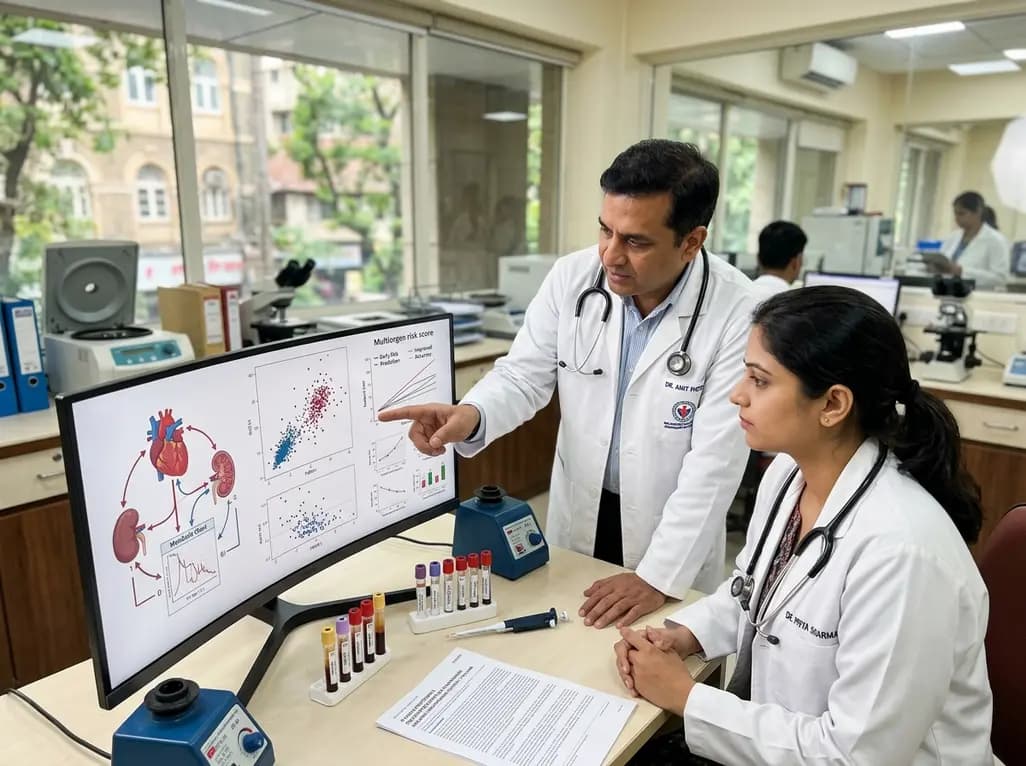
A large UK Biobank study reveals that plasma proteomic signatures capture preclinical organ damage and improve multiorgan risk prediction across early CKM syndrome stages 0 to 2 beyond traditional PREVENT clinical models.
Today

A retrospective CBCT study reveals that superior TMJ space asymmetry correlates moderately with occipital condyle-atlas-axis asymmetry in unilateral TMJ osteoarthritis, highlighting an imaging correlate between jaw biomechanics and upper cervical alignment rather than a standalone diagnostic marker.
Today

A Bayesian multilevel meta-analysis reveals that aerobic training combined with moderate carbohydrate restriction modestly lowers HbA1c in type 2 diabetes. However, sparse data and very low certainty leave incremental benefits over exercise or diet alone unproven, highlighting the need for individualized care.
Today
