

Loading, please wait...
Loading, please wait...
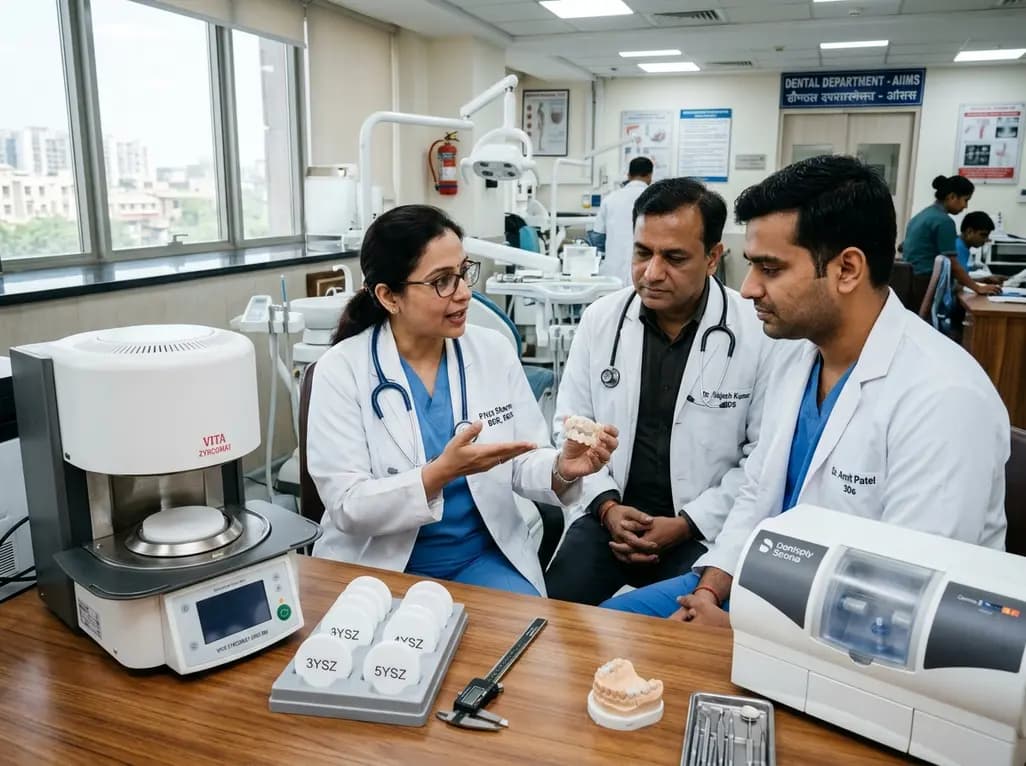
Modern restorative dentistry relies heavily on ceramic prostheses to restore function and aesthetics. Therefore, dental zirconia sintering remains a pivotal thermal process determining the mechanical integrity and optical quality of final restorations. Conventional isothermal sintering protocols typically demand extended dwell times of up to two hours at peak temperatures. However, recent scientific advances suggest that eliminating this holding period does not degrade material performance. Instead, non-isothermal thermal profiles can preserve physical properties while significantly accelerating prosthetic turnaround times.
Dental laboratories traditionally follow manufacturer recommendations that mandate prolonged dwell times at target temperatures ranging from 1350 °C to 1550 °C. Consequently, technicians spend hours waiting for ceramic restorations to reach full theoretical density. During conventional heating, atomic diffusion merges individual oxide granules and eliminates internal microscopic voids. However, prolonged exposure to elevated temperatures frequently promotes exaggerated grain growth within the ceramic matrix.
Furthermore, excessive crystal coarsening can jeopardize the mechanical resilience of polycrystalline ceramics. Large grain boundaries often facilitate microcrack propagation under repetitive masticatory forces in the oral environment. In contrast, non-isothermal sintering protocols ramp up to peak temperature and immediately initiate controlled cooling without dwell time. Therefore, this streamlined thermal approach prevents unwanted grain coarsening while achieving essential material densification. As a result, clinicians and dental technicians gain substantial operational advantages without sacrificing quality. Additionally, eliminating dwell times reduces furnace wear and overall energy consumption. Modern dental practices demand rapid turnaround times for same-day restorative workflows. Consequently, optimizing furnace schedules represents a vital priority for contemporary prosthodontic services.
The comparative investigation evaluated three distinct yttria-stabilized formulations: 3YSZ, 4YSZ, and 5YSZ. Specifically, researchers pressed 300 disc specimens and exposed them to sintering temperatures between 1350 °C and 1550 °C. The experimental group underwent non-isothermal sintering with zero dwell time, whereas the control group experienced a two-hour dwell period.
Remarkably, non-isothermal sintering at higher temperatures produced relative densities exceeding 99 percent across all three material classes. Therefore, eliminating the isothermal holding stage did not compromise atomic densification when adequate peak temperatures were applied. In fact, statistical analysis revealed no significant density differences between the two thermal protocols at optimal firing levels. However, lower firing temperatures below 1450 °C yielded incomplete densification during rapid cycles. Consequently, adequate peak thermal energy is crucial for driving pore elimination in the absence of dwell time. Dental technicians must select precise furnace calibrations to guarantee complete volumetric shrinkage. Furthermore, achieving full density ensures structural stability during intraoral mastication. Clinicians can confidently utilize these rapid sintering profiles knowing that core density remains robust.
The study revealed striking microstructural advantages in specimens processed through the non-isothermal approach. Specifically, eliminating dwell time effectively restricted grain growth across 3YSZ, 4YSZ, and 5YSZ ceramics. The resulting microstructure exhibited significantly smaller crystallite dimensions compared to conventionally sintered counterparts.
Furthermore, phase composition analysis demonstrated that non-isothermal sintering maintained a higher proportion of metastable tetragonal zirconia. This crystallographic finding carries profound clinical implications for dental prostheses. In 3YSZ, the tetragonal phase provides transformation toughening, which actively arrests advancing crack tips under tensile stress. When mechanical loads induce stress, tetragonal grains transform into the monoclinic phase and expand, creating compressive forces that stop fracture development. In addition, fine-grained microstructures improve resistance to low-temperature hydrothermal degradation. Conventional prolonged dwell times often induce excessive cubic phase formation, especially in higher yttria formulations. Conversely, the non-isothermal protocol preserves uniform phase distribution and limits grain boundary slippage. Therefore, practitioners can expect dependable structural performance from restorations subjected to challenging intraoral environments. Ultimately, maintaining tight grain boundaries significantly elevates resistance to localized mechanical wear and surface microcracking.
Mechanical evaluation demonstrated clear structural benefits from non-isothermal thermal processing. In fact, 3YSZ specimens sintered without dwell time exhibited significantly higher biaxial flexural strength compared to conventionally sintered controls. The refined grain matrix and increased tetragonal phase directly boosted resistance to mechanical fracture.
Similarly, 4YSZ and 5YSZ ceramics maintained excellent flexural performance when processed with zero dwell time at elevated temperatures. Although cubic-containing zirconia materials inherently possess lower baseline toughness than 3YSZ, non-isothermal sintering preserved their load-bearing capacity effectively. Consequently, clinicians can utilize non-isothermal processing for both anterior and posterior restorations without compromising structural durability. Moreover, mechanical reliability depends on minimal flaw sizes within the sintered ceramic body. Because non-isothermal sintering prevents excessive grain coarsening, critical defect sizes remain exceptionally small. Therefore, catastrophic fractures initiated by microstructural flaws become far less probable during function. In summary, fast non-isothermal protocols deliver high-strength restorations that safely withstand everyday chewing forces. Furthermore, predictable load tolerance allows prosthodontists to prepare more conservative tooth reductions. Conservative preparations preserve healthy tooth structure, thereby extending the clinical longevity of abutment teeth.
Aesthetic outcomes represent a vital consideration when fabricating monolithic ceramic restorations. Notably, the study revealed distinct optical behaviors among the three evaluated zirconia generations. For traditional 3YSZ, non-isothermal sintering did not alter the translucency parameter at higher temperatures. Therefore, technicians can fabricate posterior crowns without risking aesthetic discrepancies.
However, 4YSZ and 5YSZ exhibited slightly reduced translucency values under non-isothermal processing. This optical variation stems directly from smaller crystal dimensions and differences in cubic grain distribution. Because smaller grains create more grain boundaries per unit volume, internal light scattering increases moderately. Consequently, high-translucency materials may appear slightly more opaque when sintered without prolonged dwell times. Nevertheless, clinicians can leverage this subtle opacity to mask discolored dentin or metal core foundations. Alternatively, technicians can adjust shade selection or glaze applications to restore desirable optical depth. Furthermore, for anterior restorations requiring maximum natural vitality, laboratory technicians should weigh aesthetic requirements against speed. Overall, understanding these optical trade-offs enables dental teams to choose the ideal sintering profile for each clinical indication. Thus, tailored protocol selection guarantees superior clinical outcomes.
No, eliminating dwell time does not compromise density if the furnace achieves adequate peak temperatures. Research demonstrates that non-isothermal sintering at temperatures between 1450 °C and 1550 °C yields relative densities exceeding 99 percent, matching conventional two-hour protocols. However, firing at lower temperatures without dwell time can result in incomplete densification. Therefore, maintaining precise furnace calibration and optimal peak heat remains essential for achieving complete volumetric shrinkage and structural stability.
Non-isothermal sintering boosts 3YSZ flexural strength by restricting grain coarsening and preserving a higher proportion of the metastable tetragonal phase. Because the protocol eliminates isothermal holding, individual grains remain significantly smaller and more uniform. Consequently, transformation toughening mechanisms function more efficiently to arrest propagating microcracks under intraoral stress. Therefore, dental prostheses fabricated with this protocol withstand higher masticatory loads and exhibit superior resistance to catastrophic fracture during clinical service.
The slight reduction in translucency observed in 4YSZ and 5YSZ stems directly from microstructural alterations and light scattering dynamics. Non-isothermal sintering produces smaller crystal dimensions, which dramatically increases grain boundary density per unit volume. These numerous microscopic boundaries scatter light rays as they pass through the ceramic prosthesis. Furthermore, differences in cubic phase distribution reduce optical transmittance. Consequently, the material appears slightly more opaque than conventionally sintered high-yttria ceramics.
Disclaimer: This content is for informational and educational purposes only and should not be considered medical advice. Refer to the latest local and national guidelines for clinical practice.
References
Souza LVS et al. Non-isothermal sintering of dental zirconia for enhanced flexural strength and workflow efficiency without compromising translucency. Dent Mater. 2026 Nov 12. doi: undefined. PMID: 43020734.
Kauling AEC et al. Conventional, Speed Sintering and High-Speed Sintering of Zirconia: A Systematic Review of the Current Status of Applications in Dentistry with a Focus on Precision, Mechanical and Optical Parameters. Materials (Basel). 2022;15(16):5685.
Juntavee N et al. Influence of high-speed sintering on translucency, phase transformation, and flexural strength of multi-layered monolithic zirconia. J Prosthet Dent. 2020;124(4):485.e1-485.e9.

Read summarized clinical updates, watch expert medical content, and earn CME certifications right from your smartphone.
Open your smartphone camera to scan and install.





A breakthrough study shows non-isothermal sintering without dwell time matches conventional density, increases flexural strength, and refines grain microstructure across 3YSZ, 4YSZ, and 5YSZ dental ceramics, streamlining chairside and laboratory workflows.
Today

The VOCAL-AHF study reveals that most acute heart failure patients across reduced and non-reduced ejection fraction categories are eligible for in-hospital GDMT initiation. Notably, nearly two-thirds of HFrEF patients qualify for quadruple therapy, while non-reduced EF patients show high eligibility for dual therapy.
Today

Ascertainment bias in cancer case-control studies inflates odds ratios and penetrance estimates when cases are drawn from high-risk clinics. A landmark modeling study demonstrates substantial bias ranging up to 23.72, highlighting the critical need for ascertainment adjustment in genetic risk counseling.
Today

Researchers demonstrate that central induction of synthetic torpor in non-hibernating rats provides striking cardioprotection, reducing myocardial infarct size by ~40% during ischaemia-reperfusion injury through endogenous survival signaling, independent of hypothermia.
Today

A meta-analysis shows that movement representation techniques significantly enhance upper limb and wrist function in distal radius fracture rehabilitation. While effects on pain and grip strength remain inconclusive, early low-cost telerehabilitation and mirror therapy provide promising clinical benefits.
Today
A novel fluorine-functionalized near-infrared copper fluorescent probe selectively illuminates lung tissue, revealing critical links between hyperglycemia, ER stress, and pulmonary malignancy for improved early diagnosis.
Today
