.webp&w=384&q=75)

Loading, please wait...
Loading, please wait...
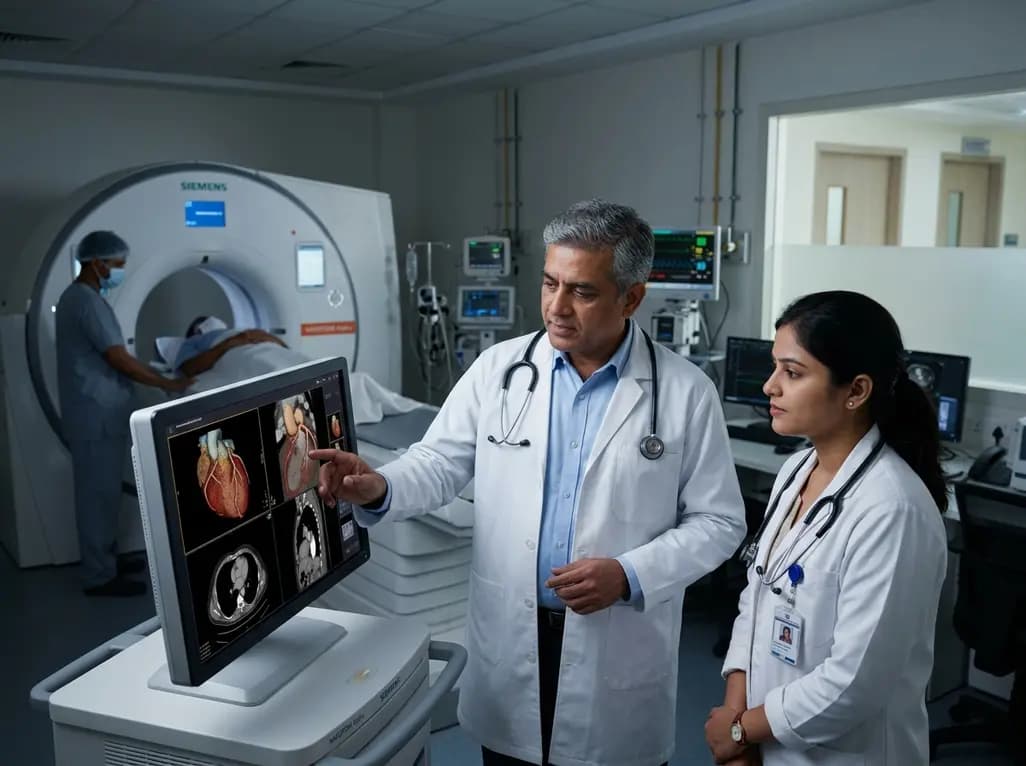
Coronary artery disease remains a leading cause of cardiovascular morbidity globally, necessitating continual refinement in noninvasive imaging modalities such as photon-counting CCTA. For several decades, standardized preparation protocols have routinely mandated sublingual nitroglycerin administration prior to scan acquisition. However, the introduction of photon-counting detector technology has revolutionized spatial resolution and minimized image noise. Consequently, cardiovascular specialists are now questioning whether legacy pharmacological premedication protocols remain essential for diagnostic accuracy.
Noninvasive coronary assessment has progressed significantly over the last few decades. Conventional energy-integrating detector systems heavily relied on sublingual nitrates to dilate coronary vessels, thereby enhancing arterial visualization and facilitating stenosis quantification. However, conventional scanners frequently struggled with severe calcification artifacts, small branch blurring, and elevated electronic noise. Photon-counting detector computed tomography overcomes these inherent technological barriers by directly converting individual X-ray photons into electrical signals.
Furthermore, this advanced mechanism delivers ultra-high spatial resolution alongside inherent multi-energy spectral capabilities. Consequently, photon-counting CCTA enables superior characterization of coronary plaques, clearer lumen visualization, and accurate delineation of distal arterial beds without requiring artificial vessel dilation. As modern clinical centers increasingly implement photon-counting platforms, re-evaluating whether routine premedication remains mandatory is crucial for optimizing cardiovascular imaging pathways.
Sublingual nitroglycerin serves as a potent smooth muscle relaxant that triggers rapid coronary and systemic arterial vasodilation within minutes of administration. Historically, cardiac imaging guidelines recommended routine nitrate use because older CT platforms required expanded vascular calibers to detect obstructive coronary artery disease accurately. Dilating coronary vessels helped mitigate partial volume averaging and decreased false-positive interpretations in calcified segments.
Nevertheless, nitroglycerin administration introduces notable clinical and logistical challenges into cardiac CT workflows. Patients frequently report adverse side effects, including transient hypotension, severe headaches, and reflex tachycardia that may impair scan quality. Additionally, administering sublingual nitrates requires dedicated nursing time, pre-scan hemodynamic monitoring, and careful screening for contraindications such as recent phosphodiesterase-5 inhibitor use or severe aortic stenosis. Therefore, omitting unnecessary premedication could significantly streamline clinical throughput while reducing patient discomfort during routine diagnostic scans.
Recent clinical research has directly compared the diagnostic performance of photon-counting CCTA in patients receiving sublingual nitroglycerin versus those scanned without vasodilation. A retrospective comparative study evaluated consecutive patients undergoing photon-counting cardiac scans followed by invasive coronary angiography within thirty days as the reference standard. The study demonstrated that per-patient sensitivity was virtually identical between the nitroglycerin and non-nitroglycerin cohorts, registering at 90.3% and 90.9% respectively.
Similarly, negative predictive values remained remarkably high across both arms, achieving 86.4% in premedicated patients and 88.9% in non-premedicated individuals. Interestingly, the cohort scanned without nitroglycerin demonstrated numerically higher per-patient specificity (80.0% vs. 63.3%), positive predictive value (83.3% vs. 71.8%), and overall diagnostic accuracy (85.7% vs. 77.0%). Although these differences were not statistically significant, they clearly showed that omitting nitroglycerin did not compromise diagnostic efficacy. Per-vessel evaluations similarly confirmed comparable performance for detecting obstructive lesions across all coronary territories.
While diagnostic accuracy represents the ultimate benchmark for noninvasive testing, objective image quality parameters provide valuable mechanistic insights into scanner performance. Quantitative analysis of coronary attenuation revealed that sublingual nitroglycerin significantly increased intraluminal attenuation values compared to scans performed without vasodilation. This increase is largely attributable to greater contrast media volume within the expanded coronary lumen.
However, increased intraluminal attenuation did not translate into measurable improvements in objective image quality metrics. Specifically, signal-to-noise ratio and contrast-to-noise ratio remained comparable between both patient cohorts. Because photon-counting detector CT inherently eliminates electronic noise and optimizes spectral photon counting, the diagnostic visualization of coronary lumens does not depend strictly on extreme vasodilation. Consequently, the anatomical clarity achieved with photon-counting technology compensates effectively for minor differences in native vessel diameter, preserving image quality regardless of premedication status.
The discovery that diagnostic performance remains stable without routine nitrate administration has profound implications for busy radiology and cardiology suites. Currently, sublingual nitroglycerin protocols impose logistical delays, as clinical staff must measure baseline blood pressure, administer medication, and observe mandatory waiting periods before scanning. Eliminating routine nitrates in eligible patients could substantially reduce scanner room occupancy times and optimize departmental workflow.
Moreover, avoiding nitrates eliminates the risk of sudden post-administration hypotension, which is particularly beneficial for elderly patients or individuals with borderline baseline blood pressure. Furthermore, preventing reflex tachycardia reduces the subsequent need for rescue beta-blockade, simplifying patient preparation. While these findings are promising, clinicians should treat them as hypothesis-generating evidence. Larger prospective trials are necessary to confirm these results across diverse populations, including individuals with severe calcification, complex bypass grafts, or prior coronary interventions.
As diagnostic facilities continue integrating photon-counting systems into regular clinical workflows, updating institutional standard operating procedures will become increasingly important. Radiologists and cardiologists must collaborate to establish clear criteria for patient selection, balancing procedural efficiency with diagnostic rigor. In specific clinical scenarios, such as evaluating very small distal branches or complex congenital vascular anomalies, targeted vasodilation may still offer theoretical benefits.
However, for routine assessment of suspected obstructive coronary artery disease, current evidence suggests that photon-counting technology maintains high diagnostic reliability without obligatory nitrate administration. Future clinical guidelines will likely adopt more tailored premedication strategies rather than universal mandates. By combining advanced photon-counting hardware with individualized pharmacological protocols, cardiac imaging centers can simultaneously improve diagnostic efficiency, minimize adverse medication events, and deliver superior patient-centered cardiovascular care.
Photon-counting detector CT directly converts individual X-ray photons into electrical signals, eliminating electronic noise and conventional scintillation steps. This mechanism provides ultra-high spatial resolution and enhanced multi-energy spectral data. Consequently, the technology overcomes calcium blooming and partial volume artifacts, allowing clinicians to accurately assess coronary artery stenoses and evaluate luminal patency without relying heavily on artificial pharmacological vasodilation.
Older CT systems possessed lower spatial resolution and higher image noise, which made small coronary vessels difficult to evaluate accurately. Sublingual nitroglycerin causes rapid coronary smooth muscle relaxation, dilating arterial calibers to enhance contrast filling and lumen visibility. This vasodilation reduced false-positive diagnoses caused by partial volume averaging, making routine nitrate administration a cornerstone of standard imaging protocols for conventional energy-integrating detectors.
Current clinical evidence indicates that omitting sublingual nitroglycerin during photon-counting CT does not decrease sensitivity or negative predictive value for detecting obstructive coronary artery disease. In recent comparative evaluations against invasive angiography, diagnostic accuracy remained equally robust in non-nitroglycerin cohorts. The superior spatial resolution of photon-counting technology compensates for unexpanded vessel calibers, reliably preserving diagnostic performance across major arterial segments.
Disclaimer: This content is for informational and educational purposes only and should not be considered medical advice. It is intended to assist healthcare professionals in keeping abreast of recent clinical literature. Refer to the latest local and national guidelines for clinical practice.
References

Read summarized clinical updates, watch expert medical content, and earn CME certifications right from your smartphone.
Open your smartphone camera to scan and install.





Recent clinical evidence reveals that sublingual nitroglycerin premedication may not be necessary to achieve high diagnostic accuracy during photon-counting coronary CT angiography, offering new opportunities to streamline cardiac imaging protocols.
last month

Recent research defines ferro-aging as a conserved iron-lipid axis driving organ decline across primates. Age-related iron dyshomeostasis stimulates ACSL4-mediated lipid peroxidation, promoting cellular senescence. Notably, vitamin C directly inhibits ACSL4, suppressing phospholipid oxidation and multi-organ decay.
Today

A retrospective cohort study evaluated 1,000 low-risk singleton births to assess maternal and neonatal outcomes during office-hours versus off-hours. Off-hours deliveries were significantly associated with higher odds of intrapartum cesarean sections and episiotomies, highlighting critical obstetric staffing considerations.
Today

New clinical evidence demonstrates a shift away from strict exercise restrictions in genetic heart disease. While patients with channelopathies engage in more vigorous activity than those with cardiomyopathies, shared decision-making and individualized risk assessments ensure safe, beneficial exercise participation.
Today

Sarcopenia significantly impairs functional independence and amplifies fracture risks in patients with osteoarthritis and osteoporosis. Learn about modern diagnostic strategies, GLP-1 therapy considerations, and evidence-based non-pharmacological management across multidisciplinary clinical settings.
Today

Discover how to identify superimposed entrapment neuropathy in diabetic patients. This review details clinical evaluation, surgical decompression evidence, and a structured algorithm for primary care referrals to prevent ulcers and preserve limb function.
Today
