.webp&w=384&q=75)

Loading, please wait...
Loading, please wait...
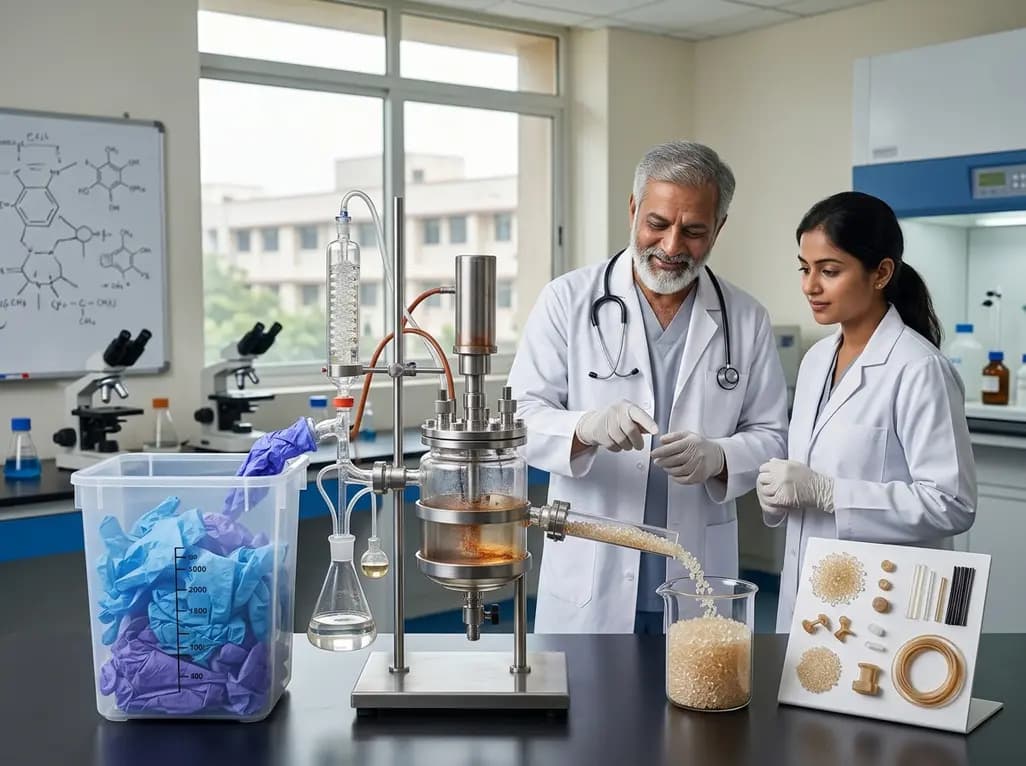
India’s healthcare sector generates hundreds of tons of biomedical waste daily. This waste predominantly consists of single-use plastics and rubbers that serve critical hygiene functions. Nitrile gloves have become an indispensable part of clinical practice, especially after the global COVID-19 pandemic. However, the sheer volume of discarded nitrile products creates a significant environmental burden. Most of this waste currently undergoes incineration or ends up in landfills, both of which pose long-term health risks to the community. Consequently, innovative nitrile plastic waste management is essential for a sustainable future. Recently, a groundbreaking study published in the Journal of the American Chemical Society introduced a novel catalytic strategy. This approach utilizes nickel and ruthenium to break down these complex polymers effectively. By converting waste into value-added compounds, this method offers a circular alternative to traditional disposal. For Indian physicians and hospital administrators, understanding these advancements is crucial. Effective waste management directly correlates with public health outcomes. Reducing the environmental footprint of medical facilities is no longer just an ethical choice. It is becoming a regulatory and clinical necessity. This article explores how nickel-catalyzed decyanation could transform the lifecycle of medical-grade plastics and rubbers.
The new strategy involves a tandem process that simplifies polymer degradation significantly. Initially, a nickel-based catalyst performs decyanation. This step removes the cyano groups from the carbon backbone of the nitrile polymers. Traditionally, breaking these bonds requires harsh conditions that often release toxic hydrogen cyanide gas. However, the nickel catalyst manages this transformation efficiently under much milder conditions. Furthermore, it traps the cyano groups and recycles them into useful nitrile compounds. Following decyanation, a ruthenium catalyst facilitates a process known as ethenolysis. This second step breaks down the remaining hydrocarbon chains into smaller, manageable molecules. Remarkably, the entire process can occur in a "one-pot" system. This means that researchers can combine all components in a single reaction vessel. Using ethylene as both an acceptor and a metathesis partner streamlines the workflow significantly. For the medical community, this represents a major leap in chemical engineering. It translates to a more efficient and less resource-intensive recycling method. By utilizing two distinct but synergistic catalysts, the researchers have unlocked a way to deconstruct recalcitrant plastics. This breakthrough paves the way for industrial-scale upcycling of materials that were previously considered non-recyclable.
One of the primary concerns with nitrile plastic disposal is the potential release of cyanide. When hospitals incinerate nitrile gloves, the high temperatures can lead to the formation of hazardous gases. Cyanide is a potent toxin that inhibits cellular respiration by blocking the cytochrome c oxidase system. Even low-level exposure can lead to chronic neurological and cardiovascular issues in surrounding populations. Therefore, a recycling method that avoids cyanide release is a monumental public health victory. The nickel-catalyzed strategy ensures that the cyano groups are chemically captured rather than released as free species. This prevents the contamination of air and water supplies near waste processing facilities. Additionally, by avoiding incineration, we reduce the emission of other toxic byproducts like dioxins and furans. These substances are known carcinogens and endocrine disruptors. Consequently, adopting this catalytic strategy would protect both healthcare workers and the general public. Indian doctors often treat patients with respiratory illnesses exacerbated by environmental pollution. Supporting cleaner waste management technologies addresses the root cause of these systemic health problems. This shift toward "green chemistry" in waste management aligns with global efforts to detoxify our environment and improve overall health outcomes.
In the context of industrial adoption, efficiency is the most critical factor for success. Many existing recycling methods fail because they are too complex or expensive to implement. However, the "one-pot" nature of this new catalytic process changes the economic equation. By performing decyanation and ethenolysis simultaneously, the method minimizes energy consumption. It also reduces the need for expensive separation steps between chemical reactions. The researchers specifically designed the system to use ethylene as a dual-purpose reagent. This clever integration enhances the overall yield of value-added chemicals from the plastic waste. For Indian hospitals, this could eventually lead to localized waste processing units. Instead of transporting hazardous waste over long distances, facilities might upcycle materials on-site or in regional hubs. Furthermore, the value-added nitrile compounds produced during the process have significant market value. These compounds serve as precursors for pharmaceuticals and agrochemicals. Thus, the strategy transforms a costly waste problem into a profitable resource stream. Improving the efficiency of plastic degradation is essential for the wide-scale adoption of circular economy principles. As the technology matures, it will likely become a cornerstone of sustainable healthcare infrastructure globally.
The Indian government has introduced strict Biomedical Waste Management Rules to curb environmental degradation. However, compliance often remains a challenge due to high costs and inadequate infrastructure. Traditional recycling often results in "downcycling," where the quality of the plastic decreases with each cycle. In contrast, this chemical upcycling strategy maintains the value of the raw materials. By producing high-purity nitrile compounds, the process supports the domestic chemical industry. This alignment with the "Make in India" initiative could attract significant investment in sustainable technologies. Moreover, hospital administrators can leverage these advancements to meet their environmental, social, and governance (ESG) goals. Implementing such advanced recycling methods could also lead to long-term cost savings on waste disposal fees. As regulatory bodies in India tighten standards for plastic waste, chemical upcycling will become an attractive alternative to landfilling. Doctors play a vital role in advocating for these institutional changes. By understanding the science behind these processes, medical professionals can lead the transition toward greener hospital operations. This strategy not only solves a logistical problem but also supports the broader economic and health objectives of the nation.
As we look toward the future, the integration of green chemistry into healthcare is inevitable. The reliance on nitrile-containing plastics is unlikely to diminish, given their superior protective properties. Therefore, we must focus on improving the end-of-life management of these essential materials. The nickel-catalyzed decyanation strategy represents just the beginning of a new era in material science. Future research will likely expand these techniques to other types of complex medical waste, such as polyurethanes and specialized elastomers. Furthermore, the collaboration between chemists and clinicians will be vital for tailoring these solutions to the medical environment. We must ensure that the transition to recycled materials does not compromise patient safety or glove integrity. However, the success of this tandem process provides a robust framework for future innovations. As environmental health becomes a core component of medical education, doctors will increasingly demand sustainable PPE options. Supporting technologies that eliminate toxic byproducts like cyanide is a clear priority for the medical fraternity. By embracing these advancements, the healthcare sector can set a powerful example of how to balance clinical excellence with environmental stewardship. The journey toward a zero-waste hospital system is long, but such breakthroughs bring the goal within reach.
Most nitrile waste in India is either incinerated or sent to landfills. Incineration is problematic because it can release toxic gases, including hydrogen cyanide and dioxins, into the atmosphere. Landfilling is also unsustainable as nitrile polymers are non-biodegradable, meaning they persist in the environment for decades. These disposal methods contribute to environmental pollution and pose significant long-term health risks to the general public and healthcare workers alike.
Nickel-catalyzed decyanation provides a chemically controlled environment to break down nitrile polymers. Unlike incineration, which relies on high-temperature combustion that creates uncontrolled byproducts, this catalytic method specifically removes cyano groups and traps them as value-added compounds. This prevents the release of highly toxic cyanide species into the air. By operating under milder conditions, it reduces the risk of secondary pollutants, making it a much safer alternative for managing hazardous medical waste.
Yes, the "one-pot" nature of this strategy significantly increases its potential for scalability. Because the process combines multiple steps into a single reaction vessel using common reagents like ethylene, it simplifies the infrastructure required for recycling. This efficiency could allow for the development of regional or even on-site upcycling units. Such localized solutions would reduce the costs and risks associated with transporting hazardous biomedical waste across long distances throughout India.
Disclaimer: This content is for informational and educational purposes only. It does not constitute clinical advice or institutional policy. Medical professionals should consult with their hospital's waste management committee and refer to the latest local and national guidelines for clinical practice and environmental safety.
References
Liu C et al. A General Strategy for the Degradation of Nitrile-Containing Plastics and Rubbers via Nickel-Catalyzed Decyanation and Sequential Ethenolysis. J Am Chem Soc. 2026 Jul 05. doi: 10.1021/jacs.6c05182. PMID: 42402206.

Read summarized clinical updates, watch expert medical content, and earn CME certifications right from your smartphone.
Open your smartphone camera to scan and install.





Nitrile plastic waste management is entering a new era. Researchers have developed a nickel-catalyzed strategy that safely upcycles nitrile polymers without releasing toxic cyanide, offering a sustainable circular economy solution for the high volume of medical-grade plastics used in Indian healthcare.
3 months ago

Explore vital recurrent stroke predictors in lacunar stroke patients managed with intensive blood pressure lowering. This analysis examines trial findings from SPS3 to uncover residual vascular risks, metabolic factors, and targeted secondary prevention strategies for high-risk neurological patients.
Today

Odisha has established India's first state-level clinical protocol specifically tailored for pregnant women with sickle cell disease. Developed with NHM and UNICEF, the framework provides structured antenatal screening, crisis mitigation, standardized referral pathways, and specialized interdisciplinary care.
Today

India is advancing preventive healthcare by integrating genomics, artificial intelligence, and quantum technologies. With the SANGAM programme sequencing one million Indian genomes, clinicians can unlock personalized therapies, detect cardiometabolic risks early, and curb the burden of diabetes and heart disease.
Today

A randomized controlled trial demonstrates that an eight-week dual-task training intervention significantly improves static and dynamic postural control over standard balance exercises in individuals with chronic ankle instability, addressing critical neurocognitive deficits during athletic and daily activities.
Today

A retrospective cohort study of 7,716 ICU patients from the MIMIC-IV database demonstrates that Gradient Boosting Decision Trees significantly outperform traditional SOFA scores in predicting in-hospital mortality among patients with sepsis and diabetes, with SHAP analysis providing clinical interpretability.
Today
