.webp&w=384&q=75)

Loading, please wait...
Loading, please wait...
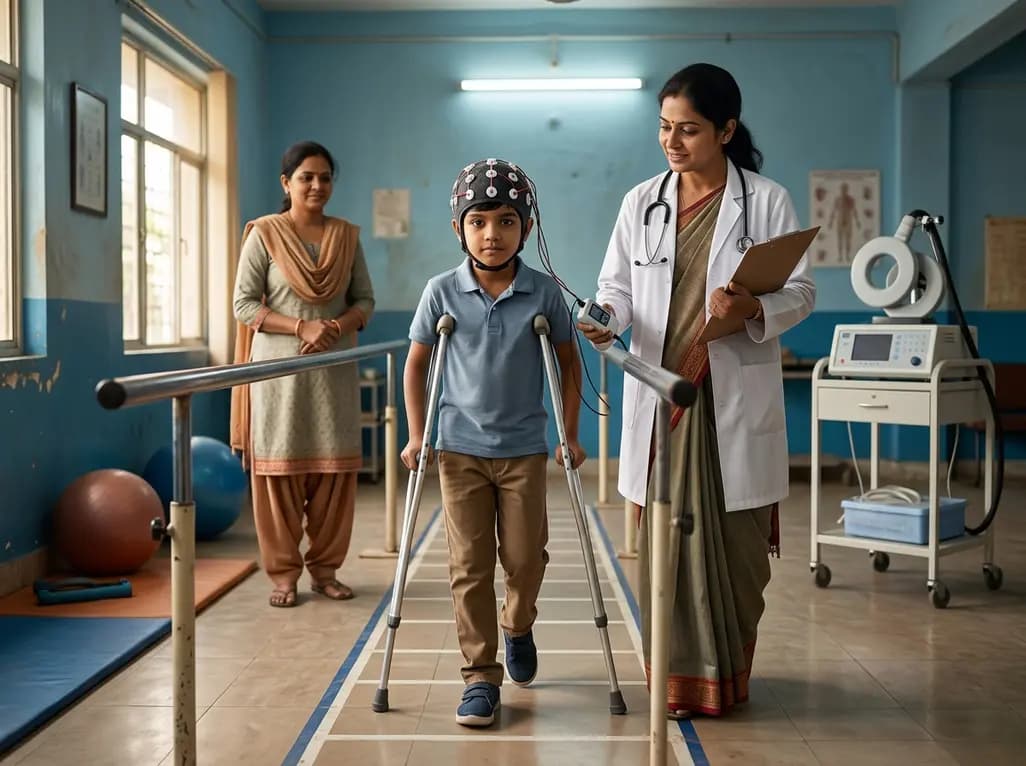
Cerebral palsy (CP) remains the most common cause of motor disability in the pediatric population. Traditional rehabilitation often yields slow progress. Consequently, clinicians are exploring NIBS for cerebral palsy as a promising adjunct therapy. This review synthesizes how non-invasive brain stimulation (NIBS) techniques, such as repetitive transcranial magnetic stimulation (rTMS) and transcranial direct current stimulation (tDCS), influence locomotor function and neural plasticity.
The systematic review analyzed data from 24 studies involving over 700 children. Researchers observed significant improvements in gait speed and cadence. Furthermore, functional mobility scores and walking endurance showed positive trends. While static balance improved across most trials, dynamic balance results were less consistent. Most importantly, NIBS appears to enhance corticospinal excitability. This neurophysiological change likely underpins the functional gains observed in these young patients.
Data suggest that tDCS protocols are currently more standardized than rTMS methods. Specifically, most tDCS trials used a 1mA current with the anode placed over the primary motor cortex. Additionally, follow-up studies indicated that these benefits might persist for several months. In contrast, rTMS protocols vary significantly in frequency and duration. Therefore, establishing a universal \"gold standard\" for stimulation remains a challenge for the medical community.
Integrating brain stimulation with lower-limb training offers a synergistic effect for children with CP. Although initial results are encouraging, clinicians should note that current evidence is largely limited to specific pediatric groups. Future studies must incorporate long-term neurophysiological monitoring to confirm safety and lasting efficacy. Ongoing research is essential to define optimal parameters for various age groups and severity levels.
Yes, current evidence suggests that NIBS, particularly tDCS and rTMS, is safe and well-tolerated in children when applied following standardized safety protocols under clinical supervision.
No, NIBS serves as a complementary tool. The best results occur when clinicians combine stimulation with active motor training, such as treadmill walking or task-specific physical therapy.
Disclaimer: This content is for informational and educational purposes only. It is not intended as medical advice or as a substitute for professional healthcare. Always seek the advice of a qualified health provider regarding any medical condition. Refer to the latest local and national guidelines for clinical practice.
References
Tardif M et al. Effects of non-invasive brain stimulation on gait and corticospinal plasticity in children and adolescents with cerebral palsy: A systematic review. Neurophysiol Clin. 2026 Jun 09. doi: undefined. PMID: 42263375.
Hadoush H et al. Non-Invasive Brain Stimulation Effectiveness on Gait, Balance, and Motor Functions in Children with Cerebral Palsy: A Systematic Review and Meta-Analysis. NeuroRehabilitation. 2025;56(3):105-118.
Neurology India. Novel Therapeutic Strategies of Non-Invasive Brain Stimulation in Cerebral Palsy. Ovid/Wolters Kluwer. 2024.

Read summarized clinical updates, watch expert medical content, and earn CME certifications right from your smartphone.
Open your smartphone camera to scan and install.





This systematic review explores how NIBS techniques like rTMS and tDCS improve gait speed, balance, and corticospinal plasticity in children with cerebral p...
4 months ago

Novel diimide and hydrazone scaffolds, particularly compound #C4, synergistically reactivate latent HIV-1 when combined with JQ1 or PKC activators. Demonstrating donor-matched proviral transcription ex vivo and non-canonical signaling, these findings advance shock and kill strategies toward reservoir eradication.
Today

A cross-sectional study reveals that maternal RSV vaccination coverage reached only 43.7% in Argentina, with maternal vaccine knowledge being the sole independent predictor of uptake. Clinicians play a crucial role in eliminating informational and structural barriers to optimize infant health.
Today

Review how tailored exercise programs benefit frail older patients with heart failure. Explore pathophysiological mechanisms, individualized training prescriptions, and strategies to overcome adherence barriers in clinical practice.
Yesterday

This comparative study evaluates posterior labral tears with and without glenohumeral instability, highlighting distinct demographic patterns, MRI underestimation in stable shoulders, and successful arthroscopic repair outcomes.
Yesterday

A clinical study demonstrates that early intervention with tocilizumab, either as monotherapy or bridged with corticosteroids, achieves significant proptosis reduction and resolves active inflammation in treatment-naive thyroid eye disease.
Yesterday
