.webp&w=384&q=75)

Loading, please wait...
Loading, please wait...
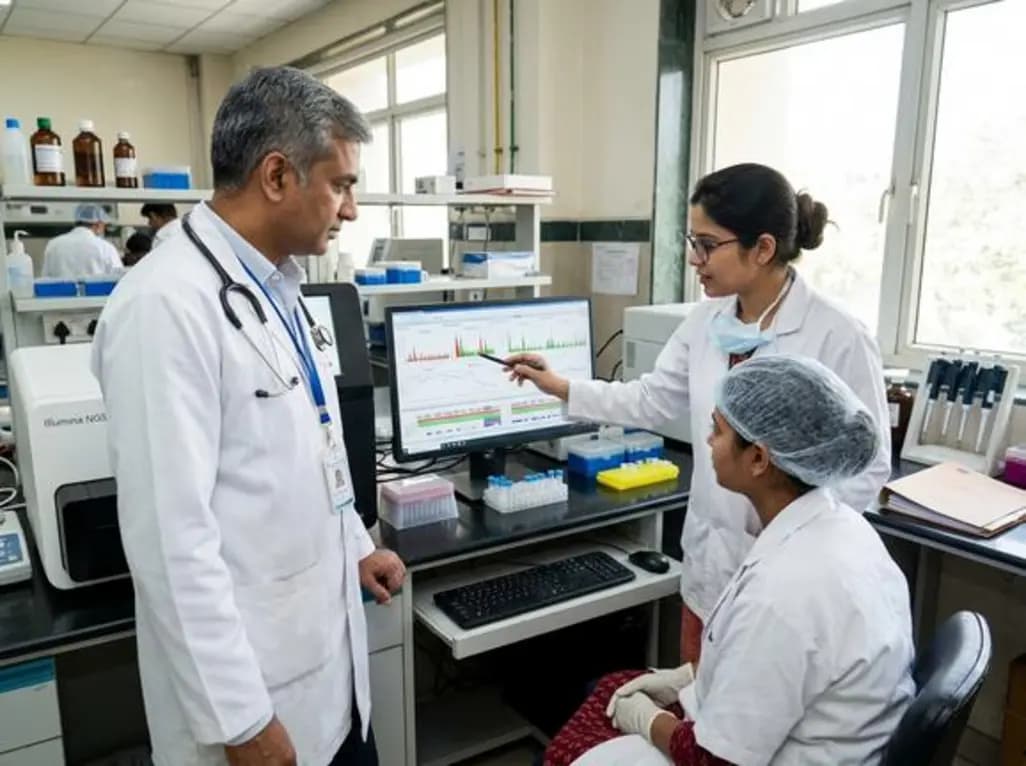
Modern cancer care in India is undergoing a dramatic shift toward personalized treatment. Specifically, next-generation sequencing has emerged as a cornerstone for identifying highly specific tumor mutations. For instance, an eighty-year-old patient with stage-four lung cancer metastasized to her brain avoided aggressive chemotherapy because of this genomic profiling. Instead of receiving traditional paclitaxel, she took daily targeted oral osimertinib. Consequently, her health improved rapidly, and she eventually regained her ability to walk independently.
Historically, doctors treated lung cancers with standard, one-size-fits-all chemotherapy regimens. However, genetic mutations vary significantly among different ethnic groups. For example, epidermal growth factor receptor (EGFR) mutations occur in about thirty-five percent of Indian lung cancer cases, compared to only fifteen percent in the West. Thus, clinicians require next-generation sequencing to identify these actionable mutations. Once identified, specific drugs can directly block the tumor's growth pathway. This highly personalized approach drastically reduces treatment toxicities like neutropenia. Furthermore, it vastly improves the overall quality of life for cancer survivors.
Despite its life-saving benefits, the high cost of genomic testing remains a major barrier in India. A basic genetic panel can cost twenty thousand rupees, while extensive screening can exceed four lakh rupees. To address this financial hurdle, the Cancer Research and Statistic Foundation established the Lung Cancer Genomic Solutions Alliance. This unique program operates in partnership with several global pharmaceutical developers and lab network 4baseCare. Together, they provide the comprehensive solid-tumor gene panel entirely free of charge to eligible lung cancer patients. Consequently, thousands of low-income families have received life-changing medical information without incurring debt.
This regional initiative has already helped thousands of patients residing in tier-two and tier-three Indian cities. Specifically, more than fifty percent of the processed genomic reports revealed targetable genetic mutations. As a result, approximately forty-five percent of these patients successfully transitioned to precision therapies. However, long-term success requires reducing the cost of companion medicines. Additionally, incorporating these diagnostic tests into public healthcare initiatives like Ayushman Bharat will make precision medicine standard practice. Ultimately, these joint efforts are transforming lung cancer from an immediate death sentence into a manageable chronic illness.
Q1: What is the primary benefit of using next-generation sequencing for lung cancer?
Next-generation sequencing decodes a patient's tumor genome to locate actionable driver mutations. Therefore, oncologists can prescribe targeted therapies that attack cancer cells directly, minimizing the painful side effects of standard chemotherapy.
Q2: Who is eligible for the free genomic tests provided by the LuNGS Alliance?
The alliance provides free testing for eligible lung cancer patients across India. In particular, the program targets patients from low-income groups and those residing in tier-2 and tier-3 locations to ensure equitable healthcare access.
Disclaimer: This content is for informational and educational purposes only. It does not constitute medical advice or replace professional judgment. Refer to the latest local and national guidelines for clinical practice.
References

Read summarized clinical updates, watch expert medical content, and earn CME certifications right from your smartphone.
Open your smartphone camera to scan and install.





The LuNGS Alliance is democratizing lung cancer care in India by offering free next-generation sequencing tests. This breakthrough collaboration bridges the genomic testing gap, allowing tier-2 and tier-3 clinicians to detect actionable mutations and transition patients from standard chemotherapy to targeted drugs.
4 months ago

Review how tailored exercise programs benefit frail older patients with heart failure. Explore pathophysiological mechanisms, individualized training prescriptions, and strategies to overcome adherence barriers in clinical practice.
Today

Recent clinical studies reveal maternal autoantibodies targeting IL-1RA as potential triggers for preterm labor, opening avenues for targeted cytokine therapies. Concurrently, new perioperative findings show inhaled cannabis increases propofol requirements during upper endoscopy compared to oral edible consumption.
Today

In high-risk pulmonary embolism complicated by severe anemia and active uterine bleeding, systemic thrombolysis is contraindicated. Large-bore aspiration thrombectomy provides rapid hemodynamic rescue without fibrinolysis, supported by inferior vena cava filter placement and multidisciplinary critical care.
Today

This comparative study evaluates posterior labral tears with and without glenohumeral instability, highlighting distinct demographic patterns, MRI underestimation in stable shoulders, and successful arthroscopic repair outcomes.
Today

A clinical study demonstrates that early intervention with tocilizumab, either as monotherapy or bridged with corticosteroids, achieves significant proptosis reduction and resolves active inflammation in treatment-naive thyroid eye disease.
Today
