.webp&w=384&q=75)

Loading, please wait...
Loading, please wait...

Researchers have recently achieved a significant breakthrough in brain-inspired computing with neuromorphic artificial synapses using crystalline Germanium Selenide (GeSe). This technological development addresses the rising global demand for energy-efficient hardware capable of mimicking complex biological learning processes. By refining the structural integrity of chalcogenide materials, the research team demonstrated superior switching stability and reproducible synaptic learning mechanisms. Consequently, these advancements pave the way for more sophisticated and power-efficient artificial intelligence (AI) tools in the clinical setting.
The study systematically compared amorphous and crystalline GeSe thin films, finding that annealing at 375 °C significantly improves grain integrity. Specifically, crystalline devices exhibited lower operational voltages and an impressive endurance exceeding 4,000 cycles. Furthermore, the researchers successfully reproduced Pavlovian associative learning, which is a cornerstone of classical conditioning, across multiple cycles. This adaptive behavior is essential for developing AI systems that can learn and adjust in real-time, similar to the human nervous system.
In addition to hardware stability, the study implemented an artificial neural network (ANN) using the experimental synaptic characteristics. This network achieved high classification accuracies of approximately 73% and 87% for complex data sets. Therefore, crystalline GeSe stands out as a promising, cost-effective material for next-generation AI hardware. In healthcare, such efficiency enables the creation of portable diagnostic tools and wearable monitors that process data locally without heavy battery drain. Moreover, these systems could eventually lead to more responsive neuroprosthetics and real-time seizure detection devices.
These are electronic components that mimic the behavior of biological synapses. They allow computers to process information using neural-like architectures, which is much more energy-efficient than traditional computing for AI tasks.
Neuromorphic hardware enables low-power, real-time data analysis. This is crucial for wearable medical devices, implantable neurostimulators, and portable diagnostic equipment that requires high-speed pattern recognition without relying on cloud connectivity.
Crystalline GeSe provides more uniform filament formation during switching. This leads to higher stability, better endurance, and more predictable performance compared to amorphous materials, making it suitable for high-stakes medical applications.
Disclaimer: This content is for informational and educational purposes only and does not constitute medical advice or a recommendation for specific hardware in clinical use. Refer to the latest local and national guidelines for clinical practice.
References
Kamble GU et al. Crystallization-Driven Stable Resistive Switching and Reproducible Synaptic Learning in GeSe-Based Artificial Synapses. ACS Appl Mater Interfaces. 2026 May 26. doi: 10.1021/acsami.6c06594. PMID: 42186873.
Smith A et al. Neuromorphic applications in medicine. J Neural Eng. 2023;20(4):041001. doi:10.1088/1741-2552/aceca3.
Arterex Medical. AI in Medical Devices: Applications, Benefits & Regulations. 2025 Sep 26.

Read summarized clinical updates, watch expert medical content, and earn CME certifications right from your smartphone.
Open your smartphone camera to scan and install.





Researchers have developed crystalline GeSe-based artificial synapses that mimic Pavlovian learning, promising energy-efficient hardware for medical AI....
4 months ago

Explore vital recurrent stroke predictors in lacunar stroke patients managed with intensive blood pressure lowering. This analysis examines trial findings from SPS3 to uncover residual vascular risks, metabolic factors, and targeted secondary prevention strategies for high-risk neurological patients.
Today

Odisha has established India's first state-level clinical protocol specifically tailored for pregnant women with sickle cell disease. Developed with NHM and UNICEF, the framework provides structured antenatal screening, crisis mitigation, standardized referral pathways, and specialized interdisciplinary care.
Today

India is advancing preventive healthcare by integrating genomics, artificial intelligence, and quantum technologies. With the SANGAM programme sequencing one million Indian genomes, clinicians can unlock personalized therapies, detect cardiometabolic risks early, and curb the burden of diabetes and heart disease.
Today
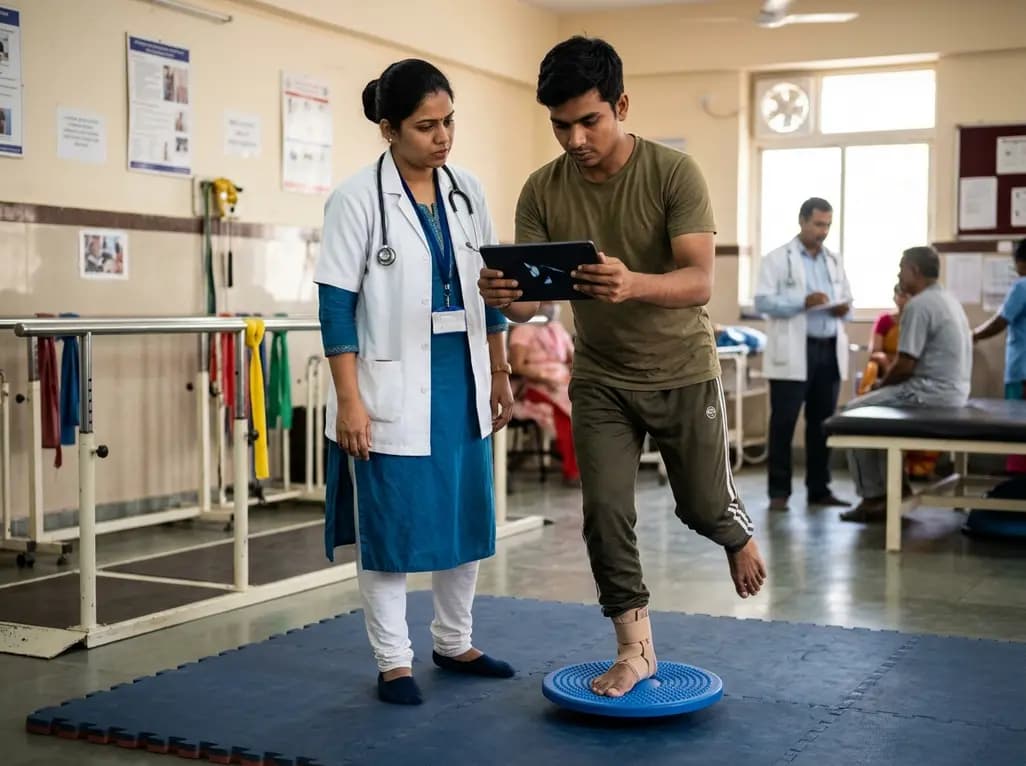
A randomized controlled trial demonstrates that an eight-week dual-task training intervention significantly improves static and dynamic postural control over standard balance exercises in individuals with chronic ankle instability, addressing critical neurocognitive deficits during athletic and daily activities.
Today

A retrospective cohort study of 7,716 ICU patients from the MIMIC-IV database demonstrates that Gradient Boosting Decision Trees significantly outperform traditional SOFA scores in predicting in-hospital mortality among patients with sepsis and diabetes, with SHAP analysis providing clinical interpretability.
Today
