.webp&w=384&q=75)

Loading, please wait...
Loading, please wait...
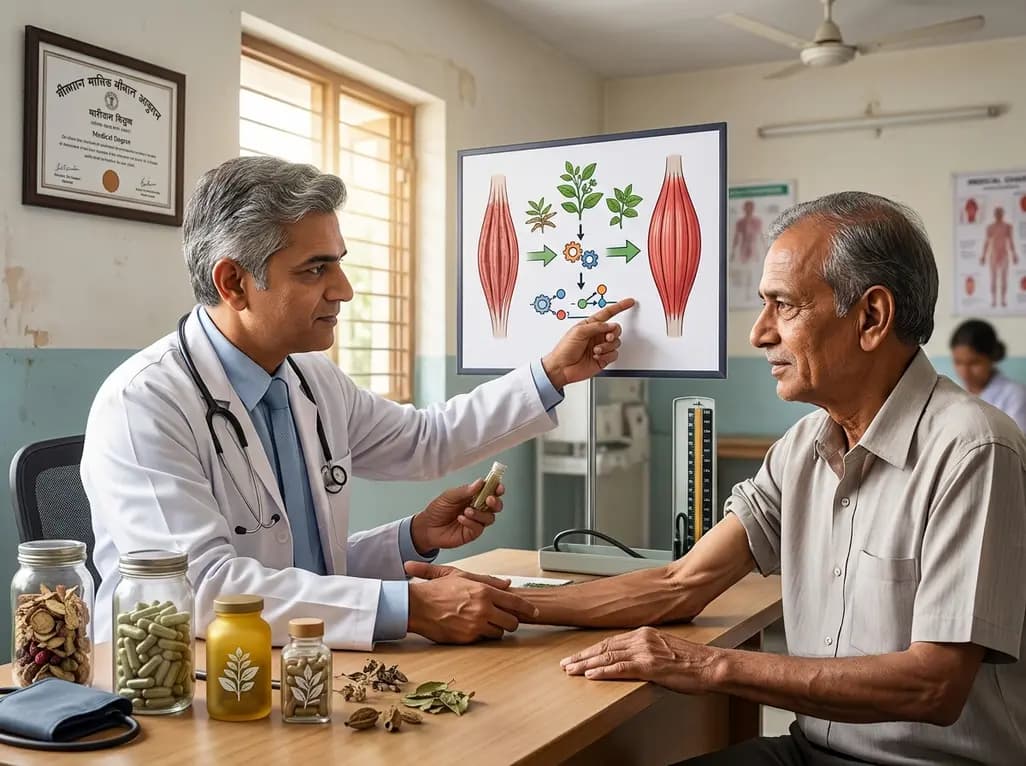
No, natural products should complement, not replace, standard interventions like resistance exercise and nutritional support. They work synergistically to enhance muscle recovery and prevent degradation.
Research frequently highlights flavonoids (like quercetin), polyphenols (like resveratrol), and terpenes. These compounds inhibit FoxO-mediated protein breakdown by activating the Akt signaling pathway.
Many of these compounds are available as nutraceuticals or are found in traditional AYUSH formulations. However, patients must use them under medical supervision to avoid potential interactions with prescribed steroids.
Disclaimer: This content is for informational and educational purposes only. It does not constitute medical advice or a professional relationship. Always seek the advice of a qualified healthcare provider regarding any medical condition or treatment. Refer to the latest local and national guidelines for clinical practice.
References
1. Dai W et al. Plant‑derived natural products alleviate dexamethasone‑induced skeletal muscle atrophy by modulating FoxO (Review). Int J Mol Med. 2026 Aug undefined. doi: undefined. PMID: 42246193.
2. Dabur R et al. Natural products: Potential therapeutic agents to prevent skeletal muscle atrophy. Eur J Pharmacol. 2022 Jun 15;925:174995. doi: 10.1016/j.ejphar.2022.174995.
3. Kim H et al. Myoprotective Role of Quercus acuta Thunb. Fruit Extract Through IGF-1–Akt–FOXO Axis Modulation in Dexamethasone-Induced Sarcopenia. Nutrients. 2025; 17(1):123. doi: 10.3390/nu17010123.
"
Read summarized clinical updates, watch expert medical content, and earn CME certifications right from your smartphone.
Open your smartphone camera to scan and install.





Recent research highlights the potential of plant-derived compounds to combat dexamethasone-induced muscle atrophy by targeting the FoxO transcription facto...
4 months ago

Novel diimide and hydrazone scaffolds, particularly compound #C4, synergistically reactivate latent HIV-1 when combined with JQ1 or PKC activators. Demonstrating donor-matched proviral transcription ex vivo and non-canonical signaling, these findings advance shock and kill strategies toward reservoir eradication.
Today

A cross-sectional study reveals that maternal RSV vaccination coverage reached only 43.7% in Argentina, with maternal vaccine knowledge being the sole independent predictor of uptake. Clinicians play a crucial role in eliminating informational and structural barriers to optimize infant health.
Today

Review how tailored exercise programs benefit frail older patients with heart failure. Explore pathophysiological mechanisms, individualized training prescriptions, and strategies to overcome adherence barriers in clinical practice.
Yesterday

This comparative study evaluates posterior labral tears with and without glenohumeral instability, highlighting distinct demographic patterns, MRI underestimation in stable shoulders, and successful arthroscopic repair outcomes.
Yesterday

A clinical study demonstrates that early intervention with tocilizumab, either as monotherapy or bridged with corticosteroids, achieves significant proptosis reduction and resolves active inflammation in treatment-naive thyroid eye disease.
Yesterday
