.webp&w=384&q=75)

Loading, please wait...
Loading, please wait...
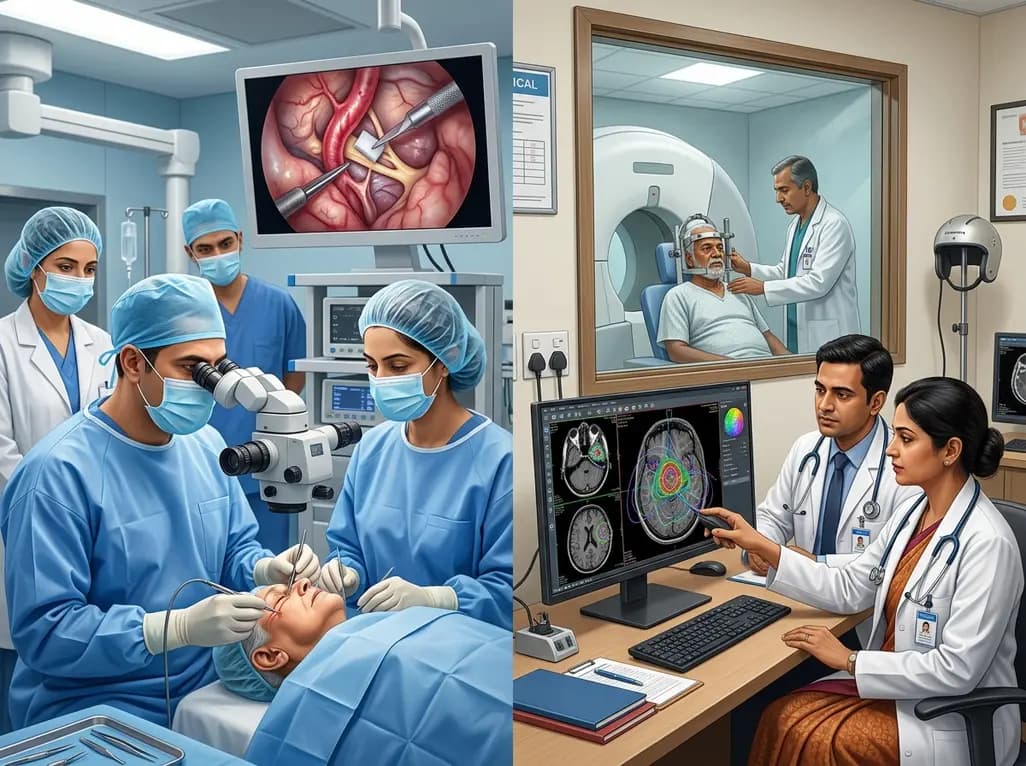
Trigeminal neuralgia represents a profound clinical challenge, often described as one of the most intense pains known to humanity. Patients suffer from sudden, unilateral, shock-like sensations in the distribution of the fifth cranial nerve. While medical therapy, particularly carbamazepine, remains the initial standard of care, many individuals eventually require surgical intervention. This shift occurs when medications fail to provide adequate relief or cause intolerable adverse effects. Two prominent surgical options exist: Microvascular Decompression (MVD) and Gamma Knife Surgery (GKS). Clinicians frequently debate which procedure offers the best balance of efficacy and safety. A recent meta-analysis by Fonseca PEO et al. has provided significant updates on this comparison. This research is particularly vital for neurosurgeons and neurologists in India, where patient demographics and resource availability vary widely. Specifically, the study highlights how Microvascular Decompression Trigeminal Neuralgia outcomes differ from those of stereotactic radiosurgery. Understanding these distinctions is crucial for optimizing patient care and ensuring long-term success. Furthermore, this analysis synthesizes data from multiple trials to offer a clearer picture of the risk-benefit ratio. Consequently, medical professionals can now make more evidence-based recommendations tailored to individual patient needs and anatomical findings.
The latest meta-analysis indicates that Microvascular Decompression provides significantly higher rates of initial pain relief compared to Gamma Knife Surgery. Specifically, the study reported a risk ratio of 1.87, favoring MVD for achieving immediate analgesia. This superiority likely stems from the direct physiological correction offered by the surgery. During MVD, surgeons physically relocate offending vessels that compress the trigeminal nerve root entry zone. In contrast, Gamma Knife Surgery relies on high-dose radiation to create a lesion in the nerve, which gradually modulates pain transmission. Consequently, MVD patients often experience an instant resolution of their agonizing symptoms upon waking from anesthesia. Furthermore, the analysis of BNI scores showed that MVD patients were more likely to achieve complete pain-free status without requiring ongoing medication. However, GKS remains an attractive option for those who cannot tolerate general anesthesia or major surgery. Moreover, while GKS is less invasive, the delay in pain relief can last for several weeks or even months. Therefore, for patients suffering from frequent and severe paroxysms, the immediate success of MVD is a major clinical advantage. Ultimately, the data suggests that for healthy surgical candidates, the efficacy of MVD makes it the preferred primary intervention.
Long-term stability is a critical factor when selecting a treatment for such a debilitating condition. The meta-analysis by Fonseca PEO et al. reveals that Microvascular Decompression Trigeminal Neuralgia treatment results in significantly lower recurrence rates than Gamma Knife Surgery. Specifically, the risk ratio for recurrence was 0.31, which underscores the durable nature of the surgical decompression. When surgeons place a non-absorbable cushion between the nerve and the offending vessel, they provide a permanent solution to the neurovascular conflict. Conversely, the radiotherapeutic effects of GKS may diminish over time, leading to a higher likelihood of symptom return. Furthermore, recurrence in GKS patients often necessitates repeat procedures, which can increase the risk of cumulative nerve damage. In contrast, patients who undergo successful MVD often remain pain-free for decades. Additionally, the study highlighted that patients with clear neurovascular compression on preoperative imaging benefited the most from the surgical approach. Therefore, clinicians must carefully evaluate MRI findings before recommending one procedure over the other. Consequently, for younger patients who have a longer life expectancy, MVD is usually the more strategic choice. By minimizing the risk of recurrence, MVD reduces the long-term burden on the healthcare system and the patient's psychological well-being.
Safety profiles represent another major area of concern for both physicians and patients. Interestingly, the meta-analysis found that MVD was associated with a lower risk of postoperative numbness compared to GKS. Specifically, the risk ratio for facial numbness was 0.50, favoring the surgical decompression group. This finding might seem counterintuitive given that MVD involves open surgery, but it reflects the different mechanisms of action. MVD preserves the integrity of the trigeminal nerve by simply removing the source of irritation. In contrast, Gamma Knife Surgery essentially causes controlled damage to the nerve through concentrated radiation. Consequently, sensory loss or paresthesia is a more common side effect of the radiolesioning process. Furthermore, persistent facial numbness can significantly impact a patient's quality of life and may lead to complications like corneal anesthesia. However, MVD does carry risks inherent to any craniotomy, including cerebrospinal fluid leaks and cerebellar injury. Therefore, the choice of procedure involves balancing the risk of sensory deficits against the risks of more generalized surgical complications. Moreover, the study noted that surgeons must refine their techniques to minimize these operative risks. Ultimately, while GKS is often viewed as safer in terms of avoiding the operating room, MVD is often superior for preserving normal facial sensation.
While MVD excels in efficacy and sensory preservation, it does carry a higher risk of general complications. The study reported an overall complication risk ratio of 1.48 for MVD. These complications typically include issues like hearing loss, wound infections, and anesthetic risks. Specifically, the suboccipital approach used in MVD requires proximity to the eighth cranial nerve, making hearing preservation a key priority for surgeons. Furthermore, the invasive nature of the procedure means that postoperative recovery times are longer than those for GKS. In contrast, Gamma Knife Surgery is performed as an outpatient or short-stay procedure with minimal immediate recovery needs. Consequently, GKS remains the gold standard for elderly patients or those with significant comorbidities that make surgery risky. Additionally, the meta-analysis emphasized that the experience of the surgical team plays a vital role in reducing MVD-related morbidity. Therefore, hospitals in India with high volumes of neurovascular cases often achieve better safety outcomes for MVD. Similarly, the availability of advanced monitoring, such as brainstem auditory evoked potentials, has made MVD safer over recent years. Consequently, although the raw risk of complications is higher for MVD, the nature of these risks is well-understood and increasingly manageable. Ultimately, the decision must involve a thorough discussion of these risks with the patient.
Selecting the right patient for the right procedure is the cornerstone of successful management in trigeminal neuralgia. The meta-analysis provides a strong framework for this decision-making process. For patients with identifiable neurovascular conflict and good physiological reserve, Microvascular Decompression Trigeminal Neuralgia should be considered the first-line surgical option. Specifically, the superior pain relief and lower recurrence rates make it the most effective path toward long-term remission. Furthermore, the preservation of facial sensation is a major benefit for active individuals who wish to avoid the discomfort of chronic numbness. However, clinicians must respect the patient's preference and risk profile. For individuals who fear open surgery or have significant medical contraindications, Gamma Knife Surgery offers a safe and effective alternative. Additionally, GKS is particularly useful for patients without clear vascular compression on MRI, as it does not rely on a mechanical decompression mechanism. Therefore, the multidisciplinary team, including neurologists and neurosurgeons, must collaborate closely. Moreover, the integration of new imaging technologies helps in identifying those who will benefit most from MVD. Consequently, the modern approach to trigeminal neuralgia is increasingly personalized. By applying the findings of this meta-analysis, clinicians can provide more accurate prognostic information. This ensures that expectations are managed and outcomes are optimized across the diverse patient population.
Data suggests that Microvascular Decompression offers superior initial pain relief and lower recurrence rates compared to Gamma Knife Surgery. Specifically, patients undergoing MVD have nearly double the chance of immediate success. However, Gamma Knife remains an excellent, less invasive alternative for patients who are not suitable candidates for general anesthesia.
The most frequent side effect of Gamma Knife Surgery is facial numbness or paresthesia, occurring more often than in MVD. Because the procedure uses radiation to lesion the nerve, sensory changes are a known mechanism of action. Most patients find this numbness tolerable, but it can occasionally be persistent or bothersome.
Recovery after MVD typically involves a hospital stay of two to four days. Most patients can return to light activities within two weeks, though full recovery may take four to six weeks. In contrast, Gamma Knife Surgery is often an outpatient procedure, allowing patients to resume normal activities almost immediately after treatment.
Disclaimer: This content is for informational and educational purposes only and does not constitute medical advice. It is not a substitute for professional clinical judgment or consultation with a healthcare provider. Always seek the advice of a physician or other qualified health provider with any questions you may have regarding a medical condition. Refer to the latest local and national guidelines for clinical practice.
References
1. Fonseca PEO et al. Efficacy and safety of microvascular decompression versus gamma knife surgery in patients with trigeminal neuralgia: an updated meta-analysis. Neurosurg Rev. 2026 Jul 08. doi: 10.1007/s10143-026-04373-z. PMID: 42414789.
2. Jonker B, et al. Microvascular decompression versus stereotactic radiosurgery for trigeminal neuralgia: a systematic review and meta-analysis. British Journal of Neurosurgery. 2018.
3. Dai ZF, et al. Efficacy of stereotactic gamma knife surgery and microvascular decompression in the treatment of primary trigeminal neuralgia: a retrospective study of 220 cases. Journal of Pain Research. 2016.

Read summarized clinical updates, watch expert medical content, and earn CME certifications right from your smartphone.
Open your smartphone camera to scan and install.





This updated meta-analysis evaluates the outcomes of Microvascular Decompression (MVD) versus Gamma Knife Surgery (GKS) for Trigeminal Neuralgia. Findings suggest MVD offers superior immediate pain relief and significantly lower recurrence rates, while GKS serves as a key alternative for high-risk patients.
3 months ago

Discover the crucial role of glymphatic dysfunction in stroke, where perivascular clearance failure and neuroinflammation exacerbate cerebral edema and post-stroke brain injury.
Today

A prenatal case highlights severe glutaric acidemia type II presenting as bilateral hyperechoic cystic kidneys at 18 weeks. Whole-exome sequencing revealed a novel homozygous ETFDH frameshift variant, demonstrating the power of rapid genetic testing in fetal renal anomalies.
Today

Review how tailored exercise programs benefit frail older patients with heart failure. Explore pathophysiological mechanisms, individualized training prescriptions, and strategies to overcome adherence barriers in clinical practice.
Yesterday

This comparative study evaluates posterior labral tears with and without glenohumeral instability, highlighting distinct demographic patterns, MRI underestimation in stable shoulders, and successful arthroscopic repair outcomes.
Yesterday

A clinical study demonstrates that early intervention with tocilizumab, either as monotherapy or bridged with corticosteroids, achieves significant proptosis reduction and resolves active inflammation in treatment-naive thyroid eye disease.
Yesterday
